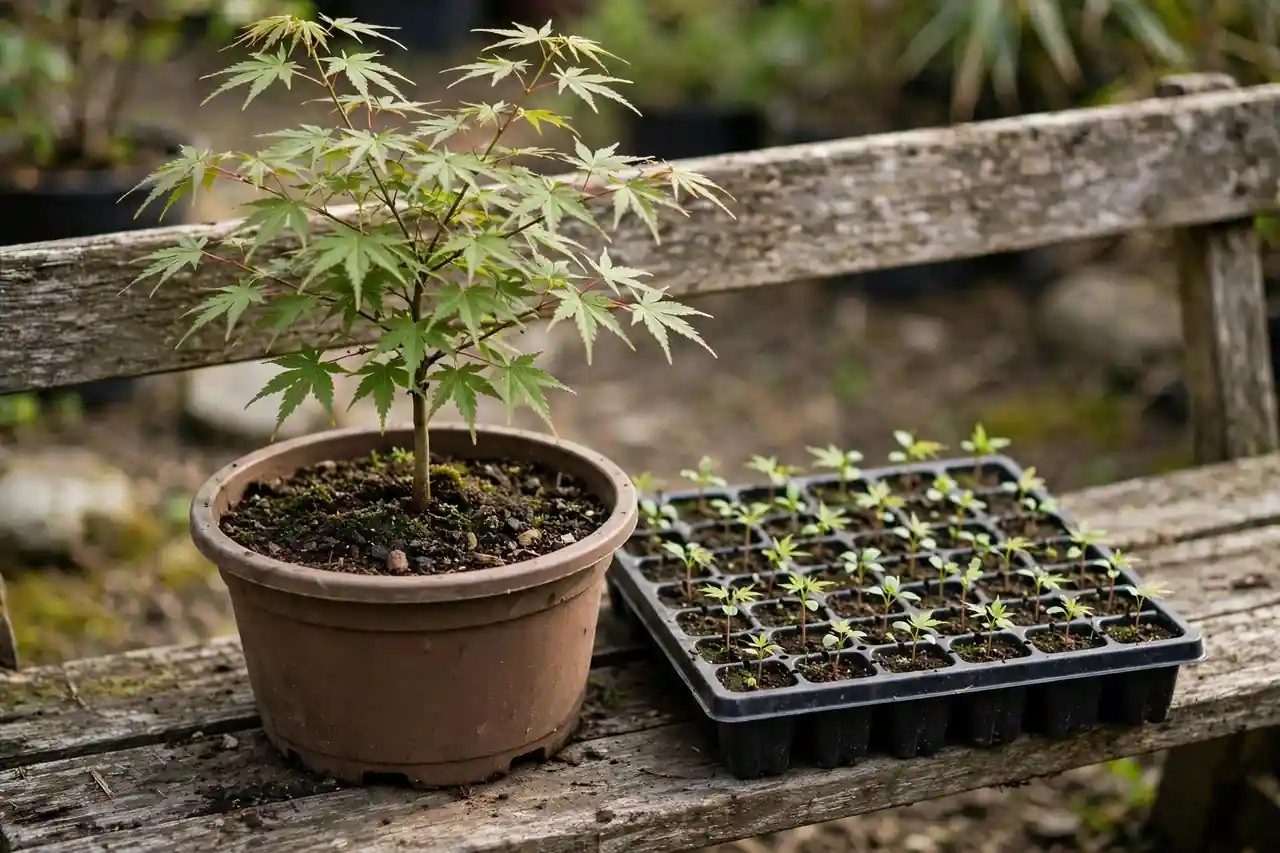
Japanese maple bonsai nursery stock vs seed is a choice that depends on specific requirements for the grower. Whereas nursery-grown bonsai will allow quicker progress, seed-grown bonsai allows greater control. However, seed-grown bonsai take much longer to be ready to style, cost very little, and require a long patience. On the other hand, nursery-grown bonsai cost more, can be styled in just a couple of years, but less control is given. Consider what is most important for you as a grower in the Japanese maple bonsai nursery stock vs seed choice.
The Nursery Stock vs Seed Answer, Briefly
In Japanese maple bonsai nursery stock vs seed, nursery-grown bonsai will help make progress quickly. A 3-5 year old tree has developed a trunk, roots and branches meaning that it can be styled relatively quickly (within 1-3 years). You can also be confident that it will be in the cultivar you want as it has been grafted. On the other hand, seed-grown bonsai offer complete control at very little cost. However, they will take 90 days of cold stratification, 4-5 years until the trunk can be styled and seedlings of a named cultivar rarely grow true to type.
For Japanese maple bonsai nursery stock vs seed, if you want to make quick progress, go for nursery-grown bonsai. If you want to raise a bonsai from the very beginning, and are willing to be patient, go for seed-grown bonsai.
The Comparison at a Glance
| Factor | Nursery stock | Seed |
|---|---|---|
| Time to first styling | One to three seasons | Four to five years |
| Upfront cost | Often $25 and up | A packet of seed, almost nothing |
| Control over the trunk | Partly decided already | Full control from the first root |
| Genetic variation | Known, a grafted tree keeps its cultivar | A surprise, seedlings rarely match the parent |
| Learning value | Pruning, wiring, and styling sooner | Germination, selection, and patience first |
| Biggest risk | Hidden history or a bad graft | Slow start or the wrong cultivar |
Time: What Each Starting Point Really Costs in Years
Nursery stock: years already done
Nursery-grown bonsai will generally be between 3-5 years old in Japanese maple bonsai nursery stock vs seed. Therefore, the tree has developed to a height, with roots and branches, that can be assessed. Bonsai Empire states that nursery-grown bonsai allows for very quick progress as you can begin styling immediately. You can style the tree within 1-3 years depending on how well it settles.
Seed: the long wait
On the other hand, seed-grown trees will have zero progress initially. Although the process is detailed in the seed-grown guide, the timeline is important. Seeds must be cold stratified for around 90 days at 34°F to 41°F. Once sown, they will take weeks to germinate and then a protected year to grow. Seedlings can be styled after a minimum of 3 years. However, to get a usable trunk in Japanese maples, they generally take 4-5 years. With nursery-grown trees, you have 3-5 years of growth done for you.
Cost: Cheap Seed, Pricier Stock, and the Hidden Spending
The upfront price
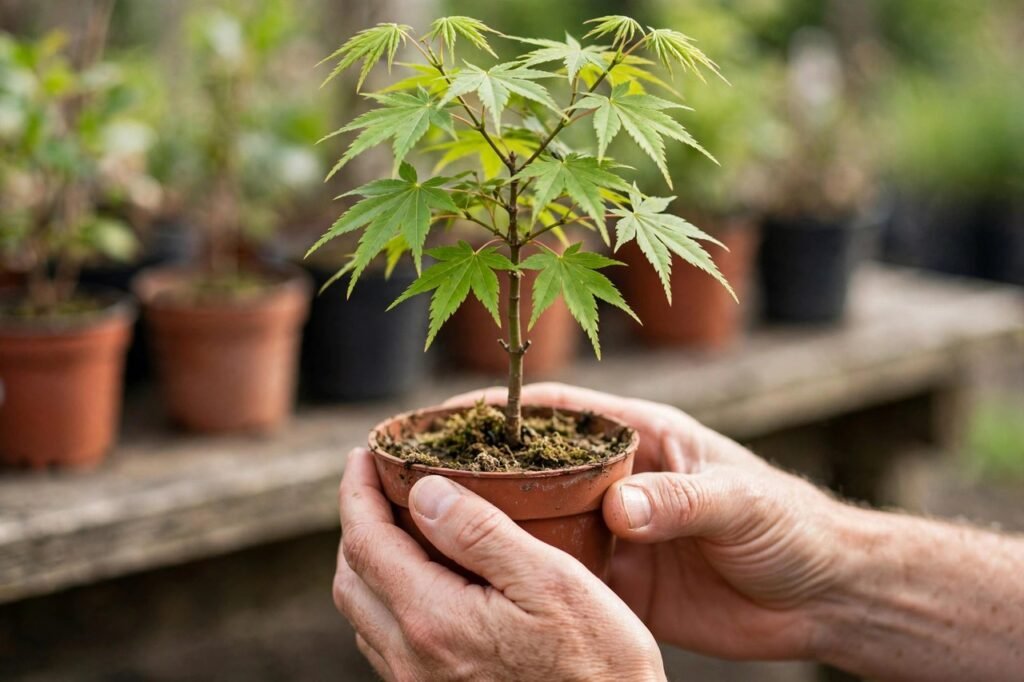
With Japanese maple bonsai nursery stock vs seed, seed-grown trees are very cheap to begin with. You may only have to pay for a packet of samaras and a few tools (trays, high quality compost and a spray bottle) in the first year. However, nursery-grown bonsai can be expensive. A young maple bonsai may cost $25+.
The hidden spending
Though, when considering hidden costs, they may be similar. Seed-grown trees will require trays, pots and compost for many years before styling begins. Meanwhile, nursery-grown trees will require a styling pot and fresh compost sooner. Though a cheap seedling dying in the first summer may only cost you time, an expensive tree with poor soil and hidden root issues may cost you both time and money. For this reason, it is very important to lift the pot and smell the soil (as detailed in the choosing guide) before paying.
Control: Who Decides the Trunk
Seed: control from the first root
In Japanese maple bonsai nursery stock vs seed, seed-grown bonsai allow for complete control. As soon as roots appear you can decide on the soil, pot and seedlings to keep. The flare can therefore be shaped from the beginning. Bonsai Empire states that this is a huge benefit of growing from seed. However, despite having control from the beginning, it will take many years before any decisions made affect the trunk.
Nursery stock: choosing, not shaping
Nursery-grown bonsai allow less control. The trunk has a certain shape, branches are in certain places and the graft union is fixed. Therefore, you are simply choosing the tree that most closely fits your desired trunk shape, taper and low branching. As detailed in the nursery development guide, you should carefully consider these 4 factors when choosing a tree. If you enjoy controlling every aspect of the tree’s development, seed-grown bonsai would be best for you. If you want to practice bonsai techniques on an existing tree, nursery-grown bonsai would be best.
Genetic Variation: What You Get vs What You Hoped For
Seed: a surprise in every packet
When it comes to Japanese maple bonsai nursery stock vs seed, seed-grown bonsai can be surprising. As a new individual, the seedling will have a combination of characteristics from both parents. Therefore, Royal Horticultural Society states that it is unlikely for seed-grown bonsai to be ‘true to type’. For this reason, named cultivars such as ‘Bloodgood’ are generally grafted rather than grown from seed. If red dissectum seeds are sown, green, upright or plain seedlings may be produced. Seed-grown bonsai means that you cannot decide on the tree until it has grown.
Nursery stock: the graft guarantees the name
Nursery-grown bonsai remove this problem. By grafting, you can be confident that you have a named cultivar. Different names offer different leaf size, speed of growth and colours, as detailed in the varieties guide. To be confident that the tree above the graft is as described on the label, refer to the choosing guide. If you require a specific cultivar, nursery-grown grafted bonsai would be best. If you are happy with the species, seed-grown bonsai gives you a wider choice of trees to choose from at a cheaper price.
Learning Value: What Each Path Teaches
Seed: patience and the life cycle
Different learning can be gained from Japanese maple bonsai nursery stock vs seed. Seed-grown bonsai allow you to learn about dormancy, germination, initial leaf growth and making difficult decisions on which seedlings to keep and which to compost. It also teaches patience in a unique way, as feedback will be very slow. If seedlings die, you can learn about the watering and shading conditions.
Nursery stock: techniques in year one
In Japanese maple bonsai nursery stock vs seed, nursery-grown bonsai allow you to learn key bonsai skills such as pruning, wiring, repotting and understanding trunks. As these are the most desirable skills for beginner bonsai growers to learn, nursery-grown bonsai allow you to practice them in your first year. Many experienced bonsai growers will grow both seed-grown and nursery-grown bonsai in parallel. The nursery-grown bonsai acts as a class, whilst the seed-grown bonsai acts as a long-term project.
How to Decide: Five Questions
Consider the following questions to help decide Japanese maple bonsai nursery stock vs seed. If you score 3 or more in one category, consider growing that type.
- How quickly do you want to style a bonsai? If you want to style in this or next year, consider nursery-grown bonsai. If you want to style in 5 years, seed-grown bonsai may be a good option.
- Do you need a specific cultivar? If yes, consider growing grafted nursery-grown bonsai.
- How much space do you have on your bench, and how much spare time do you have? Seed-grown bonsai will require a number of trays and pots, and daily attention in the first summer. One nursery-grown bonsai will only require one pot.
- How much money do you want to spend on your first bonsai? Nursery-grown bonsai will cost money up front, but save you time. Seed-grown bonsai will cost very little up front but take a long time.
- Do you want to learn bonsai techniques, or the life cycle? Nursery-grown bonsai allow you to learn techniques quicker. Seed-grown bonsai allow you to learn the life cycle.
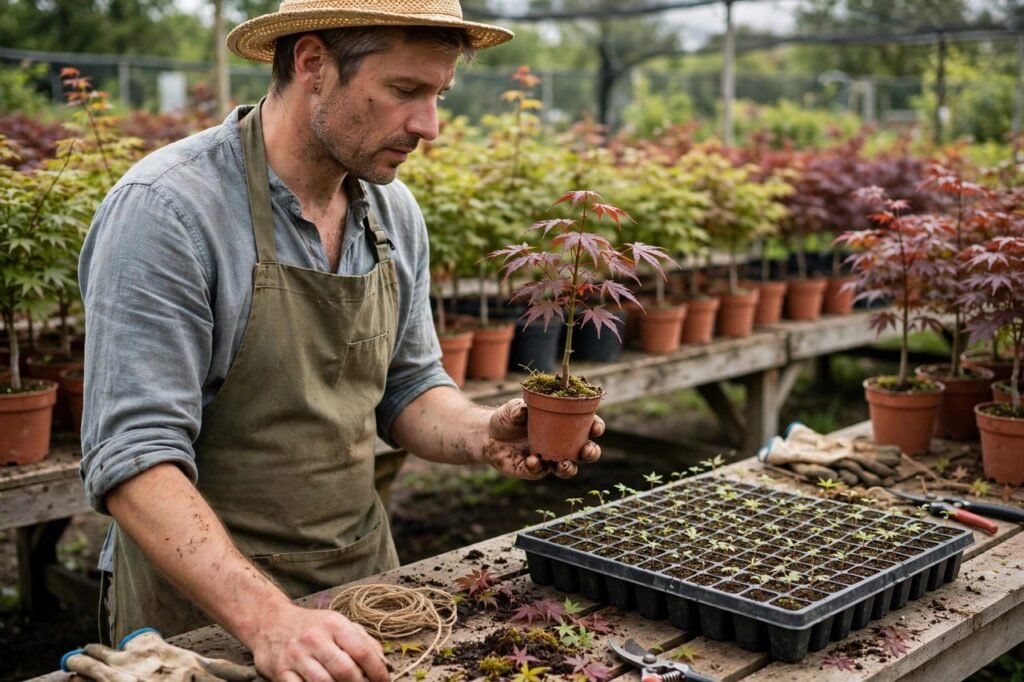
Cultivar, Climate and Pot: What Changes for Nursery Stock vs Seed
Cultivar and climate
It may be better to grow one type of bonsai than the other depending on the conditions in your garden. Fast growing seedlings can be grown in any conditions. However, slow growing dwarf cultivars, such as ‘Kiyohime’, require patience and milder conditions. Acer palmatum suits USDA zones 5 to 8. A few cultivars, ‘Bloodgood’ among them, will also grow in zone 9. Ensure that the bonsai you choose is suitable for the zone in your garden. If you live in hot conditions, afternoon shade is most important.
Season
Nursery-grown bonsai should be bought in spring, so that you can see the foliage. Refer to the seasonal guide to see how this changes depending on your climate.
Settling in
Seed-grown bonsai are also sown in spring, after cold stratification. Therefore, both options begin in the same season. However, young nursery-grown bonsai will settle quickly. Older bonsai in small pots may have less margin for error.
One Bench, Two Beginnings
Two growers begin their bonsai in Spring.
Nursery-grown The grower buys a 3 year old bonsai. The trunk is curved and there is a good flare. The bonsai is grown in a large styling pot for 3 years. The trunk is pruned once per year. Branches begin to form in the 4th year. After 5 years, the trunk is usable and the branches are in appropriate positions.
Seed-grown The grower sows 40 samaras in March. After the first summer, 25 seedlings remain. In Autumn, 8 seedlings are chosen, with the best leaf development and shortest stem lengths. After 3 years, 2 seedlings have usable trunks. Whereas the nursery-grown bonsai is in progress, the seed-grown bonsai has a longer story.
Common Mistakes When Choosing Between Nursery Stock and Seed
- Assuming seed-grown bonsai will be quick. Seed-grown bonsai can take 4-5 years to have a usable trunk to style. Do not get disheartened after just 1 or 2 years.
- Choosing nursery-grown bonsai for height. A tall thin bonsai with no low branching and taper will be far behind a short bonsai with a curved trunk and good base.
- Sowing seed of a named cultivar and expecting it to be true to type. Seed from a prized red maple rarely produce red leaves.
- Only growing seed-grown bonsai. If you do not have bonsai to practice techniques on for many years, any beginner interest may be lost.
- Paying for a bonsai with hidden root issues. A full canopy may mean that poor soil (sour) and a circling root ball is not noticed. To avoid this, check the drainage holes and smell the soil before paying. Lift the pot.
If Nursery Stock vs Seed Still Fails
- No growth from seeds. Ensure that the seeds were cold stratified. Without around 90 days of damp cold conditions, many seeds may have to wait until next year.
- Very little growth from nursery-grown bonsai. New bonsai will take time to settle in. If a harsh cut, repot and heavy wiring is done all in one year, growth may be stalled for a year. Try only doing one major task per year.
- All seedlings look the same and none are good. Sow more seeds than you need, and be very selective. Only keep seedlings with the best leaf development, shortest internodes and strongest roots.
Nursery Stock vs Seed: Questions and Answers
Can I grow seed-grown and nursery-grown bonsai?
Yes. Most experienced growers do. The nursery-grown bonsai will be what you develop skills on now, whilst the seed-grown bonsai will be a long term project.
How long until seed-grown Japanese maples look like bonsai?
It will take 4-5 years to get a usable trunk. To look mature, it will take 10+ years.
Is nursery-grown bonsai always best for beginners?
Usually. You will be able to practice pruning, wiring and repotting in the first year. However, growing seed-grown bonsai alongside nursery-grown bonsai will teach you the whole life cycle.
Will seedlings from my red maple be red?
Rarely. As seedlings from named cultivars rarely grow true to type, the colour, shape and habit may be different.
Which is more expensive?
Seed-grown bonsai are cheaper to start with, but take a long time. Nursery-grown bonsai cost money to start with, but save time.
Conclusion
Japanese maple bonsai nursery stock vs seed depends on your goals: whether to grow nursery-grown or seed-grown. Nursery-grown bonsai saves you time and gives you confidence in your bonsai. You will have a trunk to work with, confidence that it is the correct cultivar, and can practice techniques in the first year. On the other hand, seed-grown bonsai gives you complete control. It is the cheapest way to start bonsai, you will be shaping from the first root, and you will develop patience. Consider which type of bonsai fits your goals best, and begin with this type. Let the other type follow.
Sources
Trusted reference guides for further reading: