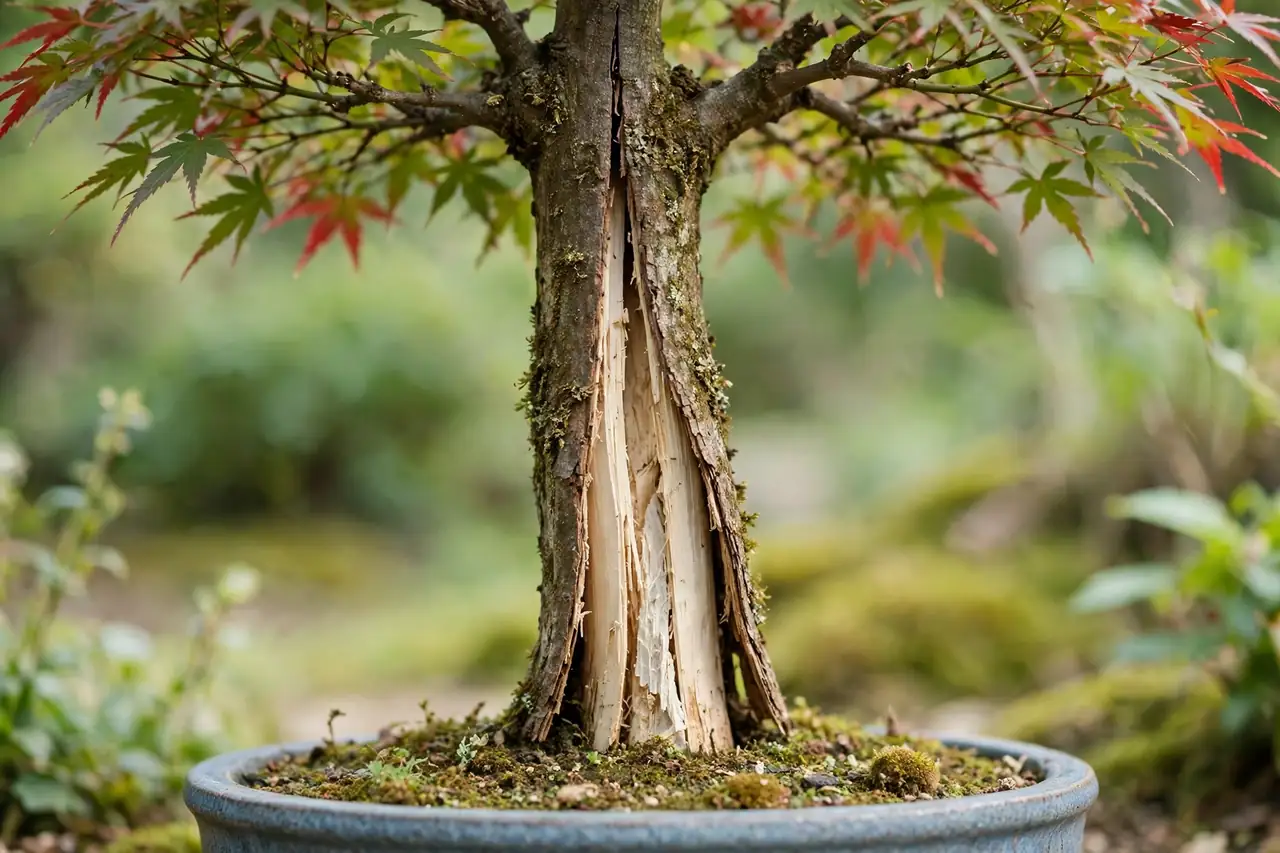
Using your finger, run it over the trunk of your maple during spring and you may find an elongated, sharp cleft in the bark. Beneath this cleft, the wood can be seen. Although the maple appears to be in good health, its trunk has become cleaved. This is where the bark has separated and the wood underneath is visible. There are several reasons for Japanese maple bonsai to suffer from bark splitting and, generally, healthy trees are able to repair this.
The Bark Splitting Answer, Briefly
A cleft is where the bark has split and the wood is visible. Japanese maple bonsai can suffer from a cleft as a result of a sudden cold snap following a sunny day in winter, sunscald, rapid flexible growth following heavy feeding, or as a result of an impact or wire. Generally, a healthy tree can repair Japanese maple bonsai bark splitting within one or two seasons. Do not interfere and ensure the tree remains dry. Look for black, wet or rancid wood. If the cleft formed in winter, please refer to the snow protection and winter care guides for advice on inspecting and protecting your maple.
What a Bark Split Actually Is
How bark grows and why it parts
There are two layers of bark. The outer layer is made up of dead material and is inflexible. The inner layer, known as the cambium, is live and is responsible for increasing the trunk girth year on year. As the trunk becomes thicker, the outer bark cracks and flakes. Japanese maple bonsai bark splitting is a single line split in the bark, which occurs suddenly and allows the wood to become visible.
A split is not peeling bark
As maples age, they can lose their outer bark in flaky sections. Beneath this, the wood is still protected by a smooth, paler layer of bark. Conversely, in a cleft the bark splits along a single line and the wood is exposed. If the wood is smooth, pale and dry then it can be repaired. However, if it is dark, wet and/or rancid then it is rotten.
The Five Causes of a Split
There are typically 5 reasons why Japanese maple bonsai can develop clefts and these can be recognised by the nature of the cleft and when it occurred.
Frost crack and freeze-thaw
During a bright day in winter, the sun-facing side of the tree’s bark heats up to a greater extent than the surrounding air. At night, temperatures fall rapidly and the outer, heated bark cools quicker than the wood underneath. Eventually, the strain on the tree becomes too great and fibres break. The resulting cleft is long, straight and vertical and tends to occur on the south west facing side. Please refer to the winter care guide for advice on protecting your maple from frost cracks.
Sunscald
Whilst similar to a frost crack, sunscald is a more gradual process. During a warm day in winter, the sun can heat the bark sufficiently to activate the live cells in the inner layer. This is then killed off by a subsequent severe freezing period. In spring, a sunken, coloured area of bark is visible. This dead bark either splits or flake off. Please refer to the sunlight guide for information on positioning your maple so that its trunk is not over-heated.
Growth cracks from fast, soft growth
Where there is rapid growth, the inner layer (cambium) will grow more quickly than the outer bark can stretch and a cleft will occur. This usually happens in spring following a wet period or intensive feeding. Typically, this cleft occurs on a lively young trunk. The exposed wood resembles new bark – it is smooth, pale and dry and is not rotten. Reduce feeding rates to ensure even growth. Please refer to the fertiliser guide for suitable feeding levels.
Knocks, wire and tools
Maple bark is delicate and does not tolerate impacts. Trees can suffer clefts as a result of pots toppling over, branches being bent too much, a wire remaining on for too long during a rapidly growing period, or using scissors incorrectly. With bonsai, it is typically the wire which causes clefts. As a branch thickens, the wire digs in and causes a cleft to form along the wire. As soon as the wire begins to dig in, it should be removed. Please refer to the pruning guide for advice on making swift, clean cuts.
Canker and disease
A canker is a section of dead bark which is caused by a fungal infection. Unlike other clefts, a canker is not self repairing. It is sunken and dark in colour and may have raised borders. It can also seep liquid, particularly in damp weather. Unlike frost cracks, cankers progress slowly. Usually, cankers begin on already damaged bark. Before attributing a cleft to environmental factors, check for scale insects (which appear as bumps) and honeydew (sticky substance). Please refer to the diseases guide for information on distinguishing between cankers and other types of damage. The pests guide provides details on insect species which can cause bark to split.
| Cause | What the split looks like | When it appears | First step |
|---|---|---|---|
| Frost crack | Long, straight, vertical, southwest side | Late winter, early spring | Leave it; watch it close |
| Sunscald | Sunken, discoloured patch that splits or peels | Spring | Shade the trunk; leave it |
| Growth crack | Straight crack, fresh pale bark inside | Spring, after fast growth | Slow the feeding; leave it |
| Wound or wire | Short split at a nick or under a wire | Any season | Remove the wire; clean the edge |
| Canker | Dark, sunken, sometimes oozing | Spreads slowly | Diagnose first; cut back to clean wood |
How Bad Is the Split?
Check the living layer
Using your fingernail, gently scrape a section of bark either side of the cleft. If it is green and moist then the live layer (cambium) is present. Bark that is brown and dry is dead bark. Investigate above the cleft too – if there are swollen buds then the branch is still receiving water.
Signs the tree is coping
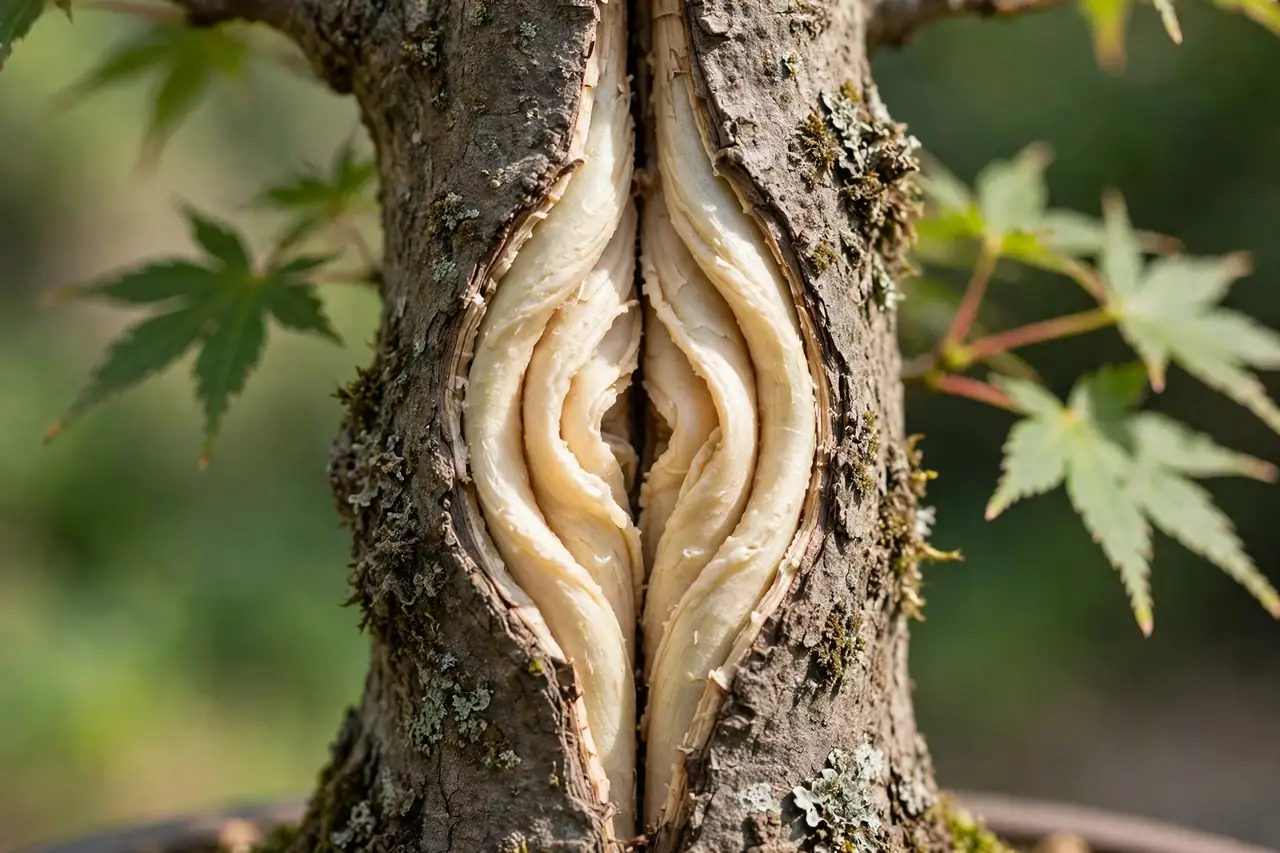
A repairing cleft has neat characteristics. The sides of the cleft curl inwards and form even, pale, wound wood edges. The cleft becomes slightly narrower each month. Leaves above the cleft also appear unaffected.
Signs of trouble
A non-repairing cleft has different characteristics. The exposed wood may be dark or wet and/or the cleft may seep. Furthermore, the cleft becomes broader rather than narrower. No wound wood develops after a complete growing season.
What to Do About a Split
Leave a clean split alone
For the majority of cases, no action is required. Like a cut, Japanese maple bonsai bark splitting can be repaired as the live layer (cambium) produces wound wood from both sides of the cleft. These then fuse together in the centre. Generally, a healthy tree can repair Japanese maple bonsai bark splitting within one or two seasons. Do not fill a cleft.
Clean a ragged edge
If the cleft has loose, flaky bark, then cut this back to solid bark. Using a sharp knife, carefully follow the line of the cleft and only remove dead bark. An even edge will allow wound wood to curl in. Ensure the knife is disinfected before and after use.
Cut back past dead wood
Should the wood above a cleft be dead then the branch above will not recover. In spring, cut back this branch to sound wood. This will be just above a healthy bud and will be indicated by a green mark. Should a cleft encircle more than half of a trunk then there is a risk that the tree will not survive.
Keep it dry and keep pests out
Only water the soil and avoid watering the trunk. Prevent mulch and moss building up at the trunk base so that air can circulate to the cleft. Inspect the cleft monthly for signs of borer dust or scale insect bumps.
Preventing the Next Split
Shade the southwest side in winter
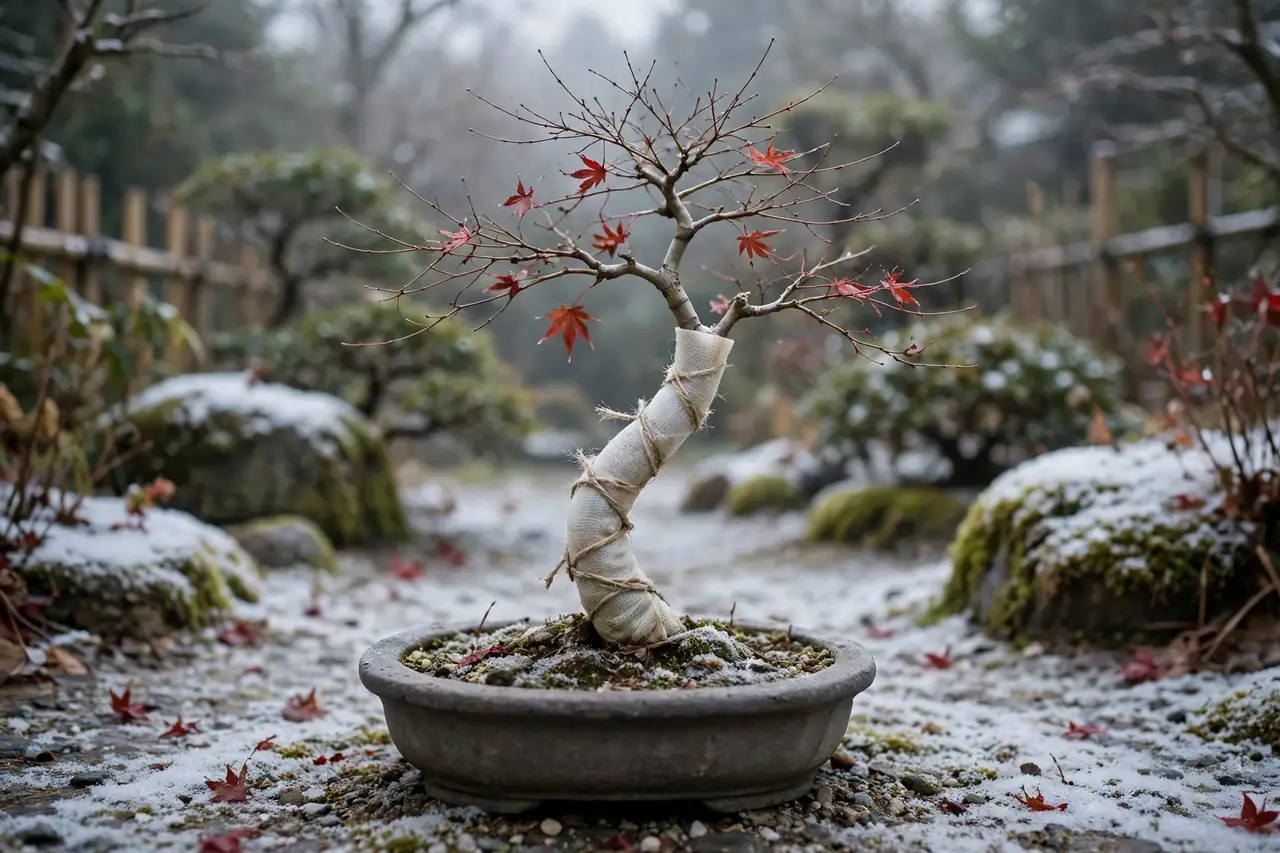
As the south-west side of a trunk is most exposed to winter sun, it is here that clefts are most likely to occur. From late autumn, cover the lower trunk in a light coloured tree guard or breathable material. Remove this cover in early spring, prior to the commencement of growth. Leaving cover on in spring causes dampness to build up against the trunk and results in rot.
Feed for steady growth, not a rush
Over feeding stimulates rapid, flexible growth which cannot be kept up with by the tree’s bark. Therefore, feed in moderation between spring and early summer only. Stop feeding by late summer so that new wood can harden off in time for winter.
Handle with care and watch the wire
Inspect wired branches weekly in spring as this is when growth is most rapid. As soon as a wire begins to dig in, remove it even if the branch has not yet fully hardened off.
Shelter from freeze-thaw swings
The most severe clefts occur where there are continual daily fluctuations in temperature around freezing point. A pot placed on the ground in a sheltered corner will be more stable in temperature than one on an outdoor bench. Please refer to the frost protection guide for details of night-time covers which can be used to protect sensitive growth.
Two Trunks, Two Different Splits
There were two maples on the same bench. Both had suffered clefts. However, the two clefts differed considerably. Tree one – winter cleft. This maple was a young tree with delicate bark. It was continually in full sun in winter afternoons. The bark would heat up in the daytime and then freeze at night. Consequently, a lengthy cleft formed on the south west side. The tree was not interfered with and in the following winter the trunk was shaded.
Tree two – over-fed tree. This maple was an older tree which had been heavily fed throughout the summer to stimulate growth. In spring, a straight cleft had formed. However, the exposed wood was pale and fresh and showed no signs of rot. The owner reduced feeding levels and the cleft then repaired itself.
What Not to Do With Bark Splitting
Filling a cleft with sealant or paint. Fillings hinder drying and so reduce the speed of repair.
Removing a cleft. This causes further damage as it involves cutting into the trunk.
Watering the trunk. Watering the bark stops a cleft drying out. Only water the soil.
Over-feeding to promote repair. Over feeding stimulates flexible growth and this in turn can lead to further clefting.
Failing to remove cover. As previously mentioned, leaving cover on in spring encourages dampness to build up and therefore results in rot.
If Bark Splitting Still Fails
Cleft fails to repair. Investigate for dark or wet wood. Trim uneven edges and provide shade for the trunk from winter sun.
Dark or seeping wood. Cut back to sound, pale wood. Disinfect a knife and then refer to the diseases guide to investigate further.
Wilting leaves above a cleft. Investigate the bark above the cleft. Should it be brown and dry then cut back the branch to sound wood in spring.
No wound wood after a full growing season. The tree lacks sufficient strength to repair itself or the cleft is infected.
Cleft on a branch. Branches can self repair if they suffer from a clean cleft. If a branch above a cleft is dead then it should be cut back to sound wood.
Bark Splitting: Questions and Answers
Can a cleft prove fatal for my Japanese maple bonsai?
Provided that a cleft is clean and the tree is healthy then almost certainly not. Frost and growth clefts can both self repair within one or two seasons. However, only cankers and clefts which encircle most of a trunk are fatal.
Should I fill a cleft?
No. Fillings prevent a cleft from drying out and so impede repair. Allow a clean cleft to remain open and enable the tree to repair itself.
Is it possible to wire a tree which has a clefted trunk?
Yes. However, do not wire across a cleft. Avoid positioning wire on or near a cleft. Inspect wires regularly.
How quickly can a Japanese maple bonsai repair a cleft?
Generally, a healthy tree can self repair a clean cleft within one or two growing seasons. However, cankers cannot self repair and must first be treated by removing dead wood.
Conclusion
Although Japanese maple bonsai bark splitting may appear severe, for the most part it is not. Healthy trees are generally able to self repair. Allow clean clefts to remain undisturbed, remove dead wood and provide winter shade for the trunk. Inspect the trunk in spring so that you can identify and address a cleft at an early stage.
Sources
Trusted reference guides for further reading: