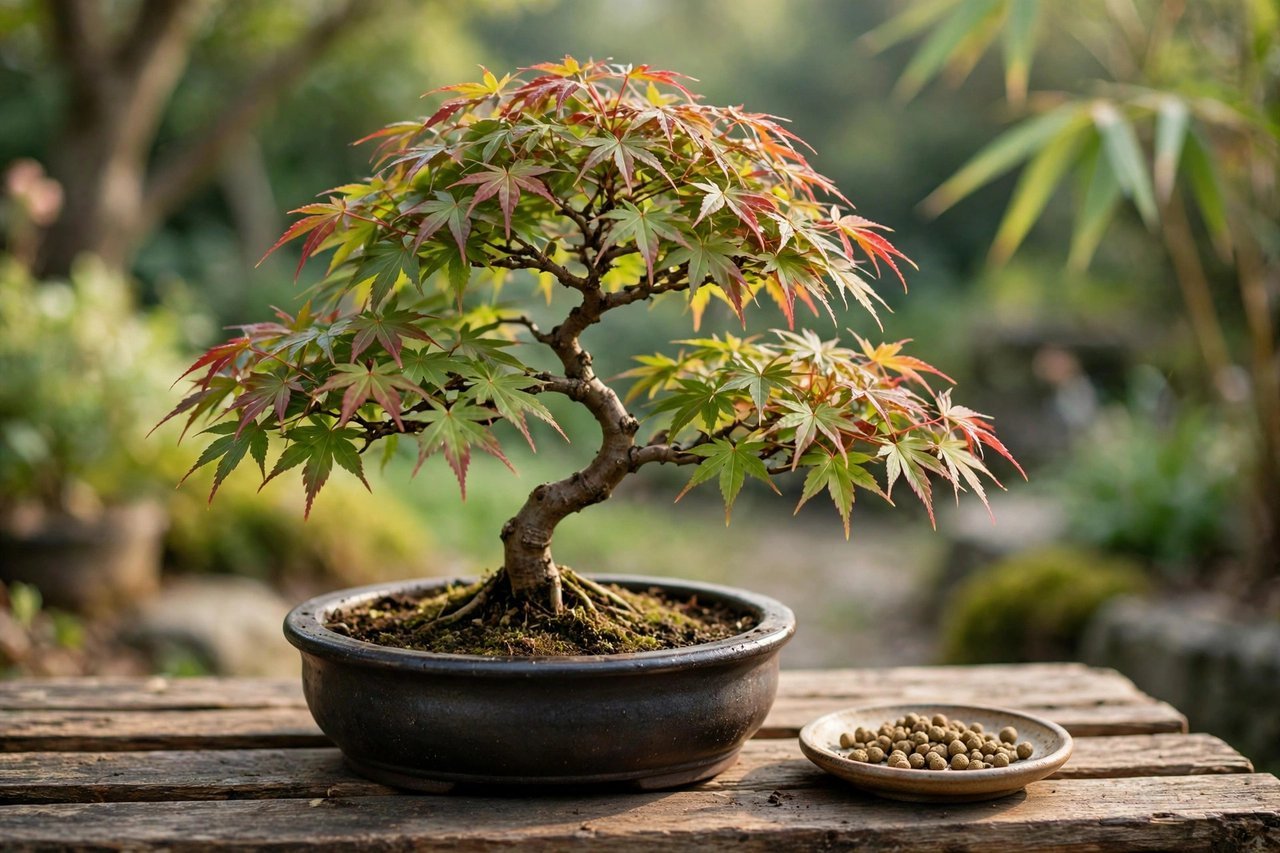
Sometimes, even with the best soil, watering and placement, your Japanese Maple bonsai may start to look a bit sad by mid summer. This could be due to a lack of nutrients in the pot. Your bonsai won’t be sick, but it will have used up all the nutrients in the pot. Shallow bonsai pots only have a few handfuls of gritty mix, and every time you water some of the nutrients will be lost through the drainage holes. You will need to give your tree some help, but not too much to make it become soft and leggy. Choosing fertilizer for Japanese maple bonsai is about feeding lightly and only while the tree is growing.
Feeding, in Short
The best fertilizer for Japanese Maple bonsai is a gentle balanced feed. Most beginners will apply a solid organic fertilizer to the soil every 4-6 weeks from Spring to early summer. Alternatively, you can use a liquid fertilizer diluted by half every 1-2 weeks. During mid summer reduce the amount of fertilizer. Apply a light feed once during Autumn if the tree is healthy. Don’t feed during Winter. Good fertilizer for Japanese maple bonsai works slowly and gently.
Why a Bonsai Pot Changes the Feeding
Japanese Maple bonsai trees are grown in a very small amount of soil. This soil is intentionally gritty to allow the water to drain through quickly. As explained in the bonsai soil guide, most of the soil will be made up of akadama, pumice and lava rock. This means there isn’t a lot of nutrients in the free draining soil.
Fertilizer for Japanese maple bonsai needs a gentle, frequent feeding schedule. Maple bonsai are watered regularly throughout the year and sometimes daily during the summer. This means that using a gentle, frequent feeding schedule will help your tree. Japanese Maple trees are slow to moderate growers. Overfeeding will cause long, leggy growth with large gaps between the leaves. The leaves will be large and the red colour will fade.
NPK, in Plain Terms
All fertilizers will have 3 numbers on them. For example, 10-10-10 or 5-5-5. These are the NPK values. This means there is 10% (or whatever number it is) of Nitrogen (N), Phosphorus (P) and Potassium (K) in the fertilizer. Nitrogen will help with leaf and shoot growth. Phosphorus will help with roots and energy. Potassium will help with general health.
A balanced fertilizer with equal or similar numbers will be a good place to start. Bonsai Empire advise against using high Nitrogen fertilizers as this will cause large leaves and long internodes. For most of the season a balanced feed such as 10-10-10, 6-6-6 or 5-5-5 at the recommended strength will be sufficient. A balanced feed is a good starting point for fertilizer for Japanese maple bonsai.
Organic or Liquid
Solid organic fertilizers come in pellet, cake or ball form. They sit on top of the soil. Sometimes they will come in small baskets to stop them washing away. They are broken down by microbes meaning the nutrients will be released slowly to the roots. This makes them a gentle option to use. Bonsai Empire advise using a solid organic fertilizer for mature Japanese Maple bonsai. They are slow to work, need to be reapplied every 4-6 weeks and can sometimes smell. That gentle, slow release is why many growers choose fertilizer for Japanese maple bonsai in pellet form.
Liquid fertilizers are mixed with water. They will get to the roots quickly. They can be applied in precise amounts due to being diluted. They will wash out of free draining soil quickly so will need to be applied every 1-2 weeks. They are much easier to overfeed. If you prefer to use one product, choose whichever you will actually use.

Choosing a Fertilizer for Your Tree
Ask yourself what stage your tree is in. If you have a young maple that you are growing out, you could use a richer feed. However, if your tree is mature and well shaped, you should only feed it lightly. This is because you want your tree to stay healthy and compact. Ask yourself how healthy your tree is. If your tree is growing new shoots, has healthy leaves and is drinking water regularly, it is ready to be fed. If your tree is looking pale, losing leaves, full of pests or has dry soil, you should address the underlying issue first.
Fertilizers aren’t a cure for poor light, damaged roots or watering issues. Check the label. Choose a balanced NPK with low Nitrogen. Make sure it states how to use it on container plants. Avoid lawn fertilizers. Start with a weaker feed. Observe your tree for 2-3 weeks. Start light, then watch how your tree responds to fertilizer for Japanese maple bonsai.
A Feeding Schedule Through the Year
This fertilizer for Japanese maple bonsai schedule follows the tree, not the calendar.
Early Spring, as Buds Swell and Leaves Open
Once leaves have opened slightly, feed with a balanced organic pellet or first feed with half strength liquid. That first feed is a gentle start for fertilizer for Japanese maple bonsai.
Late Spring to Early Summer
This is the most stable time to feed. Top up your pellets every 4-6 weeks or feed with liquid every 1-2 weeks. Keep that rhythm through early summer for fertilizer for Japanese maple bonsai.
Midsummer, When Days Stay Above About 85 to 90°F (29 to 32°C)
Reduce or stop feeding. Trees won’t grow in the real heat. Fertilizers can burn the roots if they sit in hot dry soil. As stated in the Triangle Bonsai Societys feeding guide, trees will stop growing once temperatures hit 90 degrees. In the heat, fertilizer for Japanese maple bonsai can wait.
Autumn, as Growth Slows
Feed once lightly. If your tree is healthy, feed around a month before dormancy. One light autumn feed is enough for fertilizer for Japanese maple bonsai.
Winter, While the Tree Is Dormant and Leafless
Don’t feed your tree. As stated in the care guide.
How to Apply Fertilizer, Step by Step
Water first. Never feed a dry tree. Water the soil thoroughly and allow to drain. See how to check soil moisture here. Wet soil first, then fertilizer for Japanese maple bonsai.
Check the label. Start with a weaker feed. For liquids, half the strength. For pellets, use the number stated on the packet for the size of your pot. Half strength is the safe starting point for fertilizer for Japanese maple bonsai.
Pellets Place the pellets on top of the soil. Don’t place them against the trunk. Spread them out evenly so they are just inside the edge of the pot.

Liquid Evenly pour the liquid feed over the soil. Use a watering can and feed slowly. Don’t pour over the leaves. Strong feed can burn the leaves.
Feed in the morning or evening. Avoid feeding in the middle of the day. Avoid feeding right before a heavy downpour. This will wash the liquid feed out of the pot.
Observe your tree for 2 weeks. If it is feeding well, your tree will grow steadily, have good sized leaves and vibrant colours. If the edges of the leaves are turning brown, losing leaves or the soil surface is turning white from salt build up, stop feeding. Water the pot thoroughly to flush it and allow the tree to recover.
With fertilizer for Japanese maple bonsai, less is safer than more.
Cultivar, Climate and Pot: What Changes for Feeding
Of all the maples, the plain green Acer palmatum is the one that puts up with the most neglect. They can take a standard balanced feed. Bloodgood types and other red cultivars only hold their colour with enough sun. Too much Nitrogen will cause the leaves to turn more green and become soft and prone to burning. Variegated and laceleaf cultivars are the ones that suffer first. Pale or delicate leaves scorch in very little sun. Overfeeding will cause soft growth which will burn first. Fertilizer for Japanese maple bonsai should be lightest for red and variegated cultivars.
In a cooler climate you will feed for longer. In a hot climate you will have 2 feeding periods. Feed in Spring, stop feeding during the hot Summer and feed lightly once it has cooled down. Young trees will be heavy feeders. Older, well shaped trees in a small pot will be light feeders. If you have just repotted your tree, don’t feed for 4-6 weeks. The roots have been cut and are healing. Feeding will burn the fresh cuts. In a hot climate, fertilizer for Japanese maple bonsai has two short seasons.
Feeding in Practice
A grower in a mild climate has a green Maple bonsai in a shallow pot. The bonsai is in free draining akadama. During Spring the tree put on good growth but by June the new shoots are short and the leaves are pale. This is likely to be due to the tree running out of nutrients in the pot. To help, feed with a balanced organic pellet monthly and half strength liquid feed every 2 weeks. The colour should return over the next month.
Another grower in a hot climate has a red laceleaf maple. They have been overfeeding with a high Nitrogen liquid feed at full strength all Summer. By August the leaves are large, soft and burnt around the edges. The red has faded. To fix this, stop feeding, water well, place in afternoon shade and wait. These are just examples.
Both examples show why fertilizer for Japanese maple bonsai should match the tree and the climate.
Feeding Mistakes to Avoid
- Feeding when the tree isn’t ready. Don’t feed a newly repotted tree, sick tree, tree with pests or drought stress. Trees need 4-6 weeks to grow new fine roots after repotting.
- Too much Nitrogen. High Nitrogen feeds, especially lawn fertilizers, will cause long, soft growth with large leaves. The red will fade and leaves are more prone to burning.
- Feeding according to a schedule. If the tree has stopped growing during a heatwave, don’t feed. The tree will tell you if it needs feeding. The shoots, leaves and water intake will tell you more than the date.
- Feeding dry soil. Always water first.
- Pale leaves. Pale leaves can be due to too much sun, not enough light or the roots aren’t taking in the nutrients. If you haven’t seen any improvement after 2-3 weeks, stop adding more. Check the light, water, soil and root health first.
Feeding Questions, Answered
When should I start feeding my Japanese Maple bonsai?
Feed once the leaves have opened slightly and the tree is clearly growing. Don’t feed during Winter when the buds are bare, the Tree Is Dormant or has been recently repotted. Once you see new growth, fertilizer for Japanese maple bonsai can begin.
How often should I feed my Japanese Maple bonsai?
Every 4-6 weeks during growing season with solid organic fertilizer. Every 1-2 weeks with liquid fertilizer at half strength. Reduce or stop feeding during mid summer. Don’t feed during Winter.
Is organic or liquid fertilizer better for Japanese Maple bonsai?
Neither is better. Organic pellets will slowly feed the tree and are gentle. This is great for mature Maple trees. Liquid feed will work quickly and can be applied in precise amounts. This is great for young trees. Either type can work well as fertilizer for Japanese maple bonsai.
Can Japanese Maple bonsai get burnt from fertilizer?
Yes. Too much fertilizer, a strong dose of liquid on dry soil or feeding a stressed tree can cause the fine roots to burn. The edges of the leaves will turn brown, leaves will fall off and there will be a white crust of salts on the soil. Stop feeding and water the pot thoroughly to flush. Let the tree recover.
Should I feed my Japanese Maple bonsai during Summer?
Feed lightly during early Summer. Once the temperature is consistently over 85-90°F/29-32°C, reduce or stop feeding.
Conclusion
Most Japanese maple bonsai won’t need much feeding. A small amount of balanced feed (if it is liquid then half strength) during the growing season is enough. Mature trees will benefit from a solid organic feed. Don’t provide too much nitrogen as this will do more harm than good. Stop feeding well before your tree goes into dormancy. Your tree will let you know if you have provided the right amount of feed. Short shoots, nice sized leaves and nice colours are a sign that you have. Keep track of what you are feeding your tree with.
Sources
Trusted reference guides for further reading: