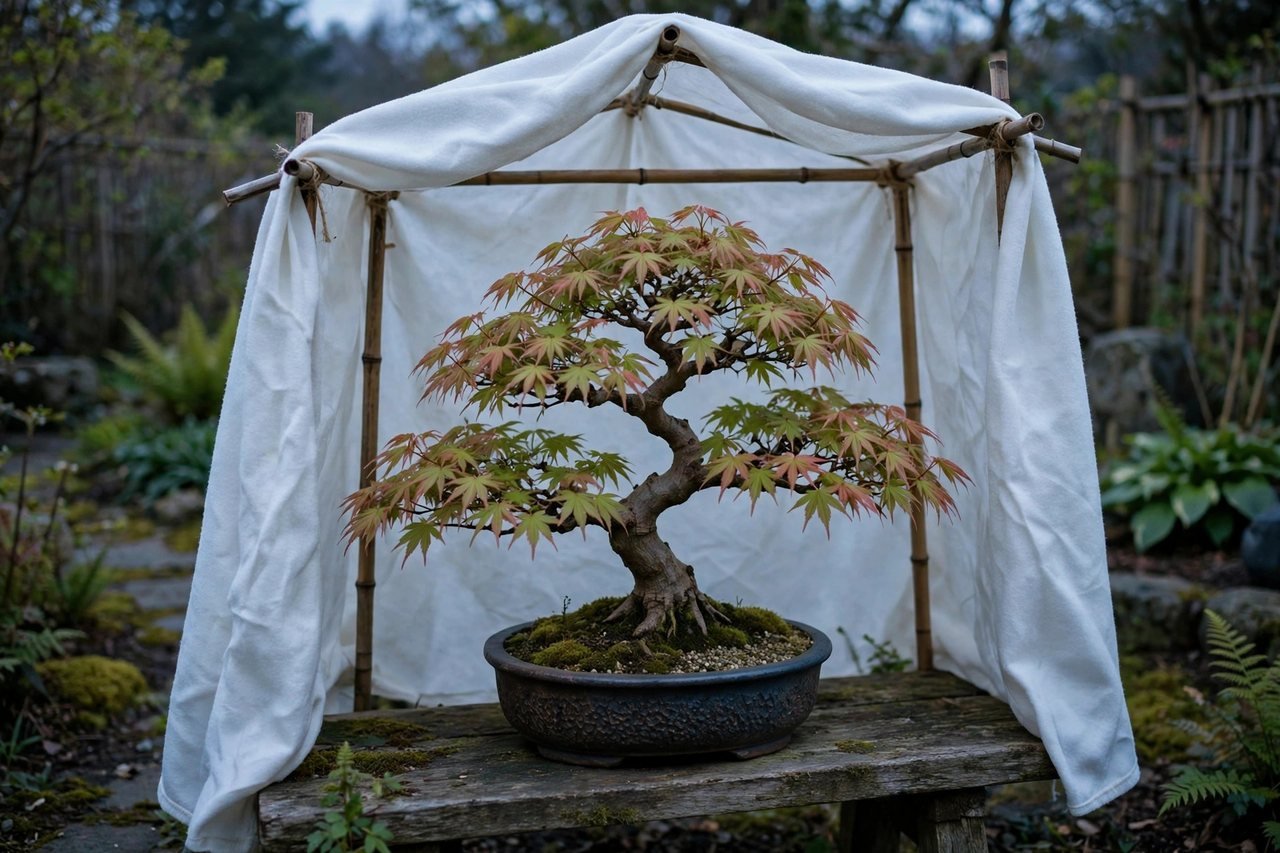
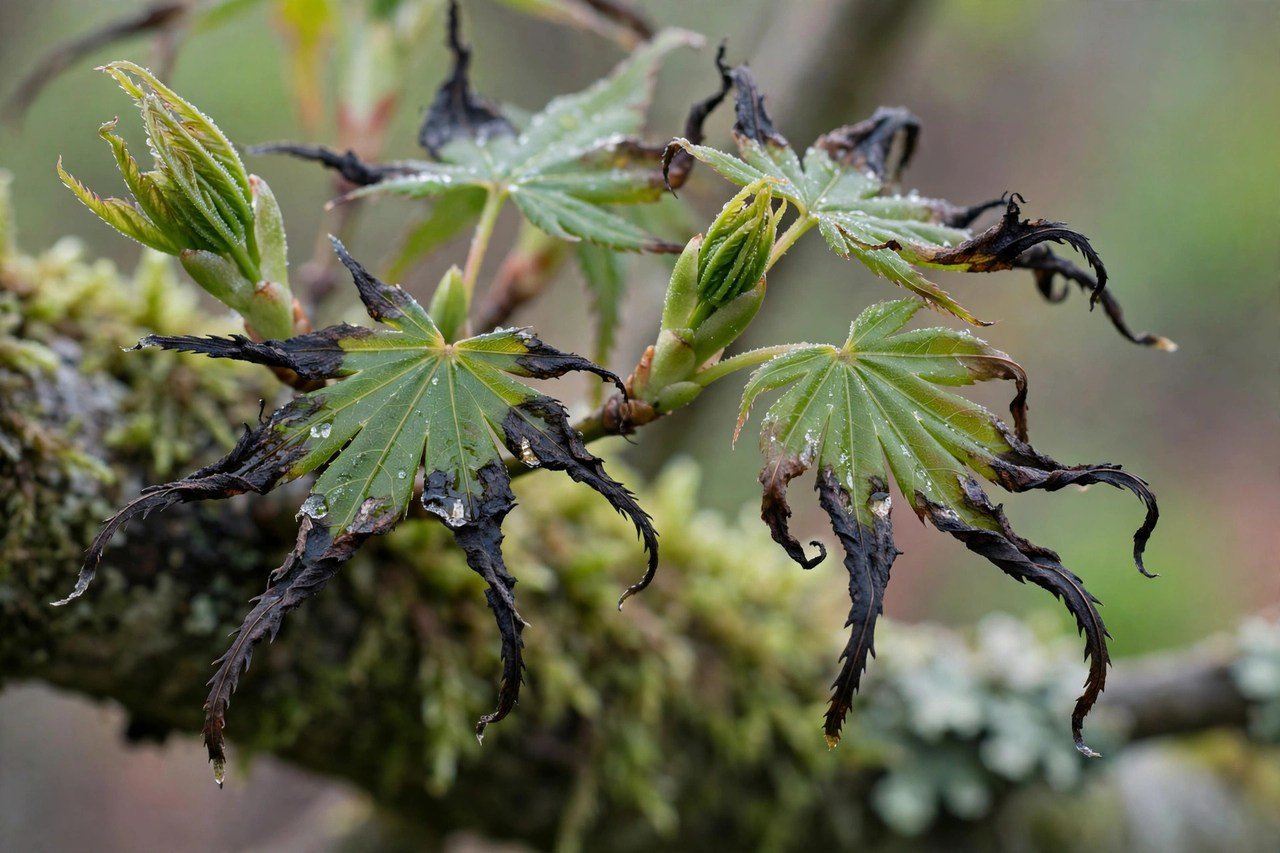
One warm spring week will cause the buds to swell and open, giving a tree that looks like it has successfully got through the winter. However, if it is forecast to be a clear and still night, the new leaves will turn black and floppy. The tree is not dead and will grow again. However, this has caused a setback to the new growth. The most common and easiest way to damage your healthy Acer palmatum bonsai in the spring is by late frost — the reason Japanese maple bonsai frost protection matters.
Frost Protection, in Short
If you see the buds have opened and there is a frost, bring the tree under cover or loosely cover with a breathable cover before dark. Remove in the morning. This is Japanese maple bonsai frost protection in one line: cover before dark, remove in the morning. If there is a light frost overnight, leaves can turn black, however if they are covered they will usually be fine. Even if they do get some frost, they will usually produce a second flush. To find out what to do for the rest of the spring months, have a look at our bonsai care guide. This is just for frost.
Why New Leaves Are So Vulnerable
While the maple is dormant it is quite hardy. With no leaves and tight buds it can survive temperatures down to 15°F (-10°C). However, once the buds start to open the tree becomes very vulnerable. The new leaves are mostly made up of water with a thin skin and no wax. A light frost will cause the water in the leaves to freeze. The cell walls will burst and the leaves will turn black and floppy.
Once the leaves have hardened they can survive a light frost with just a brown edge. The window for Japanese maple bonsai frost protection is very short, between bud burst and hardened leaves (usually 2-4 weeks). Trees that leaf early after a warm period are most at risk. Usually after an early leaf, there will be at least one more cold night. Dissectums with fine leaves will be the first to show damage.
Not all cold nights are the same. Frost is when ice crystals form on the surface of the leaves. This can happen even if the temperature is just above freezing. If there is a frost advisory, this means the temperature will be between 33°F-36°F overnight. Freezing is more serious as the air and plant will be below 32°F. The cells will freeze causing the plant to turn brown or black and collapse.
Radiation frost will occur on calm and clear nights. This will only be a few degrees below the danger point and can be covered. Advective freezing will occur with a cold front and wind. This will blow away any warm air and therefore covering won’t help as much. A good shelter is needed.
Reading the Forecast Like a Bonsai Grower
Throughout the time the buds are swollen and leaves have not hardened, Japanese maple bonsai frost protection starts with checking what the overnight temperature will be. This is the key point.
There are 3 things to consider. The temperature, if the buds have opened and the temperature is 36°F or below, cover. If it is 32°F or below, you must cover. The sky, if it is clear and calm it is likely to be a frosty night. The pattern, if there has been a warm period causing the buds to open and then a sudden cold night.
Don’t rely on the average last frost date. Half the years will have a frost after this date. Your garden will have its own microclimate. If there is a dip in your garden, this can be several degrees colder.
The Evening Routine: Cover Before Dark
If there is a frost forecast:
- Check the forecast. If the buds have opened and the temperature is 36°F or below, cover — that is Japanese maple bonsai frost protection.
- Water the soil earlier in the day. Wet soil will hold the heat from the day much better and will release it slowly throughout the night. This is what you want to trap with a cover. Water in the morning so the leaves will be dry by evening. See our watering guide to see how to tell.
- Move to the most sheltered place. Against a wall, under a porch or with other pots.
- Set up any supports. A few bamboo canes or a hoop will stop the cover touching the leaves. Any fabric touching the leaves will let the cold through.
- Loosely cover. Cover right down to the ground.
- Weight the edges. Place a brick or stone on both sides so the wind can’t blow it.
Leave it. In the morning remove once the temperature has risen above freezing. Don’t leave a cover on in the sun as it will create a small oven. Check the leaves. If they are healthy they will look the same as they did the previous evening. If they have frosted they will be dark and floppy. Put the tree back and give it some gentle morning sun. See our sunlight guide to see how much morning sun your maple should have in the spring.
Choosing a Cover: Fleece, Sheets, or Plastic?
Using the wrong material can cause more damage. A breathable cover is the key to Japanese maple bonsai frost protection.
Horticultural fleece is the best option. It is light and soft and allows air and some light through. Thicker fleeces will provide more protection. A heavy duty fleece (35gsm) will provide more protection than a light one (17gsm). Double up the fleece for more protection. Old bed sheets will work the same way. As long as they are dry. If they are wet they will be worse than nothing.
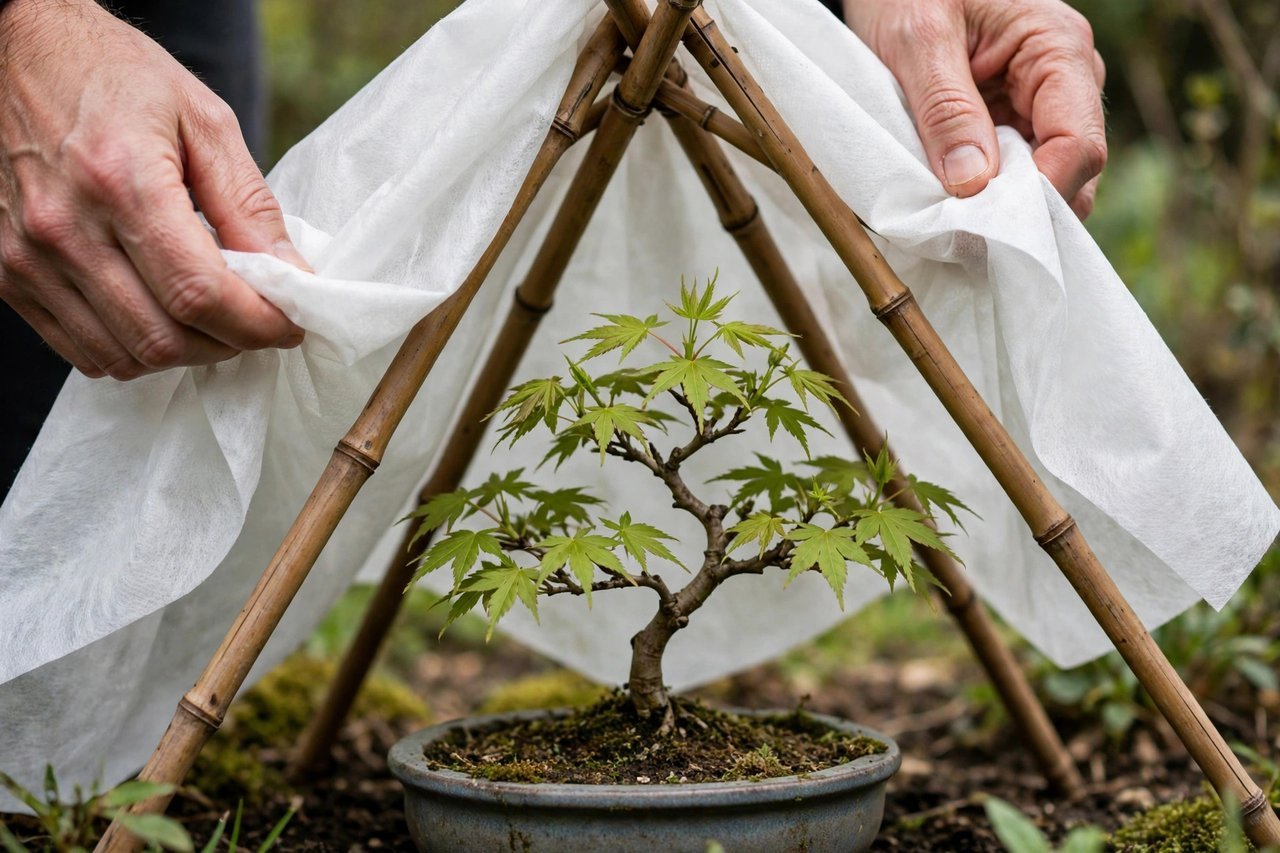
Avoid using plastic. Plastic will not allow any air through and will cause moisture to build up underneath. This will cause condensation on the leaves and then freeze. This will burn the leaves you are trying to protect. It won’t provide any insulation and can get very hot in the morning sun. If you have to use plastic, only use it on a frame. Don’t let it touch the leaves. Floating row covers can be left on for days. There are different grades which can provide up to 10°F of protection.
Shelter Options for a Frosty Night
It is often easier to move the tree somewhere. Usually the best option for bonsai. An unheated garage, porch, cold frame or shed. You don’t want to warm the tree — Japanese maple bonsai frost protection just keeps the leaves frost free. It should still be cold.
Cold frames need to be looked after. Open during the day otherwise the temperature can rise to over 130°F in under an hour. Don’t bring the tree into a heated room. This will wake up the dormant buds and cause soft growth which will be killed by the next frost. See our winter care guide.
One Frosty Night, Two Trees
These are examples.
A maple that was covered. A grower in a cold valley has a young dissectum maple in a shallow pot on a bench. The buds have opened after a warm period. The forecast shows it will be a clear night with a low temperature of 30°F. She waters the soil and moves the pot to against the south wall. She covers with double fleece over 3 canes. The next morning she removes the cover once the frost has melted. The leaves are fine.
A maple that wasn’t covered and used plastic. Another grower in the same town has a maple that has leafed after the warm period. He sees the forecast and doesn’t have time in the evening. He puts a plastic bag over the tree just before bed. The plastic touches the leaves. The next morning the leaves that touched the plastic are dark and floppy. The tree isn’t dead and will produce a second flush in May. However the first flush is gone. This wasn’t luck. It was 10 minutes, a breathable cover and using supports.
Mistakes That Make Frost Protection Worse
Using plastic. Plastic won’t allow any air through so will cause condensation on the leaves. This will cause the leaves to freeze. Often the leaves that touch the plastic will die first. Use a fleece or sheet.
Waiting until morning. If you put a cover on after the frost has formed it will do nothing. The damage has already been done. Japanese maple bonsai frost protection means putting the cover on the evening before.
Putting in a warm room will wake up the buds and cause soft growth which will be killed by the next frost. The shelter should still be cold.
Cutting off damaged leaves. While the leaves look awful they shouldn’t be cut in Spring. This will cause the maple to bleed. Cutting too early will also cause you to cut off buds that may still be alive. Wait and neaten up once the second flush is starting.
Don’t feed a damaged tree. They need time, water and light.
Still Stuck on Frost Protection?
Leaves turned black overnight. This is due to a late frost and the open buds have been damaged. Don’t cut any leaves off. Don’t feed and don’t put in extra sun. Water as normal and wait. Usually a second flush will appear in a few weeks.
Just the tips of the leaves are brown. This is usually due to a light frost or the wind drying the thinnest part of the leaves. This is just cosmetic. If this is happening a lot then the tree is in a too exposed position. Move it out of the wind.
Buds look dead. Frosted buds can look dark and shriveled but this doesn’t mean they are dead. Wait 2-3 weeks and see if they start to swell. Scratch a small twig. If it is green then it is alive. Brown, dry wood means that part of the tree has died. Don’t cut anything until you are sure.
A Frost-Night Checklist
Buds opened? Forecast checked? Soil watered earlier? Tree in most sheltered place? Supports in place? Cover loosely over tree? Edges weighted? Removed in the morning? Checked leaves? Left if damaged.
Frost Protection Questions, Answered
What temperature calls for Japanese maple bonsai frost protection?
If buds have opened and the temperature is 36°F or below overnight. Always below 32°F.
How long can I leave a cover on?
Just one night. Put on at dusk and remove in the morning. A light floating row cover can be left on for a few days. A sheet or blanket should be removed every morning.
Will a late frost kill my Japanese Maple bonsai?
Almost never. A frost will only kill the leaves. A healthy maple will almost always produce a second flush in a few weeks. A frost will set the tree back for the season.
Conclusion
A late frost in the spring isn’t a disaster. Just check the forecast, follow a 10 minute routine and remove the cover in the morning. Check the buds have opened, check the temperature and water the soil while there is still sun. Cover on clear cold nights. This is how Japanese maple bonsai frost protection works: cover on clear cold nights.
Sources
Trusted reference guides for further reading: