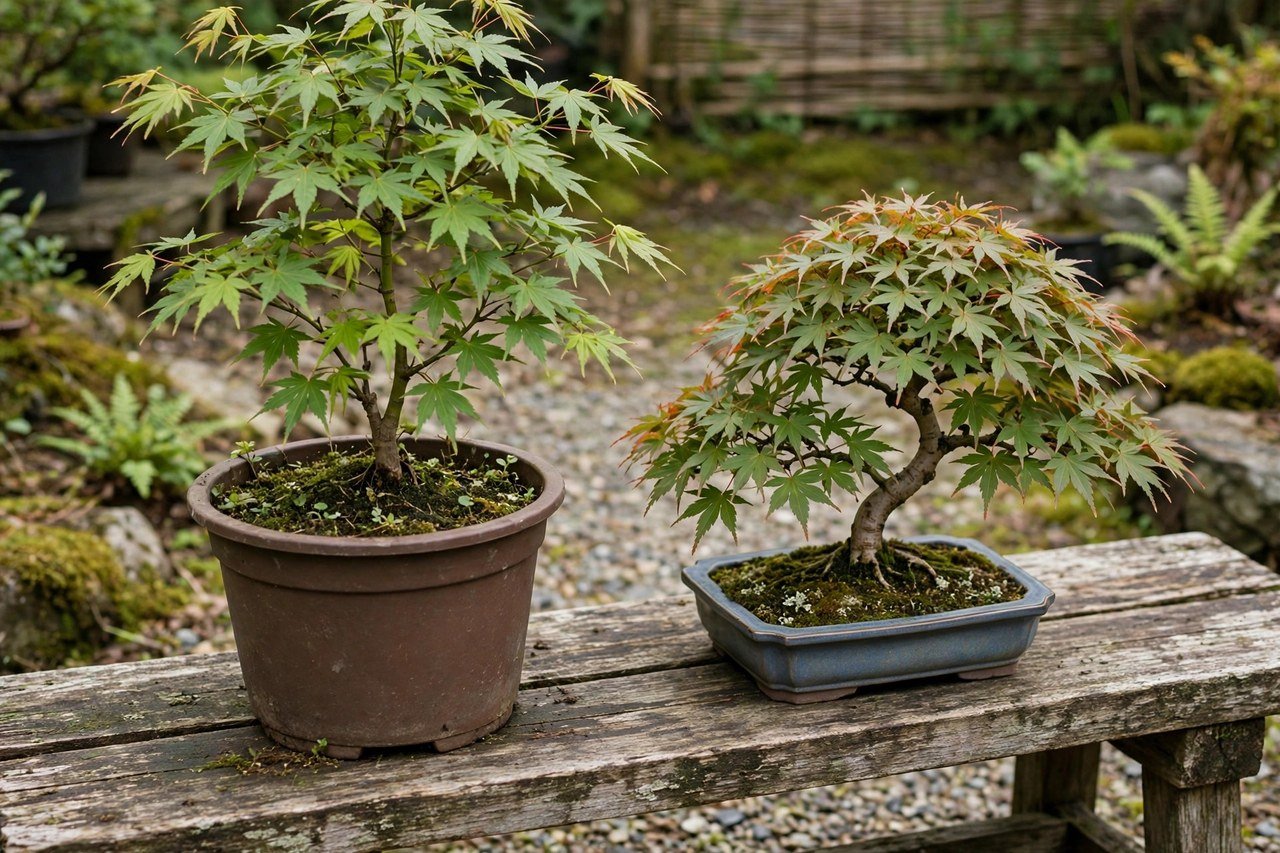
A young plant from the nursery will have long, thin branches in all directions. The trunk will be very straight. This is not a finished bonsai. To start Japanese maple bonsai development from a young plant, you do not need to cut any branches immediately. Instead, you must do a lot of things first.
The Young Tree Development Answer, Briefly
Buy the trunk. From a young maple plant, Japanese maple bonsai development starts by thickening the trunk in a large pot or directly in the ground. Once thick enough, cut back to create taper, and shape the branches. Finally, place into a bonsai pot. This process may take many years. In one season, you should perform only one of these main tasks (cutting back hard, repotting, heavy wiring). Do not do all of them in one season.
When purchasing, make sure that the trunk has good flexibility, taper, the bottom of the trunk has visible flare, and usable branches on the lower trunk. Make sure the tree is healthy. If these 4 things are correct, then you can learn the rest.
What to Look For Before You Buy
Each sapling from a nursery will have potential depending on the trunk, root flare, low branches and leaves. Even if the canopy looks nice, if the trunk is straight and the roots are matted, it will be difficult to use for Japanese maple bonsai development. Good bonsai trunks have appropriate thickness, gentle taper, good buttressing at the base, and elegant movement (Virginia Cooperative Extension).
The trunk line
Hold the tree at eye level and turn it. There should be movement in the trunk. Avoid straight trunks. A slight bend in the lower part of the trunk is better than height, as taper can be created by pruning back to a lateral branch and encouraging a new leader. A good thickness to aim for is roughly thumb-sized at the base. In Japanese maple bonsai development, growing in large containers or in the ground will mean a faster increase in thickness. Try to avoid severe bends, girdling scars, and reverse taper.
The root base
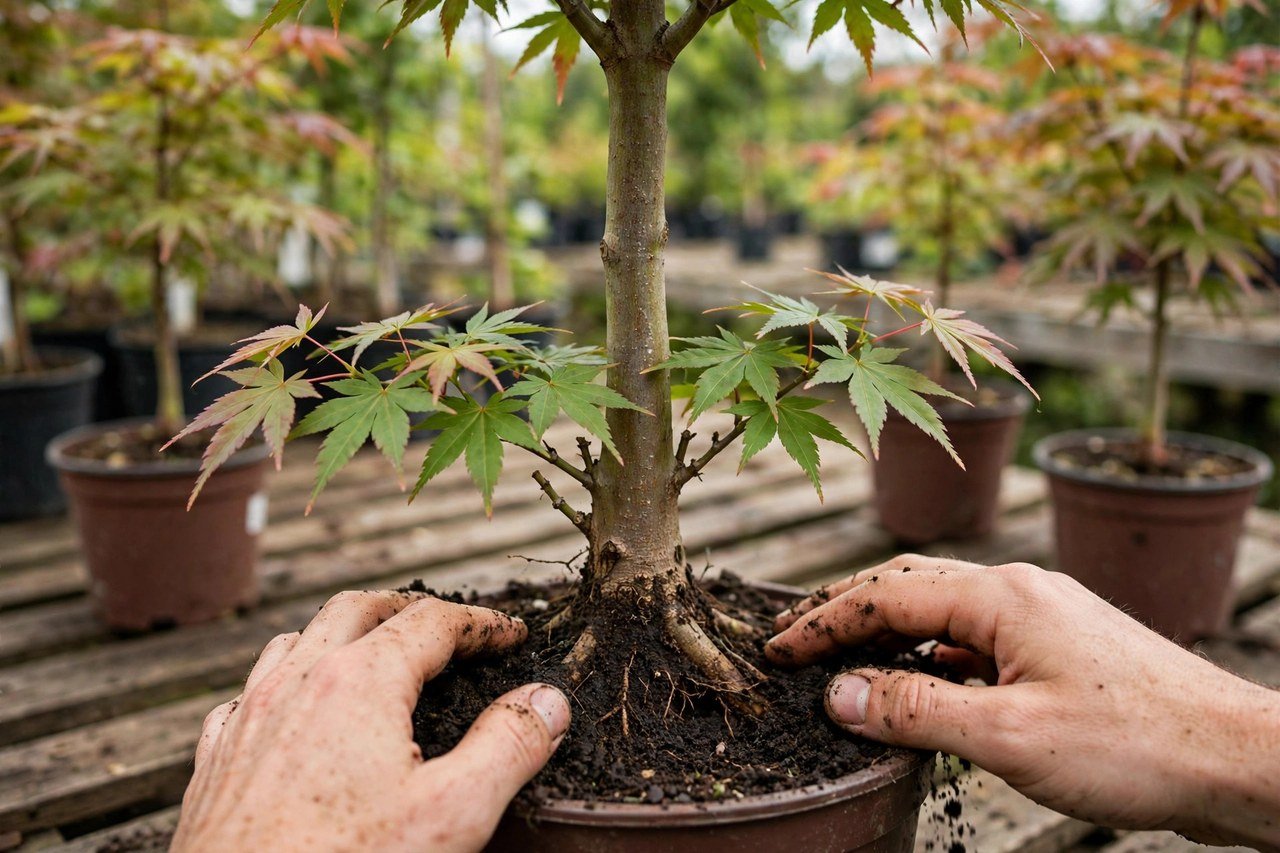
Gently remove the top layer of soil. A good root flare means that the trunk has spread out into main roots. The first thing to look for in nursery stock is a visible root flare (University of Connecticut Extension). The roots should also not be ‘girdled’, meaning that they do not wrap tightly around the edge of the container. If they do, as they thicken they will constrict the trunk.
If possible, ask to remove the tree from the pot to see. If there are three or more roots growing in different directions, the tree is promising for Japanese maple bonsai development. If there is only one thick root on one side, it is not. If the tree has been planted too deep, with the root flare covered in several cm of soil, then problems may be hidden.
The low branches
Look at the bottom third of the trunk. If there are no branches in this area, it may be a long time before new branches grow. Two or three branches in different positions in this area is good. If branches are growing straight up, crossing over each other, or in pairs from the same point, they should be removed. Refer to branch development for help deciding which branches to leave. Thick branches in the lower third can be useful. Encourage the growth of this branch as a sacrifice branch to thicken the trunk during Japanese maple bonsai development, and prune it out at a later stage.
Health checks
Ensure the tree is healthy. The leaves should be fully sized for the season, with no spotting, curling, or nibbling. Gently bend a small branch. If it is alive, it should bend. If it is dead, it will snap. Check underneath the leaves for aphid infestation. The bark should not be cracked or weeping. The bark may have a circular wound from tying. If the tree is sitting in standing water, the compost will give off a sour smell and black roots will be visible at the drainage holes. Leave this tree on the bench.
How to Choose: Seven Checks at the Nursery
Go through the following points when buying. If the tree does not meet the first 3 criteria, it is not a good purchase.
- Label
If it has a cultivar name, you can know the leaf size and growth speed. If it just says Japanese maple, you just know the species. Refer to the varieties page to know what each cultivar name signifies. - Root Flare
As above. If there is no root flare or girdling roots, problems may occur in later stages. - Trunk
As above. If it is very straight with no branches in the lower part, it is the slowest to start. - Number of low branches
If there are two or three branches at the bottom third, it is a good start. - Graft
If the tree has a named cultivar, there should be a graft mark in the lower part of the trunk. Anything growing below the graft mark is rootstock. - Health
Fully sized leaves with no spotting. No pests under leaves. No cracked or weeping bark. Fresh smelling soil (not sour). - Suitability for your bench
If the tree is very vigorous, it will need to be grown in a large training pot. If it is very slow growing (dwarf), it will only need a small pot, and patience.
The Staged Plan: What Happens When
Large Japanese maple bonsai development should run in stages. According to Bonsai Empire (Peter Chan), thick trunk, taper, root flare, and finally branching and intricate ramification should be developed in this order.
| Stage | What to do | What NOT to do |
|---|---|---|
| First season | Let it grow, check the roots, fix only what is broken | Do not cut, repot, and wire in the same season |
| Year 2 | Cut the trunk back to build taper, start the nebari | Do not chase fine branches yet |
| Years 3 to 5 | Grow the trunk on, choose the first branches, wire lightly | Do not put the tree in a bonsai pot yet |
| Year 5 and later | Move to a training pot, then a bonsai pot, refine the branches | Do not rush the final pot; a thin trunk in a small pot stays thin |
As noted by Chan, it can take nearly 20 years to get a good taper in large maples. This stage of Japanese maple bonsai development cannot be rushed. Japanese maples grow more slowly than trident maples, so plan to take years.
How Your Cultivar Changes the Young Tree Development Advice
As different Japanese maples will grow at different rates depending on cultivar, climate, season, age, pot and substrate, the schedule of Japanese maple bonsai development will be different for each sapling. Fast growing Acer palmatum seedlings in warm climates will thicken their trunks quickly (in a few years), whereas slow growing dwarfs in cooler climates will take much longer. Refer to varieties to find which cultivars grow quickly and which grow very slowly.
In zones 7 and 8, shade in the afternoon and constant watering is more important than in other areas. In hot conditions, training pots will dry out more quickly than in cool conditions. Heavy pruning and root work should be done in late winter and early spring, when buds are swelling but leaves have not emerged. Refer to repotting for more information on this time period.
Young trees can cope with heavy pruning, however older trees with thick trunks require more cautious steps. Thicker trunks can be grown in large training pots or in beds. Thin trunks can be slowed in small pots. Any substrate will do as long as it is free draining and retains enough moisture. Refer to soil for the exact mix.
Two Nursery Trees, Two Different Timelines
Two growers take trees from the same bench on the same day. After 5 years, they look very different.
Patient grower
Bought a tree with curved trunk, visible root flare. Grew in a large training pot for 3 years. Pruned trunk once a year. After 5 years, trunk is impressive, and branches are in good places.
Hasty grower
Bought tallest tree. Heavily pruned, repotted and wired in one weekend. Planted in a small bonsai pot. Throughout the season, the tree was recovering and did little growth. It remained very thin. Although it was not the cultivar’s fault, it was the wrong timing.
Common Mistakes When Developing a Nursery Maple
- Tallest tree
Height is cheap in nurseries. However, a tall straight tree with no low branches or taper is very far behind a shorter tree with curved trunk and good base. - Too many changes in one season
Doing heavy pruning, repotting and heavy wiring in one spring is too much for the tree to cope with. It will spend the year recovering. Only do one major change per season. - Putting young trees in bonsai pots too soon
Small pots will slow Japanese maple bonsai development. Keep in large training pots until trunk is thick enough. Refer to pots for more information. - Ignoring roots
If roots are girdled, this will only get worse. In the first year, check roots. Remove girdling roots, and spread the rest out. Begin to create a good nebari now. - Picking ‘front’ too early
The front of the tree depends on trunk shape and root flare. As trunk thickens, these features will change. Picking a ‘working front’ is best, and can be re-evaluated each year.
If Young Tree Development Still Fails
- Little growth after first pruning
After heavy pruning, the tree will lose its leaves. Give it a full growing season in plenty of sunlight, water and feeding. Do not prune again until it recovers. - Straight trunk with all branches at top
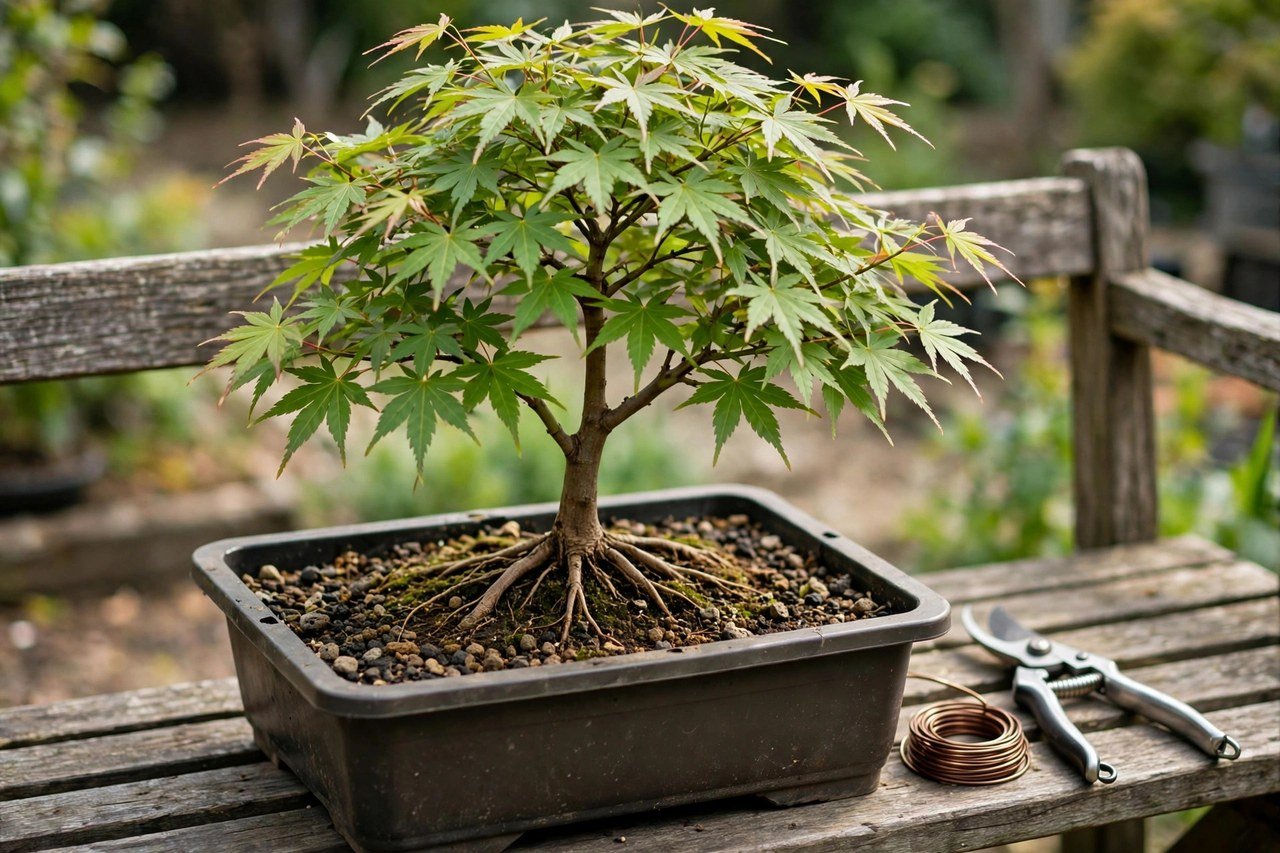
Prune trunk back to a lateral branch in the lower section. Allow this branch to become the new leader. This is a big change, but is the only way to create movement in a straight trunk. - Solid girdled roots
In late winter, remove girdled roots. Spread remaining roots flat in a shallow training box. Allow the tree to regrow feeder roots. If the tree is weak, split this into 2 springs.
Young Tree Development: Questions and Answers
How old should the tree be?
It is useful to take trees that have been propagated 3-5 years ago. If they are younger than this, there will be very little trunk to work with. If they are much older, they are often root bound and set in their shape.
Should maples be grown in pots or in the ground?
Large training pots are very useful for controlling roots. In open ground, trunks will thicken faster. However, the tap root will need to be pruned regularly (every few years), and maples in the ground are harder to move.
When should I put the tree in a bonsai pot?
Once the trunk is thick, the taper is in place, and the first branches are in place. For most nursery maples, this will be in year 5 or later.
Seedling or grafted tree?
Seedlings are cheap and vigorous. If you just want to grow the species, they are fine. If you want a named cultivar, you must have a grafted tree. Refer to varieties to see why it is important to know the name of the cultivar.
Conclusion
Nursery maples have great potential. Check the trunk, roots and lower branches before buying. Give the tree time for Japanese maple bonsai development. Thicken the trunk, create taper, and develop branches. Finally choose a pot. Only do one major change per season. Grow in large pots. Be patient as the trunk thickens. With this care, the thin tree in the back of your car will become a nice bonsai.
Sources
Trusted reference guides for further reading: