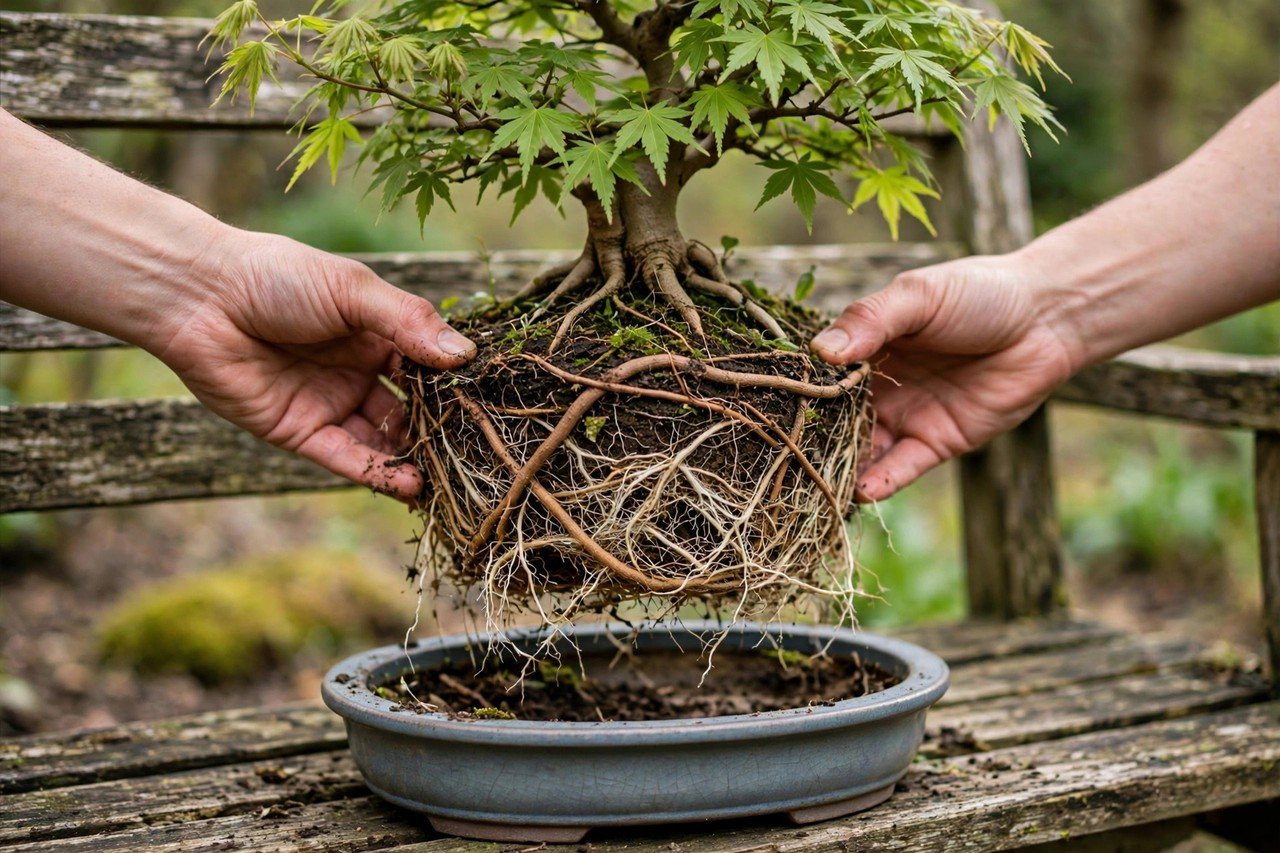
Once a Japanese maple bonsai has completely filled its pot with roots, it is time for Japanese maple bonsai root pruning. Root prune in late winter/early spring when the buds are swelling. Prune thick roots out of the root mass and keep fine feeders. When pruning Japanese maple bonsai roots, only prune a maximum of 1/3 of the root mass from a healthy tree. If the tree is weak, prune less (1/5) and if it is ill, do not prune. Prune using sharp and clean tools. Keep exposed roots damp and out of direct sunlight.
Root Pruning, in Short
Yes, Japanese maple bonsai root pruning is due when the root ball is full. Root prune in late winter/early spring, when the buds are swelling. Prune thick roots and keep fine feeders. Do not prune more than 1/3 of the root mass from a healthy tree. Prune less if the tree is weak, and do not root prune if the tree is unwell. Only use clean and sharp tools. Keep the cut roots damp and out of direct sunlight.
Why Roots Need Pruning at All
Trees in the ground will grow roots as long as they need to. Trees in pots however cannot. Therefore all of the roots in the pot will become very overcrowded. After 2-3 years the root ball will be very compact, with the soil reduced to fine particles. While the tree does not lack nutrients, it lacks space and air.
Japanese maple bonsai root pruning allows extra space in the pot (by removing thick roots to allow fresh soil and fine roots to develop) and rejuvenation of the roots. By pruning roots, new branches develop from the cut. By carefully pruning, you can change a few old roots into many new feeder roots. As stated by the RHS, pruning roots encourages the development of fine roots which absorb water and nutrients more easily.
Know the Roots Before You Cut
Before Japanese maple bonsai root pruning, consider which roots you are cutting. If the wrong roots are pruned, a healthy tree may struggle for a year. Separate the roots into groups:
The fine feeders
Fine white roots, often found in clumps near the base of the trunk and around the edge of the root ball. These are doing most of the absorbing. Try to leave as many as possible. Prune from the outside inwards. Leave the centre.
The thick structural roots
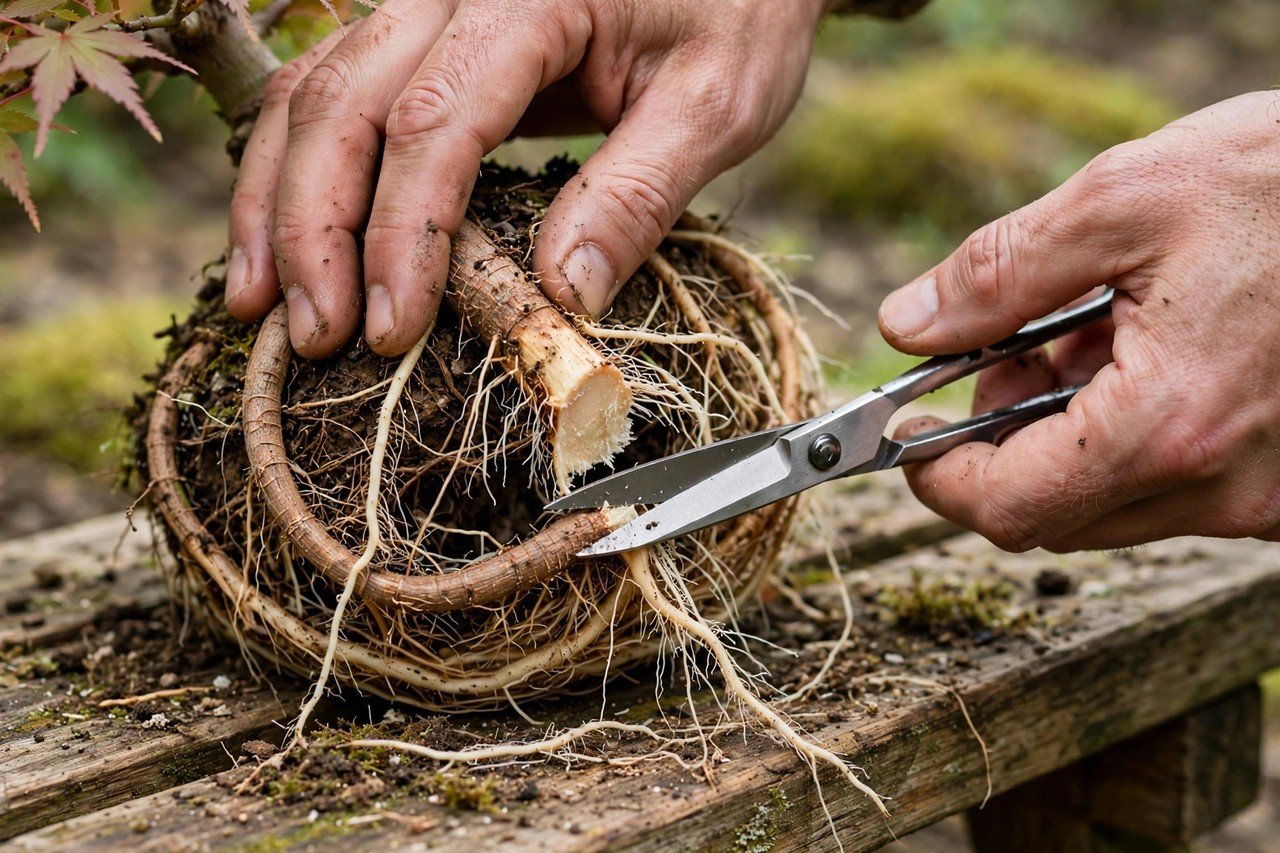
Thick brown roots (pencil sized or larger) that are either coiled around the pot or growing straight down. These give support to the tree, but take up space that feeder roots would be in. Prune back to where finer lateral roots branch off.
The taproot remnant
When grown from seed, young maples will have one main tap root. In bonsai pots, this root is of no use. On young trees, cut back heavily to allow lateral roots to take over.
Dead, damaged, and rotted roots
Dead roots will be dry and brittle. They will snap rather than bend. Damaged roots should be pruned back to clean pale wood. Rotten roots will be black and very soft with a sour smell. Cut all of these roots away. For a full diagnosis, see the rotten roots guide.
Reading the Root Ball
In early spring (before leaves have fully opened), take the tree out of the pot and inspect the root ball. A healthy root ball will be firm but not solid. There will be a layer of fine roots on the outside of the root ball, and the root ball will have a slightly earthy smell. In the base of the root ball, if there is a flat layer of roots sitting in the drainage holes, this is the first thing to prune.
If the root ball is unhealthy, there may be issues. If the centre is dry and dusty but the outside is wet, the roots in the centre are not getting water. If the root ball is very compact and a chopstick cannot be poked into it easily, the roots are not getting air. If the soil has a sour smell, or the roots are black and soft, do not start Japanese maple bonsai root pruning. Instead, treat as rotten roots.
How Much Root Is Safe to Cut
How much Japanese maple bonsai root pruning is safe depends on the health of the tree. Healthy trees will regrow lost roots quickly, whereas weak trees may take the whole season to regrow roots, and ill trees may not regrow roots at all.
| Tree condition | Safe amount to cut | Why |
|---|---|---|
| Strong, vigorous tree | Up to one third of the root mass | Stored energy regrows roots fast |
| Established, healthy tree | Up to one third of the root mass | Fine roots return within weeks in spring |
| Weak, stressed, or recently styled tree | One fifth or less, or nothing at all | Too little energy to regrow roots |
| Old, refined tree in a large pot | About one quarter | Slow growth means slow root replacement |
These restrictions exist due to the balance between leaves and roots. If 1/3 of roots are pruned, there is enough support from the leaves to allow new feeder roots to form. However, if half the roots are pruned, the leaves will wilt more quickly than new roots can regrow. If unsure, it is best to prune less. More can be pruned next Spring.
The Root-Pruning Steps
While Japanese maple bonsai root pruning is just a part of the process, the whole repotting process can be found in the repotting guide. However, to specifically root prune:
- Wet the day before
Water very well the day before pruning so that roots are soft and supple. - Gently remove
Gently remove the tree from the pot, holding the root ball in both hands. Do not pull on the trunk. - Loosen old soil
With a chopstick, gently loosen old soil from the outer roots. Work from the outside inwards. - Sort
Sort roots into 3 groups. Keep feeder root mats. Prune circling roots back to lateral roots. Remove tap root stubs and dead roots. - Make clean cuts
Use sharp scissors or a knife. Make one swift cut. If roots are crushed, they will rot before healing. - Flatten roots
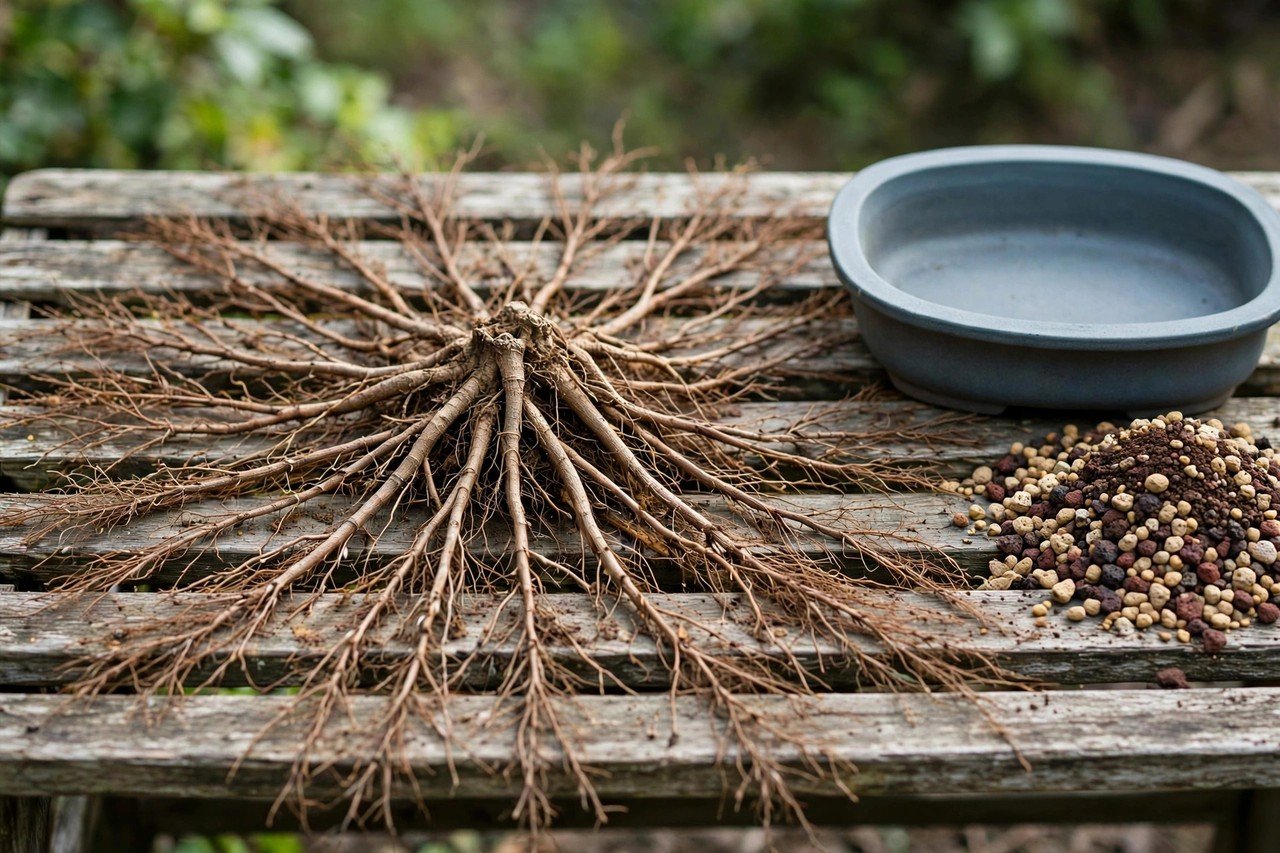
Arrange remaining roots to radiate out from the trunk. Do not cross roots. - Place in new soil
Place into fresh, free draining bonsai soil (recipe in soil guide). Press soil in, tightly tie anchoring wire, and water until run-off occurs.
Arranging Roots Radially
As root balls in round pots tend to grow round, with roots circling the pot, it is best to turn this arrangement into a star shape. Evenly arrange kept roots around the trunk. If a root is growing straight down, prune back to lateral roots or remove. If roots are crossing, do the same.
As radial roots thicken, the base of the trunk will widen to create a wide root base. This is called nebari by bonsai growers. To create a full nebari takes more time and is detailed in a later article in this series. However, every time you do Japanese maple bonsai root pruning, arrange surface roots in a radial pattern. It is especially important to do this with young trees. The roots on seedlings are still pliable so arranging them now can save a lot of correction work in the future. In the nursery development guide, root pruning of young trees is covered in the staged plan.
Cultivar, Climate and Pot: What Changes for Root Pruning
The way in which Japanese maple bonsai root pruning is done will vary depending on the maple. A vigorous Acer palmatum seedling in a warm climate will regrow 1/3 of its roots very quickly after pruning in spring. However, a slow growing dwarf maple such as ‘Kiyohime’ may take the whole season to recover after the same amount of pruning.
Depending on climate, you may need to adjust how you root prune. In hot dry climates, exposed roots will dry very quickly. Root prune in the shade and mist the root ball while pruning. In cool damp climates, cut roots will be in cold, damp soil and may rot before they heal. Allow free drainage.
Season. Japanese maple bonsai root pruning should happen in late winter or early spring (when the buds are swelling). See the repotting guide for details. Do not root prune in summer, or very cold winter months. In autumn, only root prune in mild, sheltered conditions. Age of tree and pot also affects how much to prune. Young trees can be heavily pruned. Older trees in shallow display pots should be pruned more gently.
Two Root Balls, Two Different Recoveries
Two growers root prune the same type of maple on the same morning in spring. However, by mid summer the trees look very different.
Careful pruning
A 10 year old maple is root pruned when the buds are swelling. Roots are separated into groups, and only a maximum of 1/3 pruned. Feeder root mats are left intact. Tree is placed into fresh soil in the same pot. Placed in bright shade for 2 weeks, and puts on leaves on time.
Rushed Pruning
A similar tree is root pruned, but half the roots are removed without separating. Root ball is left bare in the sun. Tree is placed in full sun that afternoon. Leaves begin to wilt within days. The tree has a long recovery period during the season. Despite not being a weak tree, it was poorly pruned.
Common Mistakes When Root Pruning a Japanese Maple Bonsai
- Too much pruning. Do not prune more than 1/3 of roots on a healthy tree. Prune 1/5 on a weak tree, and none on an ill tree.
- Pruning feeder roots. Do not prune pale feeder root mats. Prune thick roots only.
- Leaving roots in direct sunlight. Root balls will dry very quickly in direct sunlight. Root prune in shade, and keep root ball damp.
- Pruning in summer. Roots cannot be replaced quickly enough in hot summer weather. Prune only in bud swell period (unless root rot). See repotting guide.
- Hiding the flare. If too much fresh soil is added around the trunk, the bark may rot. Place tree at the same depth as before.
Still Stuck on Root Pruning?
- Wilting leaves. Water is escaping the tree faster than roots can replace it. Move to deeper shade. Mist leaves and keep soil evenly moist.
- No new growth after a month. The tree may have been weak before pruning, or too much root may have been pruned. Keep in shade and moist, and give it the season. If the tree was not growing before pruning, see the no growth guide for other reasons.
- Water running straight through pot. Air pockets may be in the soil, or the soil is too coarse for the remaining roots. Water very slowly twice.
Root Pruning Questions, Answered
How often should I root prune my Japanese maple bonsai?
Young trees should be root pruned every 2-3 years, and older trees every 3-5 years. Check the roots every spring and decide based on what you see.
Can I root prune and repot in one session?
Yes! Root pruning is done as part of repotting, in the bud swell period. See the repotting guide for full process.
Do I need to seal large cuts on roots?
No. Maple roots will form a callus over clean cuts in fresh free draining soil.
I have very few feeder roots and lots of thick roots.
The tree has too few feeder roots. Lightly prune thick roots, and leave all feeder roots. Give the tree a season in shade.
Conclusion
Root pruning Japanese maple bonsai is not a punishment for overgrowth. It is essential to keep maples alive in pots. Thick roots are removed, fine feeder roots are kept, and a flat, airy root ball is formed. To root prune Japanese maple bonsai, separate roots first, and do not prune more than 1/3 from a healthy tree. Keep cut roots damp and in shade. Root prune in the bud swell period, and Japanese maple bonsai root pruning will be one of the quietest tasks on your bench.
Sources
Trusted reference guides for further reading: