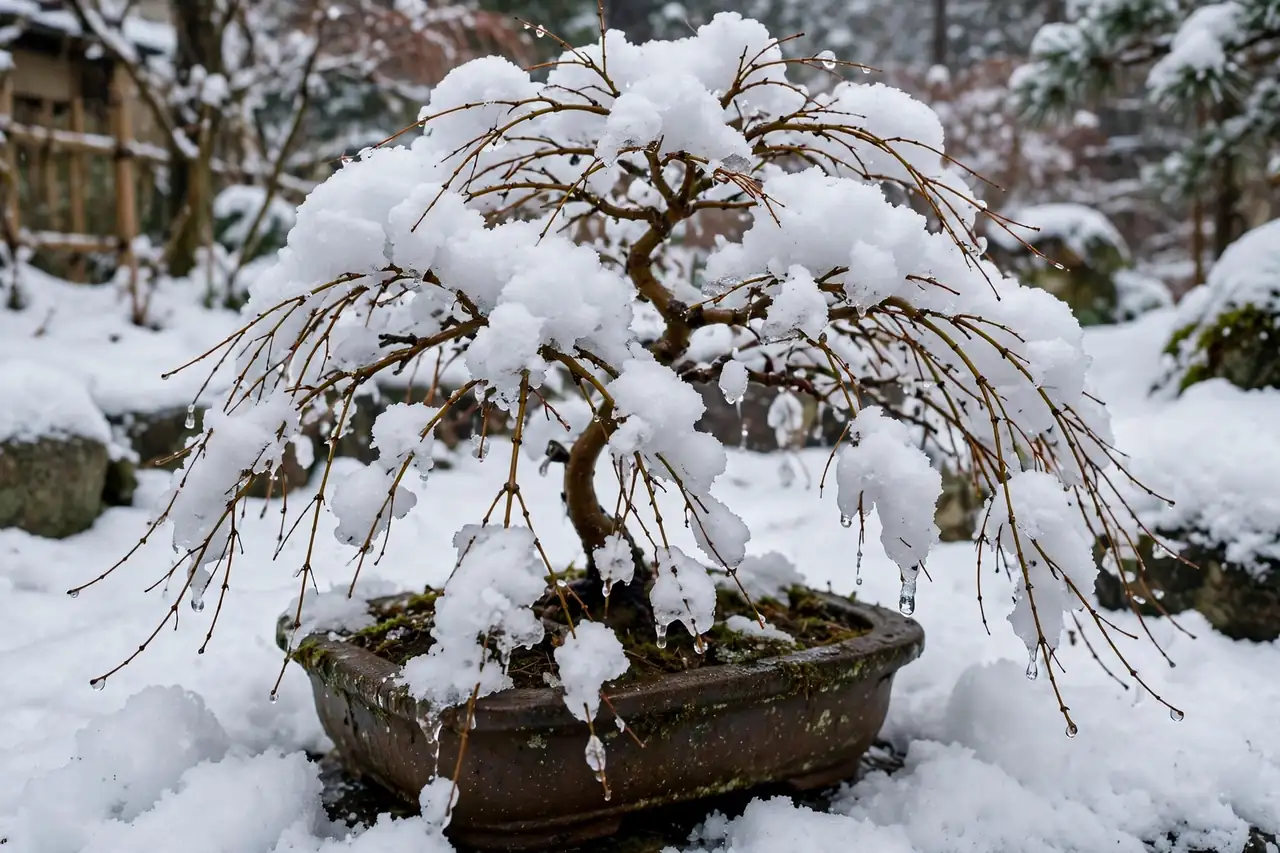
Although the initial fall of snow in winter is not on foliage, it settles on branches. Hour by hour it accumulates and eventually causes a branch often one which has supported foliage throughout the summer to snap. Japanese maple bonsai are a small tree grown in a shallow container. The branches support the snow and the container endures the cold. Thus, Japanese maple bonsai snow protection largely involves supporting branches from the weight of snow and protecting a container from cold and the freeze-thaw process.
The Short Answer on Snow Protection
Use a soft brush to remove bulk, wet snow from beneath branches. Never shake a frozen branch. Leave light dry snow and container snow as they provide good insulation. Position the container on the ground. Ensure there is good water drainage. And between storms inspect the tree, together with the container and soil, for any bowing branches, cracked containers and soil heave. Maple is a hardy species. Japanese maple bonsai snow protection focuses therefore less on heating the tree and rather on maintaining an even temperature and removing weight from the branches.
What Heavy Snow and Freeze-Thaw Actually Do
Snow load: weight on bare branches
Whilst each twig will hold some weight, a branch will support the total. Wet snow is particularly heavy. Even at the same depth, it can be significantly heavier than dry snow. Gradually a branch bows and then bows further still. Usually, it is at a branch point or on a slender twig that a branch snaps. Bonsai Station emphasises that heavy snow and ice can cause branches to snap, especially on trees such as Japanese maples which have delicate wood. Moreover, a small bonsai tree can be toppled from its container by the weight of the snow. Again, it is the weight of snow that is of concern, not its coldness.
Freeze-thaw cycles: the pot and the soil
Whilst a dormant maple can easily endure a single deep freeze, repeated fluctuation in temperature for example, between above and below freezing each day is problematic. As the temperature falls, soil water freezes and increases in volume by around 10%. This puts pressure on the container. Eventually, this can cause a container to crack. Furthermore, soil heaves can occur and this can pull out fine roots.
Plants are more adversely affected by multiple freeze-thaw events. Containers on a bench are more at risk than those on the ground. For a full explanation of sheltering, see the winter care guide.
Ice: the heaviest coating of all
Freezing rain is rain which, upon contact, immediately freezes. All twigs become encased in ice. Ice is much heavier than snow and, unlike snow, cannot be brushed from branches as it adheres to the bark. Allow it to melt naturally. Usually, detaching ice from a frozen twig will also result in twig damage.
| Snow | What it does | What to do |
|---|---|---|
| Light powder snow | Sits lightly, insulates, melts slowly | Leave it alone |
| Heavy wet snow | Loads the branches, snaps twigs at forks | Brush it off from underneath, in stages |
| Freezing rain (ice glaze) | Coats twigs in heavy ice, seals buds | Leave it alone until it melts |
Snow on the Pot Is Good, Snow on the Branches Is the Problem
As previously stated, snow has contrasting effects. On branches it adds weight; on a container it provides insulation.
When to leave the snow alone
Light dry snow on a container is good insulation. Allow it to melt naturally. It shields the soil from the wind and then slowly converts to water which can then be absorbed. Moreover, a very slight layer of snow on branches is almost weightless. Excessive attention is paid, however, to removing all snow.
When to clear it
Remove bulk, wet snow and/or snow which has accumulated and is causing branches to sag. If the ends of branches are well below their usual position then the branches already have excessive weight. Commence by removing snow from the uppermost branches and proceed downwards. Remove the snow before it hardens overnight.
Reading the Forecast Before a Snowy Spell
Just a few figures need to be analysed and this can be done swiftly.
The three numbers that matter
The quantity and duration of snowfall. Although a couple of inches of snow over a whole day is not overly heavy, the same amount in a short time span can be too heavy and cause branches to snap. Further, the temperature at which the snow falls is important. Snow which falls close to freezing is wet and bulky. Conversely, snow which falls at well below freezing is light and dry.
Finally, post-snowfall temperatures are key. Where days alternate between above and below freezing, then freeze-thaw occurs. It is at this stage that a container should be monitored. The same principle applies to analysing the weather for rain and storms. Moreover, the seasonal calendar guide demonstrates that different tasks are required in different areas, despite the same month applying.
Before the First Snow: A Snow-Ready Setup
Autumn preparations for a bonsai tree are detailed in the fall care guide. Discontinue feeding. Allow leaves to fall. And decide on a suitable shelter location.
Clear the drainage first
Prior to the initial snowfall, confirm that a container allows good water drainage. Should a container’s drainage be obstructed then it functions like a tray. Subsequently, as this tray of water freezes and thaws, it can cause a container to crack. For information on creating good draining soil, refer to the soil guide.
Watch where the roof snow falls
Should a bonsai be situated under the edge of a roof then in addition to snow, roof snow can also pose a threat. In fact, roof snow can be many times heavier than falling snow. Never locate a bonsai under a roof edge.
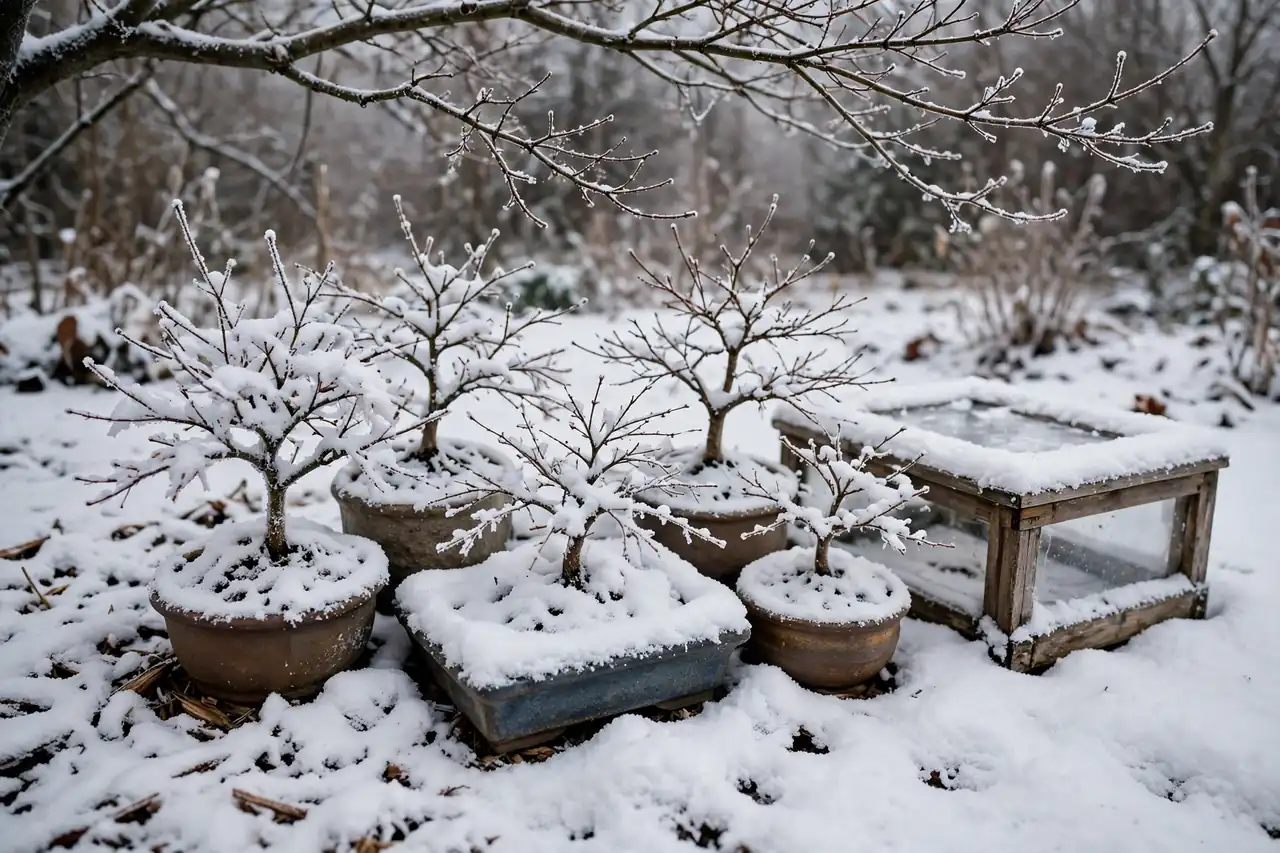
Set the pot on the ground
Whereas a container on a bench will freeze uniformly, one on the ground is more stable as the surrounding earth retains heat. See the winter care guide for further details.
During a Snowfall: Clearing Snow Safely
Good timing and technique are key to providing Japanese maple bonsai snow protection during a snowstorm.
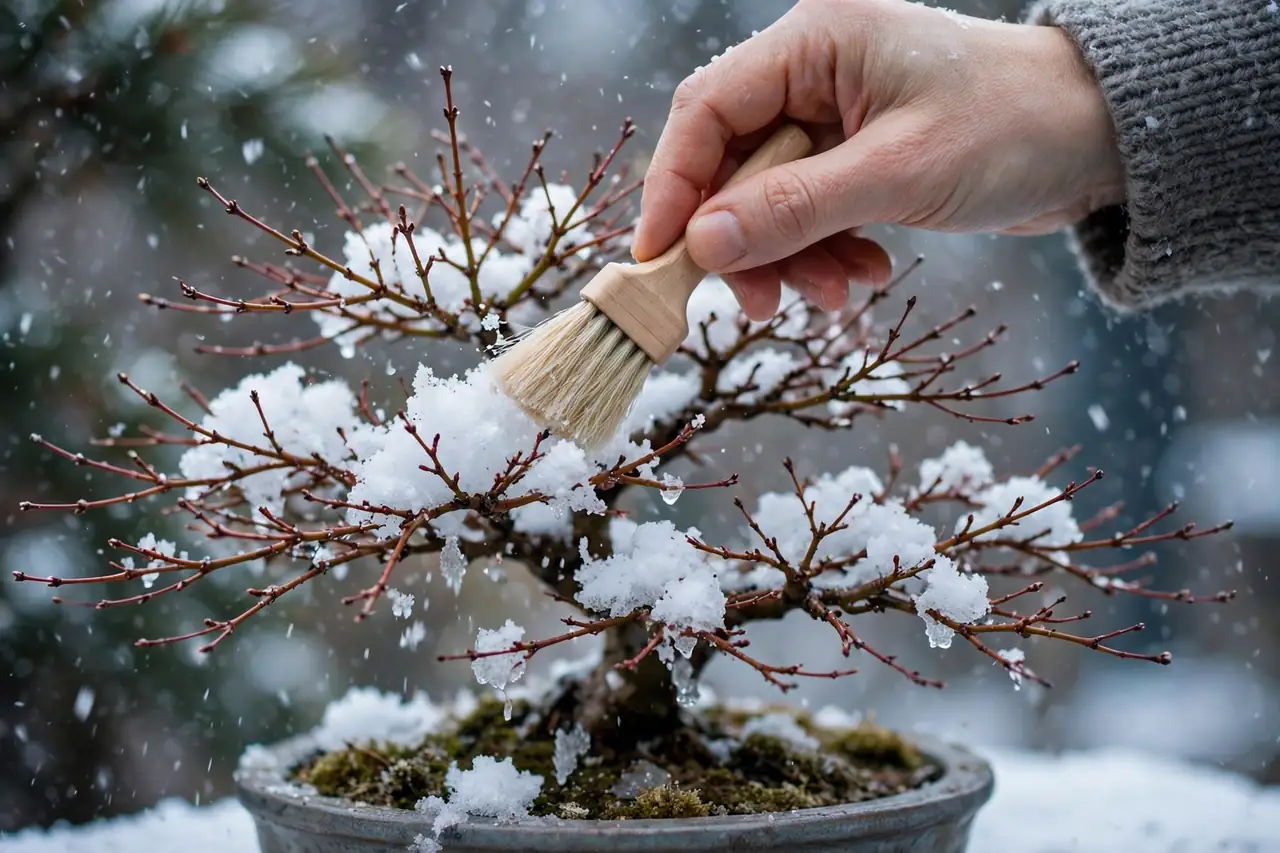
Brush, never shake
Brush bulk snow from beneath branches, again working away from the trunk. Never shake branches. Frozen twigs are fragile and will snap if shaken.
Clear in stages
Throughout an extended period of snowfall, do not await cessation of the snowfall. Remove snow from a tree when it is a couple of inches deep and then again as it builds up. Better still, remove snow in two lighter sessions rather than in one heavy one.
Leave ice alone
Should branches be frosted with ice having experienced freezing rain, do not attempt to remove this. As mentioned, ice cannot be brushed from branches. Moreover, detaching ice will also damage bark and twigs. Instead, allow it to melt. Ideally, on a mild day.
Between Storms: The Freeze-Thaw Checks
Whilst there are no obvious signs of activity between storms, Japanese maple bonsai snow protection predominantly involves monitoring for the results of a freeze-thaw cycle.
Meltwater must drain
On a mild day, check that water is draining from a container. Inspect underneath it and look for a damp area. Should a container be placed in water then its drainage holes will become sealed by ice when temperatures again fall.
Soil heave
Following numerous freeze-thaw cycles, examine the soil. Should it have risen and cracked then heave has occurred. Manually re-depress the soil but only when it is still thawed. Do not re-pot as a heaved tree is stressed. Corrective re-potting is detailed in the repotting guide.
The monthly soil check
On a mild day, each month monitor soil in the same manner outlined in the winter care guide; that is, by inserting a finger into the soil towards the edge of a container. Should the soil be cold and damp then leave it. However, if it is arid then add a little water.
After the Last Thaw: What to Look For
Stroll around a tree slowly following the final snow removal.
Bent and cracked branches
Identify any branches which continue to sag and twigs which have cracked at branch points. Depending on the branch, it may take a season for it to recuperate. Indeed, a twig is dead past its crack. Trim this in spring (see the pruning guide for further details).
Cracked pots
Carefully trace round a container to detect fine cracks. Particular attention should be paid to areas around the rim and base. A minor immobile crack can be ignored until spring. Yet, should a container be disintegrating then carefully re-site the rootball into a marginally larger container. Information on which containers are most suitable for enduring cold can be found in the pot guide.
Bark and buds
Investigate a tree’s bark for any openings which have formed over winter. And also assess buds. Record the location of any bark fissures and then leave them undisturbed until the tree resumes growth. Bulging buds indicate that a tree has survived. For information regarding action to take at this stage, see the spring care guide.
A Wet Snowfall and a Dry One
Although two maple bonsais were displayed on the same bench and during the same winter, their December experiences were wholly different.
During the first winter, there had been a wet snowfall. Large wet snowflakes fell all day at 31°F. By the evening, branches were sagging. The owner then removed the bulk snow from the tree, initially from the upper branches. No harm was done to the tree.
In contrast, during the second winter, there had been a dry snowfall. Light dry snow swirled in the wind at 18°F. As this was left undisturbed, it functioned as a blanket for the containers and so provided good soil insulation. Again, no harm was done to the tree.
It was simply a case of recognising the type of snowfall and then deciding whether or not to brush a tree.
Snow Protection Mistakes to Avoid
Shaking branches to remove snow. As a twig is fragile when frozen, it will snap if shaken.
Keeping a container on a bench throughout winter. As mentioned, a bench will uniformly freeze a container. Prior to the initial snowfall, a container should be positioned on the ground.
Neglecting to recognise roof snow. As roof snow can fall all at once, it can exert significant pressure on a small tree and cause it to snap. Never site a bonsai under a roof edge.
Attempting to remove ice from branches. Since ice sticks to bark, removing it will also damage bark and twigs. Allow ice to melt naturally.
Watering when it is freezing. Should water be added to frozen soil then it is unable to penetrate. Only water on days when temperatures are above freezing.
Snow Protection Not Improving? Check This
Sagging branches
Excessive weight of snow had been placed upon branches. Remove the snow from beneath branches and allow branches to self-recover. Do not manually re-position them.
Cracked container
As previously explained, soil water had frozen and expanded. Should a container still remain intact then postpone re-potting until spring. But should a container be deteriorating then carefully transfer a tree’s rootball into a marginally bigger container.
Heaved soil
As explained above, this was caused by numerous freeze-thaw cycles. Again as above, manually depress heaved soil but only when it is still thawed.
Cracked bark
As mentioned, note where this has occurred and then leave it undisturbed until the tree recommences growth in spring. At this point, the extent of the damage can be assessed.
No bud bulging in spring
Buds may have been harmed by ice or a deep freeze. Therefore, do not attempt to evaluate them until the foliage around them has unfolded.
What Growers Ask About Snow Protection
Do I need to remove snow from my Japanese maple bonsai?
Yes, but only remove bulk, wet snow. Again, brush this from beneath branches. Leave light dry snow and container snow as they provide good insulation. Essentially, this is the essence of Japanese maple bonsai snow protection.
Can I leave my bonsai outside in heavy snow?
Yes. Provided that a container is on the ground and that bulk, wet snow is removed from branches as it falls. Although a dormant maple is well able to endure cold, it is in fact the weight of the snow and the freeze-thaw process which are of concern – not the cold per se.
Which winter conditions are most harmful to maple bonsais?
Freezing rain. All twigs become sheathed in non-removable ice. Further, branch bowing and snapping can occur as a result of the ice’s weight. Although snow can be removed, ice must be allowed to melt naturally.
Does snow offer good container insulation?
Yes. Container snow is good insulation for soil. It also protects soil from the wind and reduces its rate of freezing. Therefore, leave container snow undisturbed. But do remove bulk, wet snow from branches.
Conclusion
Whilst Japanese maple bonsai snow protection is not concerned with heating a tree, it does involve reducing branch weight, maintaining even container temperature and ensuring good water drainage. Remove bulk, wet snow. Ignore light dry snow and ice. And between storms monitor a tree. Maple is well adapted to winter.
Sources
Trusted reference guides for further reading: