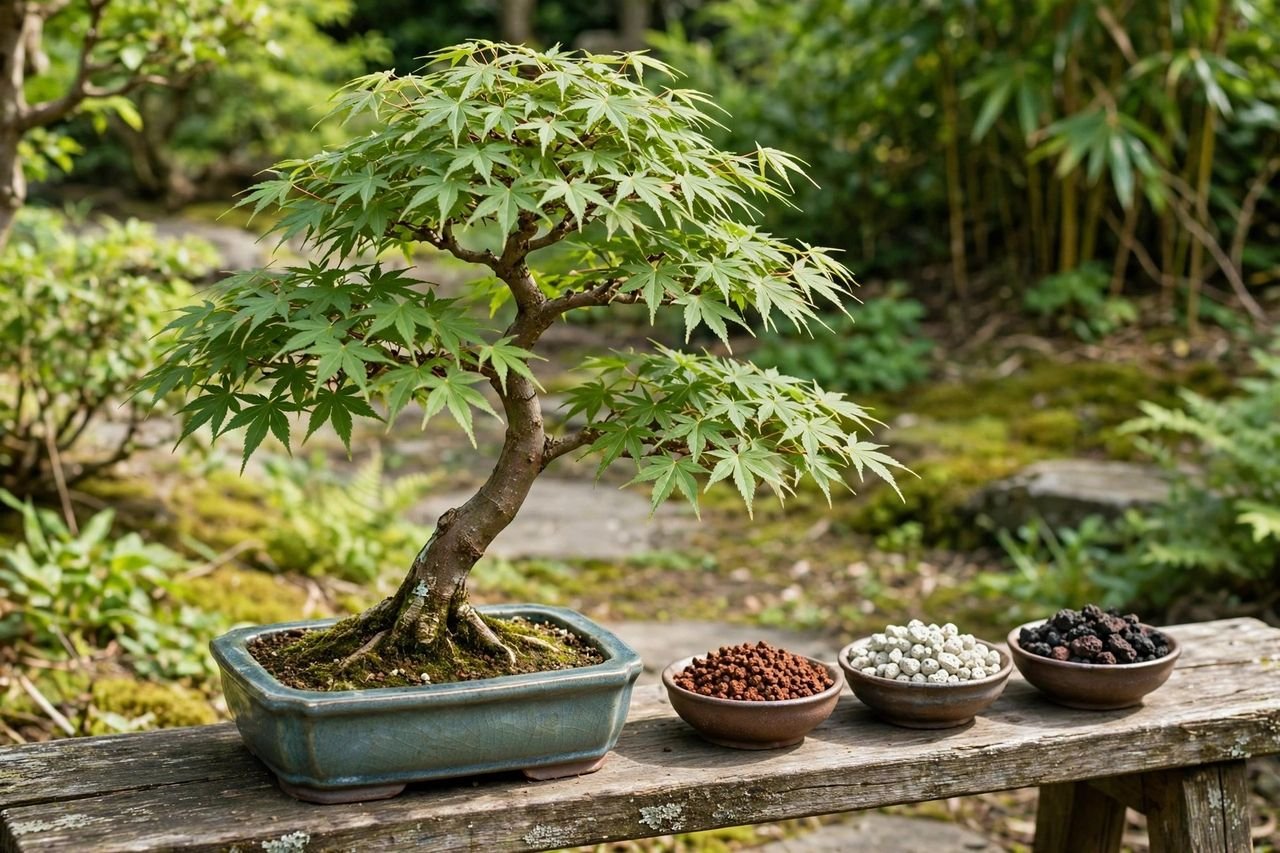
A Japanese maple bonsai may look perfect during the spring but can cause problems by mid summer. This is often due to the soil in the pot being of poor quality (holding too much moisture, drying too quickly or becoming a compacted layer with little air movement for the roots).
Soil, in Short
The best soil for Japanese maple bonsai is a free draining granular mix of akadama, pumice and lava rock. A popular mix is 2 parts akadama, 1 part pumice and 1 part lava rock. Water should run through the pot quickly, ideally within a few seconds. The soil should remain slightly moist between waterings. This mix should remain free draining for 2-3 years until the next repot. However, if the bonsai is in a hot, windy area and in a shallow pot, it will need a more moisture retaining mix.
What Good Bonsai Soil Has to Do
When grown in the ground a Japanese maple will have a large amount of soil to buffer the moisture and temperature. In a pot, the amount of soil is very small so good bonsai soil for Acer palmatum bonsai will need to be free draining to allow water to pass through and air to get trapped between the particles. It needs to retain some moisture as maples don’t like to dry out completely. The mix should remain free draining so the particles don’t break down. Finally, it needs to provide a stable base for the tree.
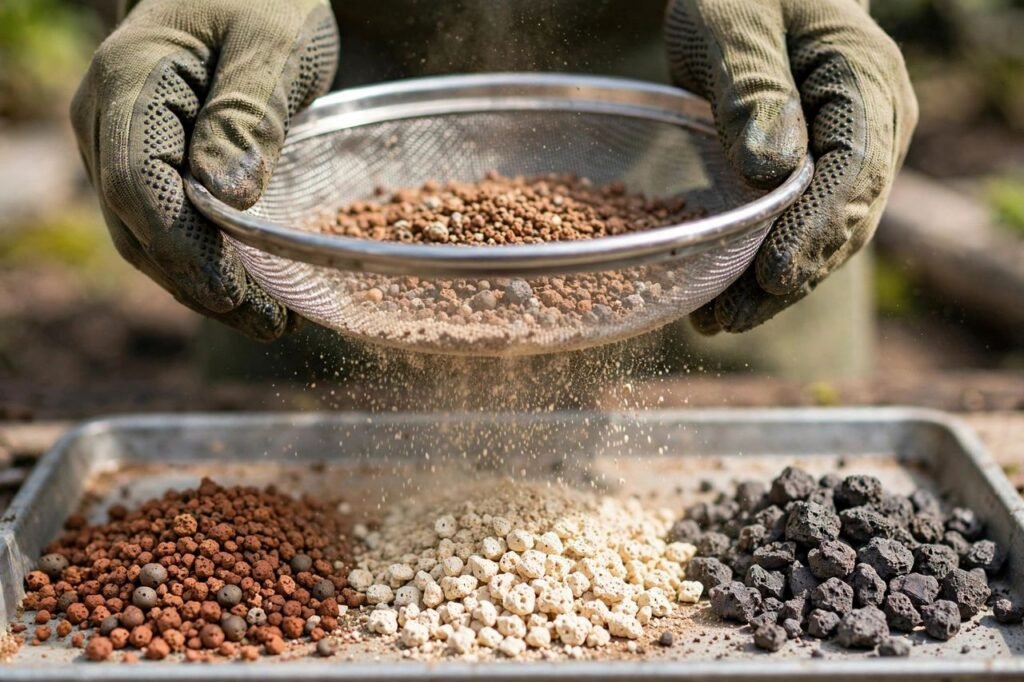
A granular mix of the best soil for Japanese maple bonsai will not contain much nutrients. This is fine as the tree will be fed during the growing season. The size of the particles is also important. The granules should be around 2-6mm in size so they retain some moisture but still have air pockets. Before mixing the particles should be sieved.
The Main Components
Akadama: the moisture holder
This is a granular clay from Japan. Each granule will retain water and release it slowly. This means the mix will remain evenly moist. The downside to this is that over 2-3 years the granules will break down due to watering and pressure from the roots. This will reduce the drainage and cause the centre to remain moist while the top looks dry. This is why it should be mixed with harder ingredients.
Pumice: the steady aerator
This is a light porous volcanic rock. It will retain some moisture in the air pockets but is mainly used to provide structure. It will not break down and will remain free draining. This is widely available in the US.
Lava rock: the drainage backbone
This is a rough hard volcanic rock. It will not retain much moisture and will provide great drainage. It will add weight and stability to the mix. It will remain free draining and provide a firm base for the roots. This should not be used on its own as it will dry out too quickly. This is used to balance the moisture retaining ingredients.
Practical Starting Mixes
The classic mix for deciduous bonsai, and the best soil for Japanese maple bonsai, is 2 parts akadama, 1 part pumice, 1 part lava rock. Bonsai Empire suggest a well drained mix using akadama, pumice and lava rock. The 2:1:1 ratio is the most popular starting point to give a healthy tree in a temperate climate.
Tweak the mix. If the bonsai is in a hot, dry or windy area, or a very shallow pot, you may want to try 3 parts akadama with 1 part pumice and lava. Monitor the tree over a hot week.
If the tree is in a cool, humid or rainy area or a deep pot, try 1 part of each ingredient. Don’t water on a schedule. Young trees often do better in a more free draining, coarse mix. However, if the tree is more refined and in a small display pot, you may want to use a finer mix which will retain slightly more moisture. However, check the soil at the next repot as it is most at risk of breaking down.
Mixing Your Soil, Step by Step
Mix outside and wear a face mask if sieving a large amount of the best soil for Japanese maple bonsai.
Measure the ingredients using volume. Use a spoon or measuring jug as they will vary greatly in weight.
Sieve each ingredient using a mesh around 2-3mm to remove dust and 6mm to remove large particles. Use the middle portion.
Mix the ingredients together dry. Mix well in a bucket to ensure the colours are evenly spread. If half the mix is akadama in one corner it won’t water evenly.
Add a little moisture.
How to Test Drainage
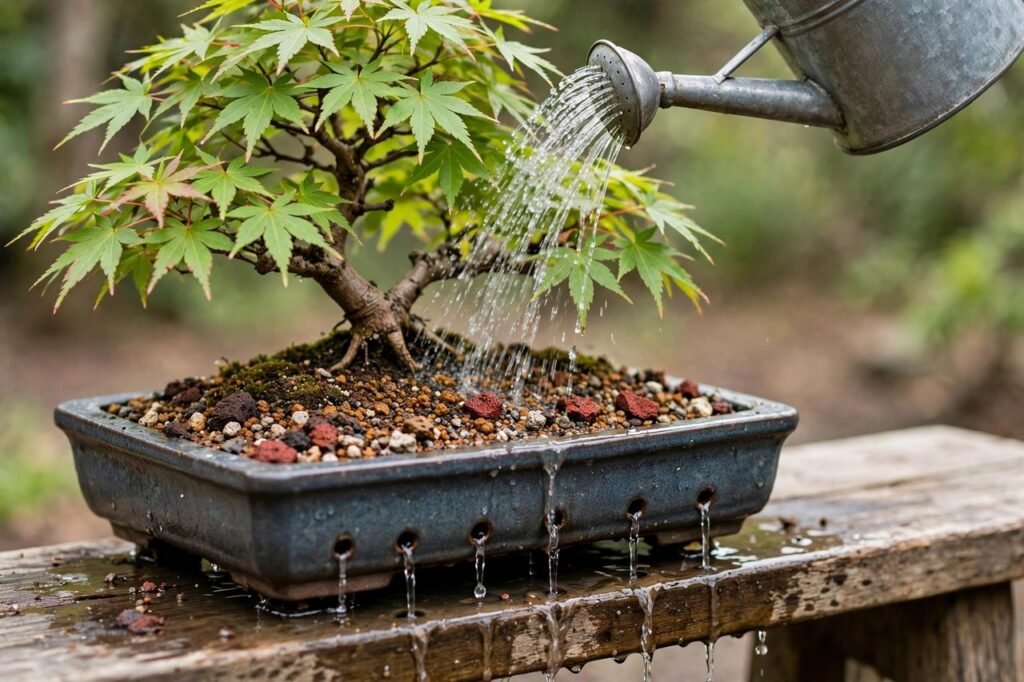
Pot the tree and water well using a fine rose. Water should come out of the drainage holes within a few seconds. If there is pooling on the surface or it takes a while to come out, the mix is too fine and dusty. If it is draining very quickly and the top is drying out within minutes on a mild day, the mix could be too coarse.
The next morning, push your finger into the mix around 1cm. It should feel cool and slightly moist. In the Summer the best soil for Japanese maple bonsai will usually require checking daily and sometimes watering daily. The tree will be in full leaf and the pot will be small.
Adjusting for Climate, Pot, and Tree
Always take local advice. If it is hot and windy, it can dry out a shallow pot in a day. To help prevent this, use a more moisture retaining mix, a slightly deeper pot, a surface dressing of fine akadama and put in some shade in the afternoon. This will help more than just one change. If it is cool and wet, a moisture retaining mix will be a disadvantage if it rains for a week. Use more lava rock and pumice. Keep the drainage holes clear and lift the pot slightly.
Depth and type of pot are also important. Shallow pots will dry out quicker. Deeper pots will retain moisture in the bottom.
A Soil Mix in Practice
A grower in a hot dry part of the US may pot their maple in Spring using a 2:1:1 mix of the best soil for Japanese maple bonsai in a shallow pot on a sunny bench. By July the leaves will be burning in the afternoon and the soil will be dry by midday. This isn’t a problem with the mix, it is a problem with the location and pot. To solve this issue, move the tree to morning sun and afternoon shade. Add a little more akadama next time you repot and check the soil in the afternoon. This isn’t a personal story but an example to show that the mix needs to suit the location, pot and tree.
Soil Mix Mistakes to Avoid
Using regular potting soil or garden soil. Potting soil in bags are designed to retain moisture in a large container. In a shallow bonsai pot this will cause it to pack down and retain too much moisture. There won’t be enough air for the roots.
Not sieving. Many drainage issues can be caused by dust. Fresh akadama, pumice and lava rock will all have fine particles which will clog up the air pockets. Sieving will take a few minutes per batch. If there is pooling on a newly potted tree it is likely to be due to dust.
Using only akadama. Pure akadama will retain moisture beautifully but will break down and create a dense moist layer. Adding pumice and lava rock will slow this down. If the tree is young, it will be repotted every 2-3 years so the mix will be changed. If the old soil falls apart in your hands it was past its time.
Judging by the top. The top 1cm will dry out first. To check how the soil is, push your finger or a wooden chopstick into the soil near the edge of the pot. If it is dark and moist, don’t water. If it is pale and dry, water.
Soil Problems? Start Here
If the leaves are burning in the summer and you are regularly watering, check the soil. Water well and check after an hour. Check again the next morning. If the top is moist but the centre is dry, the water is running down the sides of the compacted root ball. To solve this, repot into a fresh sieved mix of the best soil for Japanese maple bonsai at the correct time of year.
If the leaves are turning yellow and the tree isn’t growing, but the soil remains moist for days, the mix is too dense for the conditions. Reduce watering, keep the drainage holes clear, lift the pot slightly to allow air flow and plan to repot into a more free draining mix. Don’t feed the tree if it is struggling with moist soil. Fertiliser won’t help if there isn’t any air for the roots.
If the tree is drying out within hours of watering in normal conditions, the mix may be too coarse, the pot too small or the roots have filled the pot and pushed the soil out. If you think the roots are rotting (dark and squishy, smelly) check them when you repot. Remove any clearly dead roots using clean tools. Repot into fresh soil. If the dieback is bad or happening quickly consult your local bonsai nursery or extension service.
Soil Questions, Answered
What is the best soil for Japanese maple bonsai?
The best soil for Japanese maple bonsai is a free draining granular mix of akadama, pumice and lava rock. A popular mix is 2 parts akadama, 1 part pumice, 1 part lava rock. Adjust depending on the climate and pot. More akadama in hot dry climates, more pumice and lava rock in cool wet climates.
Can I use regular potting soil?
No, it is not a good option for long term growth. It will retain too much moisture in a shallow pot and will pack down over time. There won’t be enough air for the roots.
How often should I change the soil?
Most Japanese maple bonsai will be repotted every 2-3 years when young. Once established they won’t be repotted as often. Usually in late winter/early spring before the buds open. Repot when the mix has broken down, the roots have filled the pot or drainage has got worse.
Does the pH of the soil matter?
In general yes. Acer palmatum prefers a neutral to slightly acidic medium. Around pH 5.5-6.5. They don’t like very alkaline, calcareous conditions. A standard akadama based mix will usually be in the correct range.
Conclusion
That mix is the heart of the best soil for Japanese maple bonsai.
Your Japanese maple bonsai will thrive on good quality soil. This should be a free draining mix of akadama, pumice and lava rock with a slightly acidic pH. The exact ratio isn’t important. Just ensure it is a free draining but fine mix. You should repot every couple of years to keep the soil fresh. Using the right soil mix will make watering, feeding and pruning easier. Try using the mix provided in this guide and observe how your tree reacts over the course of a season. Adjust one part of the soil mix at a time.
Read the beginners care guide for light, pruning and repotting. Read the watering guide.
Sources
Trusted reference guides for further reading: