
Whilst your tree may look healthy from a distance, the large outer leaves can hide all of the inner growth and the lower branches will be bare. Japanese Maple Bonsai defoliation is the practice of cutting the leaves off intentionally to cause your tree to produce a second flush of smaller leaves. However, if done on a tree that isn’t suitable for this it can cause real damage.
Defoliation, in Short
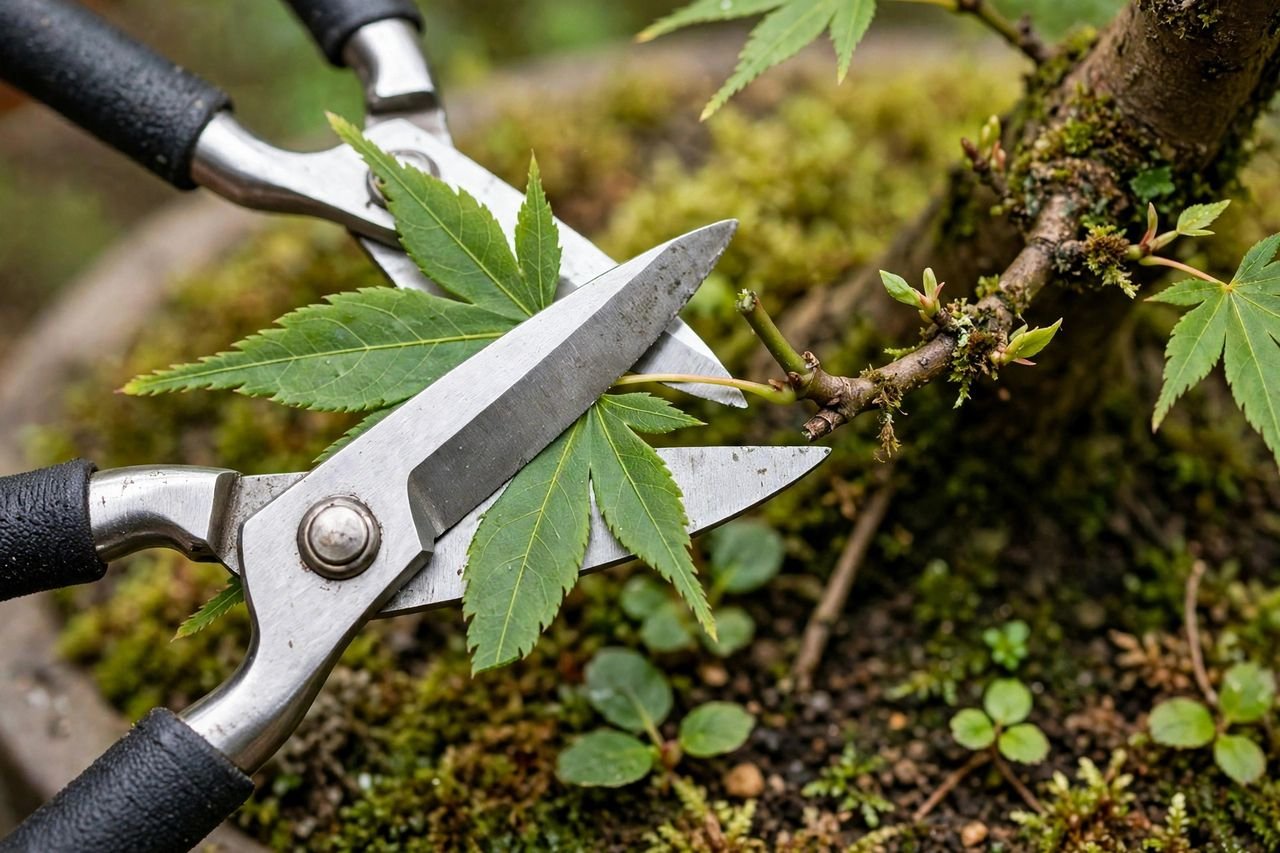
Wait until your spring leaves have hardened in early summer and use sharp scissors to snip off the leaves. This means you are cutting the leaf blade off but leaving the short leaf stem. You can do this partially by cutting one leaf from each pair or just the largest outer leaves. Only do a complete defoliation if you have a strong mature tree. This should only be done every couple of years. Never do a Japanese maple bonsai defoliation on a weak, sick, newly potted or growing tree.
What Defoliation Is — and Is Not
Japanese maple bonsai defoliation is the intentional cutting off of leaves during the growing season. This causes your tree to produce new buds as it doesn’t have any leaves. Usually the new leaves will be smaller and further apart. Bonsai Empire describes it as a way to balance out the strength of your tree. You can defoliate the top part (which is strong) and leave the bottom part (which is weak).
It is not a quick fix. It won’t thicken your trunk, create new branches or permanently reduce the size of your leaves. The leaves you cut will stop feeding your tree, so the new flush will be coming from your trees stored energy. If done on the right tree it will reduce the size of your leaves for a season and create a more balanced canopy. However, if done on a struggling tree it will just remove the leaves that are keeping it alive.
The second flush will happen because the buds are already present. When you cut off a leaf it will cause the bud at the base of the leaf stem to wake up and produce a new shoot. Because your tree is using it’s stored energy the new leaves will be smaller and closer together. Give your tree a couple of weeks to open up and harden.
Partial or Full: Which One Fits Your Tree
Usually partial.
Partial defoliation
Partial means you will be cutting some of the leaves. This means cutting one leaf from each pair on the strong parts of your tree. Maples produce leaves in opposite pairs. You could also cut the largest outer leaves. The leaves you leave will act as a ‘sugar sucker’ meaning your branch will still be fed whilst the rest grows back. This is the safest option to do and the only sensible option for a first time Japanese maple bonsai defoliation.
Full defoliation
Complete means you will be cutting all of the leaves. This will cause the most dramatic effect, as your whole canopy will be producing new small leaves. This is the most stressful to do so should only be done on a strong mature tree with standard sized leaves. The Virginia Bonsai Society suggest you should only completely defoliate your tree once every couple of years. Do this in early summer on healthy trees.
Never do it on a weak tree or a newly potted tree. Many growers will only partially defoliate an Acer Palmatum. If you do one flush a year there won’t be much recovery time if the summer is hot and dry.
Is Your Tree Ready? The Health Check
Before you do any cutting ask yourself these questions. If any of them are answered with a no then don’t defoliate this year. Your tree will still be there next year. A ready tree will have produced strong growth in spring and will still have leaves on well into summer. They will not have any burnt edges, wilting or pest damage.
Strong growth in spring is easy to spot. Your tree will have long even shoots, fully opened leaves which are firm and shiny. There won’t be any die back on the tips of your shoots. There should still be small buds on the inside of your tree. These will be the buds that produce the second flush. If your tree hasn’t grown much in spring, has patchy growth or has burnt edges then your tree has used all it’s energy to survive.
Your tree hasn’t been potted this spring, hasn’t had any major branch removal this year and isn’t recovering from any diseases, drought or harsh winter. Your tree will have a set trunk and main branches. It will have been well fed and watered throughout spring (as described in the care guide). If you’re unsure, half defoliate your tree and see how it reacts.
When to Defoliate
Defoliate in early summer once your spring leaves have fully matured. For most of the US this will be June. Bonsai Empire suggests June is the best month to defoliate most species. This leaves enough time for new leaves to grow, mature and prepare for winter.
If you defoliate too early you will be wasting your first flush. If you defoliate too late your new leaves won’t have enough time to mature. Don’t defoliate your tree if it has been potted, heavily pruned, wired tightly, suffered from drought, heat or pests this year. Also don’t defoliate the year after a complete defoliation.
The exact week will depend on where you live. If you live in a cooler area such as the northern states your tree will have harder spring leaves later so you should do it in late June or early July. If you live in a hot area such as the southern states your tree will have harder leaves earlier so you may want to do it in late May or early June. It’s more important to look at the leaves than the calendar.
Hard leaves will feel firm and slightly shiny. Soft pale leaves will still be growing so shouldn’t be cut. You should also leave at least 6 weeks of warm weather for your new leaves to open and mature.
How to Defoliate, Step by Step
Do this on a cool morning with sharp clean scissors.
- Double check. Make sure your tree is ready (as above). Partially defoliate for a first time.
- Decide which leaves to leave. Weak branches and lower branches.
- Cut off the leaf blade. Snip just above the leaf stem. This will protect the bud at the base of the leaf stem and will fall off.
- Start with the stronger parts. Begin at the top and outer parts of your tree. Cut off the largest leaves first.
- Don’t cut too much. Your tree should still look like a leafy tree. Don’t cut more than half.
- Water, shade and watch. Water well and place in dappled shade. Watch for new buds. Usually your second flush will appear in 3-5 weeks.
Aftercare: The First Weeks After
Keep the soil evenly moist and shaded. Bonsai Empire suggest placing your partially defoliated tree in shade for about a month. This will protect the new inner leaves. Fully defoliated trees should also be shaded if there is very sunny weather. Don’t feed heavily until your new leaves have opened. This will cause long coarse growth. Don’t pot, wire or prune in the same season.
In hot weather water your tree a little every day. Your tree won’t have as many leaves to pull moisture through but your new buds will need a constant supply. Place your tree in dappled shade until your new leaves have opened and matured (usually 4-6 weeks). Gradually move your tree back to it’s usual spot.
Why Defoliation Depends on Your Cultivar
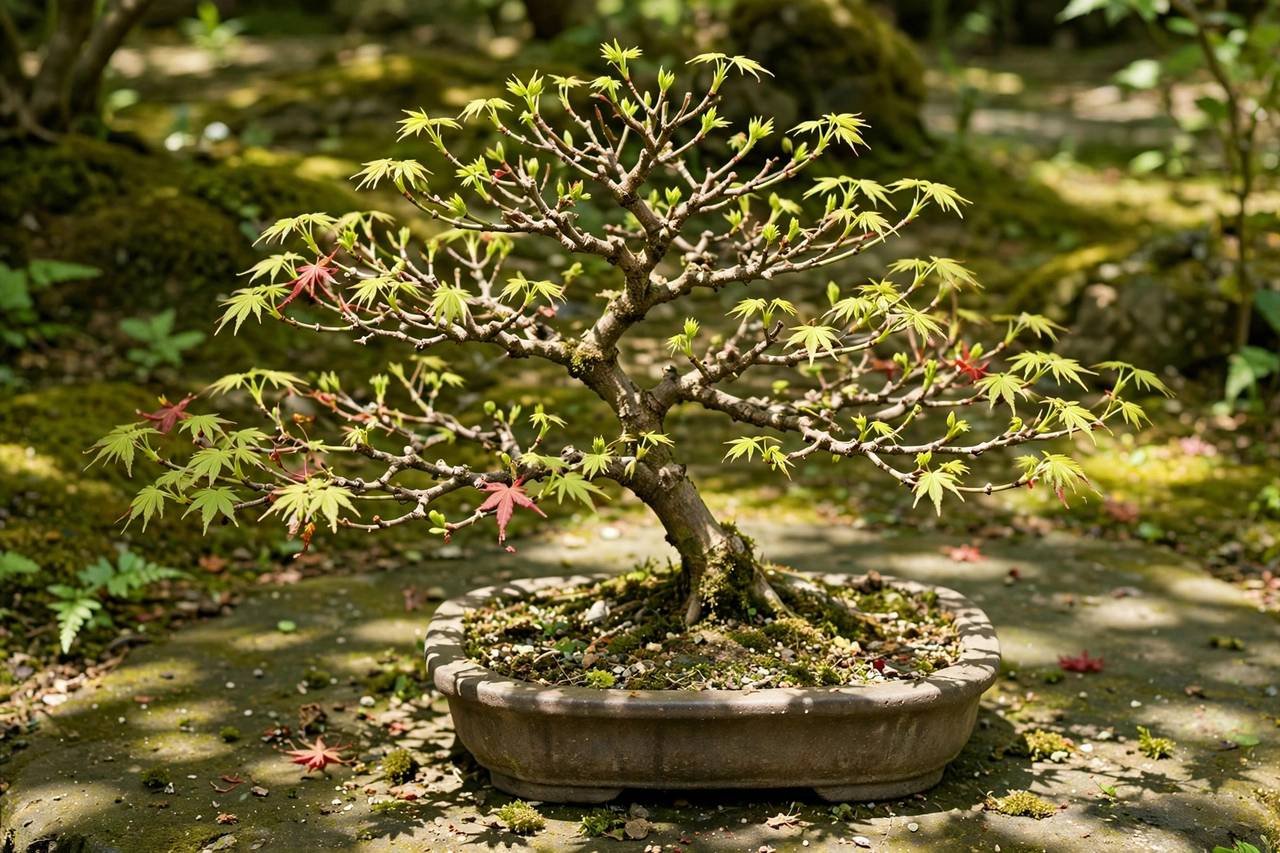
The plain green Acer palmatum is the maple most likely to forgive a hard year. They will grow strongly, back bud well and replace their leaves within weeks. Red cultivars should only be lightly defoliated or not at all. Shade them well after. Dissectum and variegated types have the least energy to spare so should only be partially defoliated.
If you live in a hot climate defoliate as soon as your spring leaves have hardened. Shade your tree during the hottest weeks. Don’t defoliate a young tree in a training pot. A mature tree in a small bonsai pot can be defoliated but gently. There is less root and less energy so should only be partially defoliated.
One Tree Defoliated, One Left Alone
This is just an example.
A strong tree has been partially defoliated. A grower has a 10 year old maple with a mature trunk and good branches. The top is coarse and the lower branches are thinning in the shade. In June the grower cuts one leaf from each pair on the top third. She also cuts the largest outer leaves. The lower branches are left fully leafed. By Autumn her canopy is more balanced.
Mistakes That Make Defoliation Worse
Japanese maple bonsai defoliation on a growing tree. If your tree needs a thicker trunk then it will need the leaves to do this. Grow your tree first then refine (see ramification guide).
Cutting all the leaves off. Full Japanese maple bonsai defoliation is the most extreme form of this technique. Start with a partial defoliation and learn how your tree reacts.
Pulling the leaves off. This will damage the bud at the base of the leaf stem. Always cut the leaf blade off.
Japanese maple bonsai defoliation in the same year as potting or heavy pruning. Both are a big stress on your tree. Spread the work out over a couple of years. Check the timing of your pruning (see guide).
Still Stuck on Defoliation?
No new leaves after a month. Your tree wasn’t as strong as you thought or the summer was too hot. Keep watering and shading.
New leaves the same size. This is normal for a strong well fed tree. Japanese maple bonsai defoliation will only cause one flush of smaller leaves.
Inner twigs dying. You have opened up your canopy too quickly or left your tree in full sun. Shade your tree after defoliation. Next time thin your tree gradually.
New leaves burning/wilting. Your inner leaves have been shaded all summer and your new growth will be delicate. Move your tree to a darker spot. Keep the soil moist. Leave the burnt leaves on.
Before You Cut: A Quick Checklist
- Mature tree (trunk and main branches set).
- Healthy tree (strong growth in spring, no pests or burning).
- Not potted, heavily pruned or wired this year.
- Spring leaves fully matured (early summer).
- Partially defoliate (one leaf from each pair).
- Use sharp scissors.
- Cut leaf blade off.
- Shade and keep moist for a couple of weeks.
Defoliation Questions, Answered
How long until new leaves grow?
Usually 3-5 weeks. A couple more until they open and mature. If there hasn’t been any new growth after a month leave it to recover.
Can I defoliate my Japanese Maple every year?
Yes you can but you shouldn’t need to. A maximum of every couple of years for a complete Japanese maple bonsai defoliation. Partial defoliation every other year is more than enough. Japanese maple bonsai defoliation every year will make your tree weaker.
Will my leaves stay smaller?
No. You will get a smaller flush but the following spring your leaves will be the usual size. To permanently reduce your leaves you will need to refine your tree over a long period of time. This is covered in full in the next article.
Conclusion
Defoliation is a refinement technique. If done on a strong mature maple in early summer it can cause your leaves to be smaller, more light in the centre and a more balanced canopy for a season. If done on a weak, young or worked tree it will just remove the leaves that are keeping your tree alive. Be honest with yourself and start with a partial defoliation. Shade your tree. Japanese Maple Bonsai defoliation is a technique that requires patience. The trees that need it the least will cope with it the best.
Sources
Trusted reference guides for further reading: