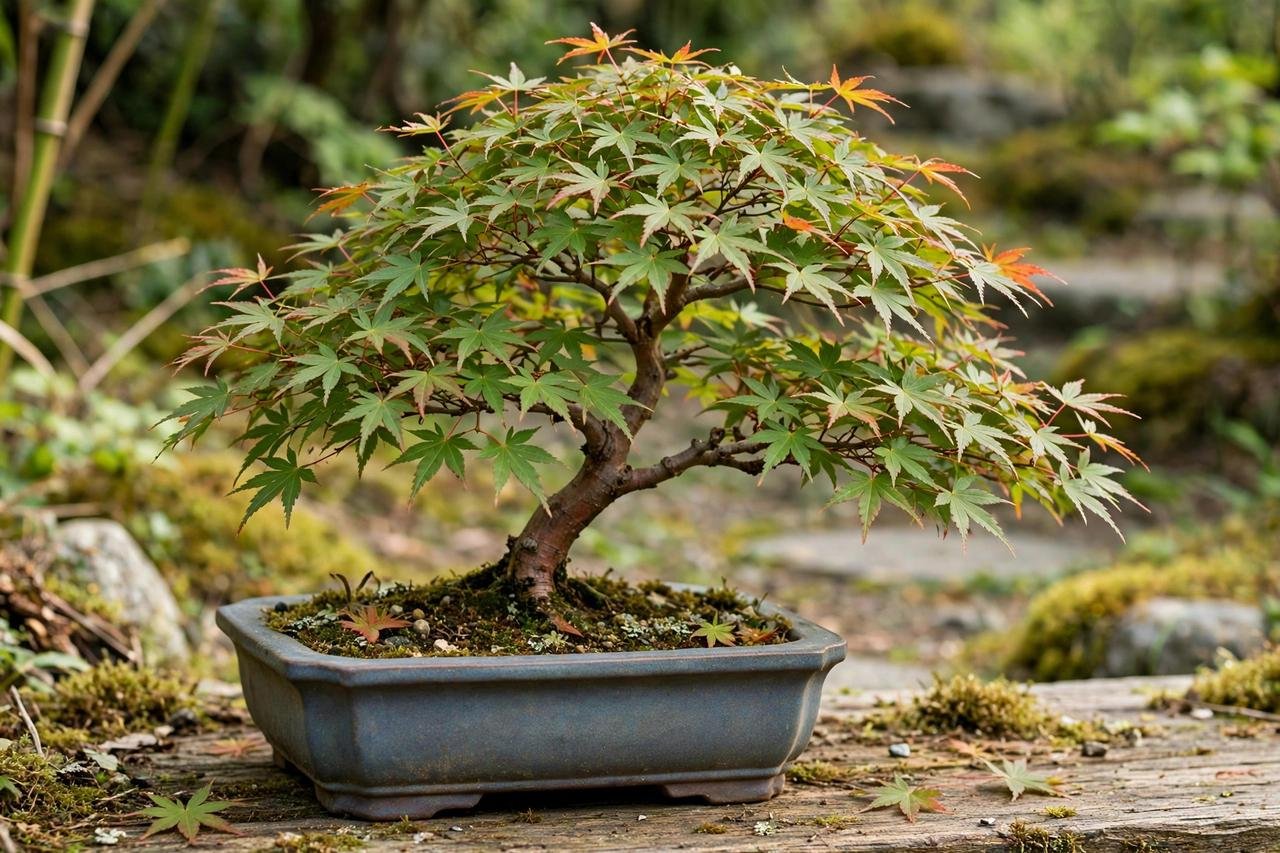
You have nice branch structure but the leaves are quite large. Unfortunately there is no quick fix to this problem. This will take some time and patience to achieve.
The Short Answer on Leaf Size
Getting smaller leaves on your Japanese maple bonsai requires 4 things — the short answer to ‘reduce leaf size Japanese maple bonsai’. Choose a small leaved variety, provide bright light, feed sparingly and pinch back regularly. Defoliation can be used to get one flush of smaller leaves on a strong, mature tree but this is just a final step. It will take a couple of seasons to get noticeable smaller leaves.
What Decides How Big a Leaf Grows
A combination of variety and leaf requirement.
Cultivar and genetics
Genetics will determine the maximum you can achieve. Whilst you can achieve a lot with a standard green Acer palmatum you will always get larger leaves from a large leaved variety such as ‘Bloodgood’. Dwarf varieties like ‘Kiyohime’ or ‘Shishigashira’ will always have small leaves as they start with small leaves. If you are buying a tree to refine then you want to choose a variety that will help you. If you already have a large leaved tree then be realistic and aim for smaller leaves.
Vigour and branch fineness
A vigorous tree will produce large leaves on long shoots. A refined tree will have smaller leaves on short shoots as it has lots of energy to spread across hundreds of small twigs. The smaller the ramification the smaller the leaves. See our ramification guide for more information on why the ramification affects the leaf size. Coarse branches will produce large leaves.
Light, water and feeding
The most powerful thing you can do daily is provide bright light. Maples in bright light will produce smaller, tough leaves. If your maple is in shade it will produce large, thin leaves to try and catch as much light as possible. See our sunlight guide for more information. In hot climates provide morning sun and afternoon shade. If your maple is consistently moist it will grow consistently. If it dries out and gets flooded it will produce coarse growth. High nitrogen will produce large, soft leaves. Refined trees should be fed sparingly. See our fertilizer guide.
The Honest Limit: No Single Technique Works
There is no one trick to getting smaller leaves. Defoliation will only give you one flush of smaller leaves and then they will go back to normal size next spring. Pinching without providing the right amount of light and feeding will just give you a bushier tree with large leaves. Underfeeding will give you smaller leaves but will make your tree weak.
This why this question ‘reduce leaf size Japanese maple bonsai’ has a slow answer. Getting smaller leaves — ‘reduce leaf size Japanese maple bonsai’ — is a combination of choosing the right variety, providing bright light, feeding sparingly, pinching and taking your time. It will take a couple of seasons to see any difference.
A Six-Season Plan That Actually Works
Think about what you want to achieve over the seasons.
- Choose/accept your tree. If buying choose a small leaved variety. If you are refining your tree then compare to last year. Note how big your leaves are this spring.
- Provide bright light. Move your tree to the brightest spot it can handle. Only provide shade during the hottest part of the day. If your leaves are burning by July then it is too bright. If your shoots are long and thin then it is too dark.
- Feed sparingly. Once your tree has structure feed your tree. Feed your developing tree well but feed your refining tree sparingly and with low nitrogen. Stop feeding by late summer so your tree can harden off.
- Pinch throughout spring and summer. Pinch off the soft tip of your new shoots once the first pair of leaves have opened. This will encourage your tree to put energy into the side twigs. Pinch your strong shoots first.
- Prune back in dormancy. Prune back to leave 1-2 pairs of leaves. See our pruning guide. Remove any coarse shoots. Don’t prune back your weak shoots so they can strengthen over the winter.
- Evaluate. Take a photo of your tree every year. If your leaves are smaller and your twigs are finer then continue. Compare the same branch every year.
Pinching and Pruning Back
Pinching is an everyday task. Pinch off the soft tip between the first pair of leaves once they have opened. This will weaken your tree in the long run so use this technique wisely. Pinch your strong areas but leave your weak shoots.
If your tree is still developing then don’t pinch early, wait until your shoot has grown to 4-6 pairs and pinch back. If you are refining your tree then pinch early. Prune back your long shoots to leave 1-2 pairs. This will encourage your buds to grow closer to the trunk so your shoots will be shorter and your leaves smaller. Don’t pinch any weak, sick or recently potted trees.

Light, Water and Feeding in Practice
Provide your tree with morning sun and bright, airy light. Move to dappled shade if it is over 85°F (30°C). See our care guide. If your tree is in deep shade it will always produce large leaves so make sure you aren’t getting the wrong leaves due to the variety. Water consistently and don’t let your tree dry out completely.
If your tree is drying out and getting soaked it will produce large, soft leaves. Feed your refining tree with a balanced or low nitrogen feed. Don’t feed your developing tree heavily. Bonsai Empire advise to avoid high nitrogen fertilisers to prevent unnecessary large leaves and internodes. A small pot will help slightly but won’t get smaller leaves.

Feed your tree sparingly. Feed your refining tree lightly with a low nitrogen feed in early spring. Feed your tree little and often throughout summer using half strength feed. Stop feeding by late summer. Feeding late will produce soft growth that doesn’t have time to harden.
How Your Cultivar Changes the Leaf Size Advice
The plain green Acer palmatum is the most tolerant maple you can grow. It will grow vigorously and respond well to pinching within a season. Red varieties need to be treated more gently and provided with good shade after working on the leaves. Dissectum and variegated have the least energy to spare so pinch gently or not at all.
In a hot climate provide morning sun and shade during the hottest weeks. Don’t judge your leaves during midsummer as they may be smaller due to the heat. In a training pot your tree is still young so don’t refine for smaller leaves. It needs large leaves to thicken the trunk. A mature tree in a small pot is a good choice. It will have the structure and energy to cope.
Your pot will also affect how small your leaves can get. A maple in a small pot will grow slower than one in a large training pot. This is because it has less room for its roots to grow. This will produce smaller leaves. However this isn’t a method to get smaller leaves. If your tree doesn’t fit in the pot it will dry out and become weak. Root prune your tree when repotting every 2-3 years.
One Tree, Smaller Leaves
Strong tree that has been refined over 3 seasons. A grower has a 10 year old green maple but the leaves are twice the size they should be for the pot. She moves it to a brighter spot, feeds it sparingly and pinches her strong shoots over 2 summers. Prunes back to 1-2 pairs every winter. By the 3rd autumn her leaves are a third smaller and her twigs are double the density.
Large leaved variety. A grower has a ‘Bloodgood’ and wants half the size leaves. She moves it to morning sun, feeds it sparingly and pinches her strong shoots over 2 seasons. Her leaves are only a quarter smaller. She will keep it as it is only a quarter smaller and it is a healthy tree.
Leaf Size Mistakes to Avoid
Trying to refine leaves on a tree that still needs to be developed. If your tree needs a thicker trunk then it needs large leaves to do this. Develop first then refine. See our ramification guide.
Underfeeding. Underfeeding and reducing water will make your leaves smaller but will make your tree weak with thin twigs and no energy for winter. Small leaves on a weak tree is a sign something is wrong.
Pinching everything. Pinching your strong top and leaving your weak bottom branches will balance your tree. Pinching everything will mean your weak areas never catch up.
Defoliation. This will only give you one flush of smaller leaves. If you do this every year it will weaken your tree. The Cheshire Bonsai Society advise against full defoliation on Japanese maples. See our defoliation guide.
Leaf Size Not Improving? Check This
Leaves still large after pinching. Check your tree is in bright light. If it is in shade then it will continue to produce large leaves no matter how much you pinch. Check you are feeding it sparingly. High nitrogen will undo your pinching.
New leaves are smaller but then get large again. This is normal. Your second flush will be smaller but your leaves will get back to full size in spring. You will notice a change over the seasons with finer twigs.
Tree looks weak after refining. You have pinched too much and/or underfed. Don’t refine next year and feed normally.
Leaves are smaller but edges are burnt. Your tree is in too bright a spot for the amount you are feeding. Move to dappled shade in the afternoon. Water consistently and feed normally until colour returns.
Before You Start: A Quick Checklist
Structure complete. Trunk and main branches are set. Tree is healthy. Growing well in spring with no pests or burning. In a bright spot with morning sun and afternoon shade. Feeding plan in place. Strong shoots to pinch. Weak shoots left. Be patient and take 2-3 seasons.
What Growers Ask About Leaf Size
How long will it take to ‘reduce leaf size Japanese maple bonsai’?
You will notice a difference after 2-3 seasons of pinching consistently, providing bright light and feeding sparingly. After 1 season your twigs will be finer and your leaves will be smaller.
Can I get tiny leaves on a large leaved variety?
No. The variety will determine how small you can get. ‘Bloodgood’ will always have bolder leaves than a dwarf variety. You can get smaller leaves but you won’t be able to change one variety to another.
Will defoliation get me smaller leaves?
No. You will get a smaller second flush but your leaves will return to normal size next spring. To get a permanent change you will need to refine over several seasons.
Conclusion
Large leaves aren’t a mistake they are telling you how much energy your tree has and how many leaves it needs. If you have searched ‘reduce leaf size Japanese maple bonsai’ then the answer is a slow process. You need to choose the right variety, provide bright light, feed sparingly, pinch consistently and have fine twigs. This will take a couple of seasons to achieve. Choose a realistic target, pinch your strong shoots and compare to last year.
Sources
Trusted reference guides for further reading: