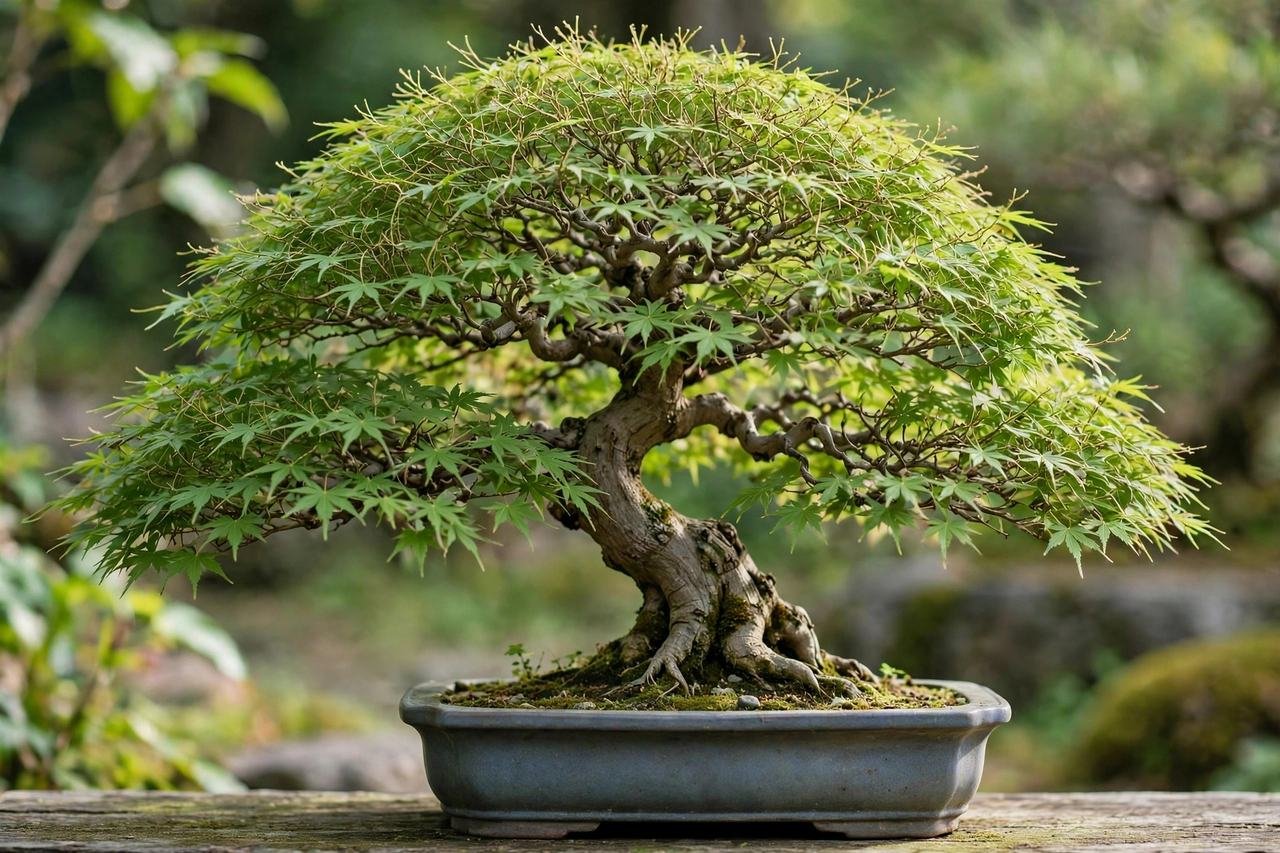
You can see that your maple has leaves but lacks ramification. The end of each branch is long and bare. Leaves only appear on the tip of each branch, creating a sort of umbrella effect. From a few feet away, your tree looks weak and unfinished.
What Matters Most for Ramification
Japanese maple bonsai ramification can be achieved by encouraging growth, pinching and pruning. In early spring, pinch your new shoots. This encourages the buds below to wake up and stop the shoot from growing. Allow the growth to set and prune your long shoots to one or two pairs of leaves. Ensure there is enough light coming into your canopy and don’t feed heavily until the first growth has set. By doing this every year, your ramification will become finer.
What Fine Ramification Actually Looks Like

The Winter Silhouette Test
During the winter, a well ramified maple will show off its ramification. You’ll see lots of fine twigs throughout the canopy. They will be denser on the edges but still allow light through. A poorly ramified maple will have a few long straight branches with bare stems.
How Density Builds, One Fork at a Time
Ramification is multiplication. Pinching or cutting the tip of a shoot will cause the two buds below to open. This will cause one shoot to turn into two. The following year will cause each of the two to turn into two. This makes 2 shoots into 4 and 4 shoots into 8. This will happen if your tree is strong enough to produce all of the shoots. Each fork will need a full growing season to set into wood.
Is Your Tree Ready for Refinement?
Structure First, Twigs Second
A tree with fine twigs should have a finished structure. If your trunk and main branches are still being developed, ramification will only slow your tree down. If your tree is still thickening its trunk, it needs to have long free growth. Pinch your branches once they’ve finished developing.
A Quick Health Check
Pinching and cutting can be stressful for your tree. Only refine a tree that is producing strong spring growth and keeping its leaves during the summer. If your tree has been repotted this spring or is weak after winter, leave it for a season. Allow it to have free growth and refine next year.
The Three Levers That Control Ramification
Light, Pinching and Feeding.
Light: The Engine
Fine twigs need light coming into the canopy. If a shoot is in shade, it will grow long to reach the light. This causes long internodes. Give your tree good light in spring and autumn. Try to avoid harsh midday sun. Remove one leaf from each pair to allow light into the centre.
Pinching: The Steering

Pinching is the smallest cut you can do and is the most important aspect of ramification. In early spring, remove the small shoot between the first pair of leaves using your fingers or tweezers. To fully ramify, remove the stipules and bud scales first then the centre leaf (Bonsai Station). Pinch before the leaves open. Once they open you won’t be able to shorten the shoot.
Feeding: The Throttle
The amount of food your tree gets will affect how hard it will grow. This causes long internodes. Don’t feed your tree whilst you are refining it. Once the first growth has set, feed with a balanced feed.
A Season of Ramification, Step by Step
Every year you will follow the same pattern.
- Early Spring – Pinch. Pinch your new shoots as the buds open.
- Late Spring – Growth and Pruning. Allow your shoots to grow to 4 or 5 pairs of leaves. Prune to 1 or 2 pairs.
- Early Summer – Light. If your tree is dark in the centre remove one leaf from each pair.
- Mid Summer – Leaf Pruning. Only if needed. If your canopy is still dense, half some of the leaves. Never remove all the leaves.
- Autumn – Refine the Silhouette. Once your leaves have fallen, prune any thick heavy shoots. Prune any overlong parts.
- Winter – Protection and Inspection. Fine twigs are the first to be affected by late frosts. Protect your tree from freezing winds.
Keeping Internodes Short
Why Internodes Stretch
An internode is the stem between two pairs of leaves. Short internodes give an aged look with lots of density. Long internodes give a young and coarse look. Internodes get long if your tree is stretching to reach light, getting heavy feeds in spring or if it is growing quickly to create wood.
What to Do With a Long Internode
Once an internode has got long, there is nothing you can do to shorten it. Pinching the tip won’t help and cutting above won’t help either. You need to remove the shoot and allow a shorter shoot to grow. Prune to lower buds or a short side shoot.
Cultivar, Climate and Pot: What Changes for Ramification
Cultivar and Leaf Size
Some cultivars will have an advantage. Kashima, Shishigashira, Kiyohime and Kotohime will have small leaves naturally. This means they will have short internodes and will be easier to ramify. Red leaved varieties will be weak growers and have less chlorophyll in their leaves. Be gentle with them.
Climate, Sun, and Wind
If your maple is in a hot and dry climate, it will be busy protecting its leaves during the summer. Give your tree morning sun and afternoon shade. Keep your tree well watered. If it is very cold in the winter, protect it from freezing winds. Late frosts can kill your finest twigs if they are below 14°F (-10°C).
Tree Age, Vigor, and Pot Size
A young tree in a large training pot will grow quickly and will be coarse. This is good for creating a structure but not good for fine twigs. A mature tree in a small bonsai pot will grow slowly. This causes short internodes.
Two Trees, Two Ramification Paths
Example 1 – Pinching Too Early. A grower had a 5 year old maple. They pinched all their shoots in spring to create density. This caused the tree to produce weak pale leaves. By mid summer the centre twigs had died back. The tree was still developing its secondary branches and pinching had stopped it from growing. The tree was allowed to have free growth for a year.
Example 2 – 3 Quiet Years. Another grower had a 12 year old maple in a shallow pot. Every spring they pinched, pruned and thinned their tree. Pinched in April, pruned in June and thinned in July. However by the third winter the silhouette had changed. The branches were now bare showing off a fine network of twigs. This is Japanese maple bonsai ramification. It is slow and boring but eventually becomes obvious.
The Usual Ramification Mistakes
Pinching a developing tree. Young trees need free growth. Pinching early will create a small weak tree.
Pinching too late. Once the leaves have opened the internode will have grown.
Cutting Everything. If you cut all your shoots back, your tree will use all its energy to replace the lost growth. Be selective with your pruning.
Dark Canopy. Fine twigs in the centre will die if they are in shade. Thin your leaves.
Sorting Out Ramification Problems
Your shoots are still growing long. Check the light and feeding. If your tree is in shade or is being heavily fed, it will grow long.
Centre twigs are dying. Your canopy is too dark in the centre. Thin one leaf from each pair. Prune your outer shoots.
One Side is Ramifying and the Other is Coarse. The strong side is using up all the energy. Pinch the strong side more and allow the weak side to grow.
A Ramification Checklist
- Finished Structure – Trunk, Primaries and Secondaries.
- Healthy Tree – Strong spring growth.
- Pinched in Early Spring – Before leaves open.
- Long shoots pruned to 1 or 2 pairs.
- Light in centre.
- Don’t feed until first growth has set.
- Checked silhouette in Autumn – Overlong parts pruned.
- Protected in Winter from freezing winds.
Asked About Ramification
How long does Japanese maple bonsai ramification take? Ramification takes years! Each fork needs a full growing season to set. This means it will take seasons to create fine branches from a coarse branch.
Can I pinch my maple in summer? You can prune your long shoots in summer but you can only pinch in early spring.
Will pinching make my leaves smaller? Yes. Short internodes and more twigs will make your leaves smaller.
Should I defoliate to create fine twigs? No. Don’t fully defoliate your Japanese maple. Thin your leaves.
Conclusion
Creating fine branches isn’t a trick. It takes many small decisions to be made at the correct time on a healthy tree. Pinch in April, prune in June, thin in July and leave it quiet in winter. Do this for a few years and your tree will become the aged maple you pictured.
Sources
Trusted reference guides for further reading: