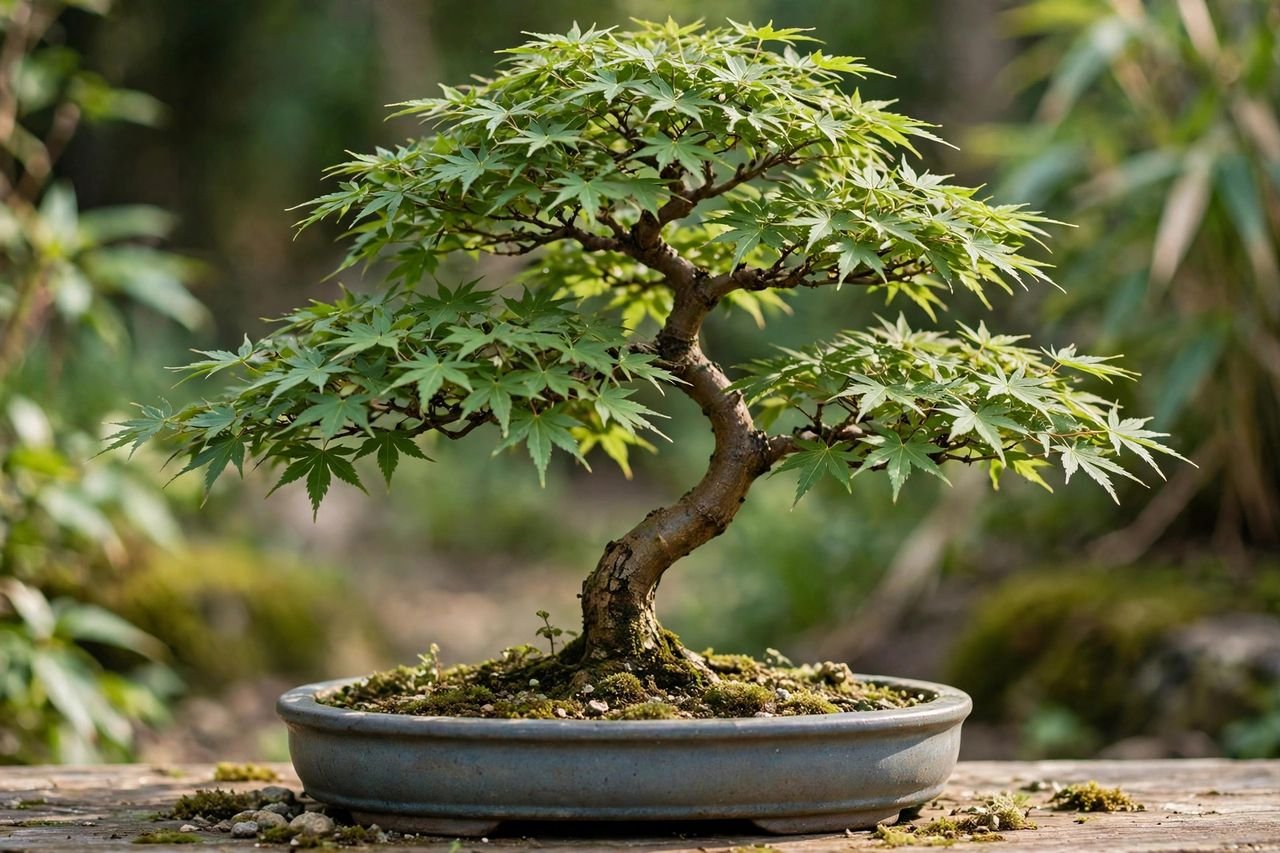
You have a nice trunk of maple and need to decide which Japanese maple bonsai styles you want to use. There are 12 different names in the books but in photos they all seem possible. However, if you are trying to decide which Japanese maple bonsai styles to do with your tree, start by reading your trunk.
Styles at a Glance
Most maples will be best suited to an informal upright. If you have a straight trunk with fine branching then a broom would be a good choice. If you have multiple trunks coming from the base then a multi-trunk or forest style would be good. The best choice is to match the Japanese maple bonsai styles to the flow of the trunk, branching and vigour of your tree.
How to Read Your Tree Before You Choose
Take your time to decide on Japanese maple bonsai styles. Look at your tree for a season before pruning.
Trunk movement
Slowly turn your tree to eye level and look at how the trunk flows. If the trunk has a gentle curve either one or two times and tapers then it will be an informal upright. If it is straight and tapers then it would be best suited to a broom. If it is leaning quite hard from the base then it could be a slanting style, however you need strong roots on the other side of the trunk. Don’t try to make a straight trunk into an S-shape with wiring as maple branches are very fragile and will snap.
Branch structure
Look at where your branches are coming off. Good branches will come off the outside of the curves. They will alternate on the trunk and get smaller and thinner towards the top. If your bottom branches are in good positions then half your job is done. The trunk and main branches are created first with the fine branches added after (see Branch Development Guide).
Cultivar, size and vigour
Your choice will depend on the type of maple. If it is a vigorous green Acer palmatum then it will be forgiving and most styles can be used. However if it is a dissectum or variegated type then it will be slow growing and doesn’t have much energy so a gentle informal upright would be best. Acer palmatum grows as a single or multi stemmed small tree with a layered appearance so it will naturally be a multi stemmed tree (NC State Extension).
Look at the roots. A good nebari (roots spreading evenly from the base) will help any style. However it is most important for a slanting tree as the roots on the other side need to be strong to support the tree. If the roots are one sided or buried then fix this over a season or two of repotting. In winter the branches will be bare which will show you the flow of the trunk and any crossing branches.
The Styles That Suit a Japanese Maple
There are 4 Japanese maple bonsai styles that can be used on most maples.
Informal upright
This is what your maple will naturally grow into. The trunk will have gentle curves, the apex will be above the base and the branches will step up with each one coming off the outside of a curve. This is the most forgiving style for a beginners tree. Most nursery maples will have a natural leaning towards this style. Japanese maple can be naturally grown into this style (Virginia Bonsai Society). Follow the curves on the trunk.
Broom
A broom will have a straight tapering trunk. The trunk will stop at around a third of the height before branching out into a dome shape. This style works well with deciduous trees with fine dense branching. A maple with good ramification can create a beautiful broom. However you will have to be patient as the dome will only look good if the twigs are fine and spread out which can take years to achieve by pinching (see Ramification Guide). In winter the branches should be fanning out evenly with no heavy branches breaking the dome and no empty wedge where a branch has been lost.

Multi-trunk and forest
Many maples will have multiple trunks coming from the base. This can be used to your advantage. A multi trunk style will have multiple trunks coming from the same root base. The tallest trunk will be in the middle and each one will be thinner than the last. A forest style will have multiple separate trees of different heights in a wide tray. Multiple trunks are one of the best Japanese maple bonsai styles (Bonsai Station).

Slanting
A slanting tree will lean from the base. The trunk should still be tapering and the roots on the opposite side of the lean should be strong and visible otherwise it will look like it will fall out of the pot. A maple will look good with a gentle slant. However if it is leaning hard then the trunk should be strong and the pot heavy. If it is only a slight lean then treat it as an informal upright.
At a glance:
| Style | Trunk | Branches | Best tree |
|---|---|---|---|
| Informal upright | Gentle curves | Outside each curve | Most nursery maples |
| Broom | Straight, ends low | Fan into a dome | Straight trunk, fine twigs |
| Multi-trunk / forest | Several stems | Tallest in the middle | Maples with several stems |
| Slanting | Leans from base | Follow the lean | A tree that already leans |
Styles to Use With Care
Not all Japanese maple bonsai styles will be suitable for your maple. By naming the difficult ones you can save yourself years. A formal upright will require a very straight tapering trunk with regular branching which is rarely the case with maples (Brussels Bonsai). A cascade requires the trunk to curve below the edge of the pot which goes against the natural growth of a maple. A literati requires a tall trunk with no branches and character. A young maple won’t have the bark or character. These aren’t impossible but only use them if your tree has the features.
Matching the Pot and the Front
The pot is part of the style. An informal upright will look best in an oval or rectangle pot. Place a third from one side. A broom will look best in a round or oval pot with the trunk in the centre. A forest will need a wide shallow tray. A slanting tree will need a deeper, heavier pot on the opposite side of the lean. Decide on your front first. Make sure the trunk flows well with no branches pointing towards you. See care guide for drainage, soil and watering.
Keep the colours simple. Most maples will look good in an unglazed brown or grey pot. A muted blue/green glaze can highlight the red autumn leaves. If the tree is still gaining strength then don’t use the shallowest pot from its final style.
A Six-Step Design Plan
- Look Look at your tree for a full season. Take photos of all sides with leaves and without.
- Front Turn your tree so the trunk, roots and branches look best from one side.
- Trunk Name the style based on the trunk. Match to informal upright, broom, multi-trunk or slanting.
- Prune Only remove what isn’t allowed in the style. Remove any crossing branches and those coming off the inside of curves (see Pruning Guide).
- Structure Wire your main branches into place. Let the tree grow for a full season.
- Assess Compare to last years photo. If it looks like it is flowing better then continue.
Seeing Style on a Real Tree
Nursery Maple with Gentle Curve
A grower buys a 3 year old maple. The trunk has one curve to the left and then one to the right. The lowest branch comes off the outside of the first curve. The grower decides to use the front where both curves can be seen. They name it an informal upright. They remove one branch from the inside of a curve and one crossing branch. In the spring they wire the lowest branch to curve downwards. By autumn it flows well as they followed the trunk.
Straight Nursery Maple with Fine Twigs
A second grower has the opposite. Their maple has a straight trunk with no useful curves but even branching. They don’t try to make it curve. They cut the trunk back to a third of the height. Let the branches fan out and pinch to create a broom crown. By the third winter it is starting to flow and the straight trunk has become the best feature.
Where Styles Goes Wrong
Picking Japanese maple bonsai styles based on a photo. You can’t see the back of the tree or weak branches. The style will fall apart when you turn it.
Over wiring a straight trunk. Maple branches will snap if over wired. If the trunk is straight then go with a broom or accept it as it is.
Styling a tree that is still growing. If you need a thicker trunk then the leaves will do this for you. Always grow first then refine (see Branch Development Guide).
Trying to do all the styles. A tree with a broom crown, cascade branch and literati trunk won’t be versatile. It will be confusing. It is better to follow one style.
Picking a pot first. If you buy a pot for a style your tree doesn’t have then you will be stuck with a certain positioning. Always pick your front first. Name your style then pick your pot.
When Styles Will Not Budge
Looks good from the front but not the side. You picked your front too early. Turn your tree a quarter turn.
Looks flat. All the branches are in one plane. Move one branch forwards and one backwards. Leave some depth in the crown.
Didn’t flow last year. A strong shoot has grown beyond the style. Cut back to the line of the style. Wait a season.
No taper on trunk. The trunk doesn’t have any taper so it won’t flow. Let it grow. Thicken the base with a sacrifice branch. Come back in a season or two.
Before You Choose: A Quick Checklist
Trunk flows from all sides (with and without leaves). Front picked where trunk, roots and branches flow best. Japanese maple bonsai styles picked based on trunk. Lowest branches on outside of curves. Pot matches style. Healthy tree. Be patient for a few seasons.
Your Styles Questions
What is the easiest of the Japanese maple bonsai styles for a beginners maple?
Informal upright. It is forgiving with gentle curves and most nursery maples will have a natural lean.
Can I change the style?
Yes, but there are limits. An informal upright can be turned into a slanting tree but if you have wired the trunk into a hard curve then you can’t make it straight again.
Does the cultivar decide the style?
It will limit your options. A vigorous green Acer palmatum will work with most styles. Dwarf and dissectum types will work with gentle low styles.
Conclusion
A style isn’t a costume for your maple. It is the shape it was naturally growing into. Just follow the flow of the trunk and name the style. Match the pot and give it time.
Sources
Trusted reference guides for further reading: