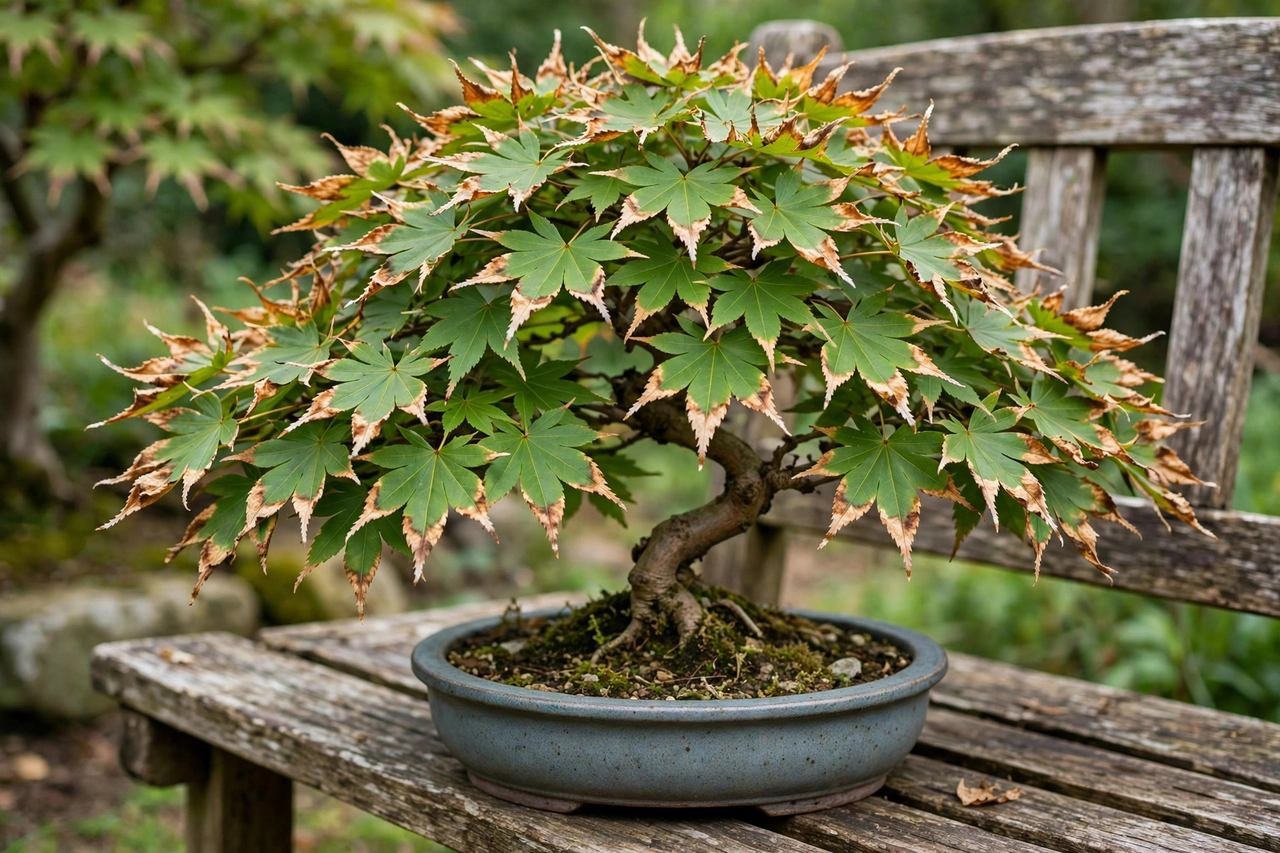
You checked the tree on Friday and it looked fine. On Sunday the edges of the leaves have become crispy and browned. This is especially bad on the side of the tree that has the most afternoon sun. The ground is also moist. You have been watering yesterday.
The reason why this is happening is because the leaves of your Japanese Maple bonsai are suffering from leaf scorch. Leaf scorch usually doesn’t happen immediately after the problem happens, it can take a few days for the leaves to start showing signs of leaf scorch. It can also be caused by several smaller issues.
What Matters Most for Leaf Scorch
Japanese maple bonsai leaf scorch happens when the leaves cannot take in enough water from the roots. Since the edges of the leaves are far away from the source of water, this is the first part to start dying. They will turn tan and then brown and crispy. Leaf scorch usually happens because of intense afternoon sun, drying winds, hot dry conditions or roots not being able to keep up. While the leaves won’t turn green again, it can recover. Start putting it in some shade gradually, sort out the watering and see if it recovers by looking at new growth.
What Leaf Scorch Actually Is
Leaves are always losing some water. Small holes on the surface let the water vapour escape. This causes the roots to supply the leaves with more water. However, on a hot sunny and windy day the leaves will lose lots of water.
Since the water travels up the leaf in the veins, the very tips of the leaves (furthest away from the main veins) will be the last to get any water. This means they will be the first to die. As Colorado State University Extension explains, leaf tissue furthest from the main veins will dehydrate first. The edges of the leaves will start to turn brown in a ring shape with the centre remaining green.
Japanese maple bonsai leaf scorch is a symptom. As explained in the Wisconsin guide, leaf scorch can be caused by a variety of problems. While the cause could be sun, wind, drought or damaged roots, they will all cause the edges of the leaves to turn brown. However, if the cause was dry soil then you would do the opposite to waterlogged soil.
The Four Ways the Balance Tips
Sun
The most common reason for Japanese maple bonsai leaf scorch is due to intense afternoon sun. The morning sun isn’t as hot and the air is often still and moist. However, after midday, the sun is hotter and the air is dryer.
The leaves will already be warm meaning the leaves can lose a lot of water in the direct afternoon sun. This means that even if the soil is moist, the leaves will lose water much faster than the roots can replace it. This means the leaves on the side facing the afternoon sun will suffer the most with the outer leaves turning brown. This is because of how much light they receive. See the sunlight guide for how much light.
Wind
While not as obvious, drying winds will cause the leaves to lose moisture throughout the day. Even if the tree is in the shade and the soil is moist, a hot dry wind on a summer afternoon can cause Japanese maple bonsai leaf scorch. The leaves on the windward side of the tree will suffer first. Delicate laceleaf varieties will suffer the most. See the summer care guide for how to protect from wind. If the leaves are suffering the most on the exposed side and the soil is moist then the cause was wind.
Heat and Drought
The most common cause of Japanese maple bonsai leaf scorch is dry weather and warm temperatures. As explained in the Wisconsin guide, a heatwave provides this perfect combination. The high temperature causes the leaves to lose more water. While the drought causes less water to be available. See the heatwave care guide for the timeline of a heatwave. Drought in bonsais can sometimes be hard to spot. The surface of the soil may look dry but the centre can be moist. Or after a shower the surface may be moist but the rootball will be dry. See the hot weather watering guide on how to check your soil.
Damaged Roots
Sometimes the issue is due to the roots not being able to take in any water. Damaged, compacted or waterlogged roots will cause the leaves to suffer from Japanese maple bonsai leaf scorch just as if the tree was dry. As explained by Colorado State Extension, too much moisture can cause leaf scorch. Waterlogged soil has no oxygen meaning new water absorbing roots won’t grow. The pot will feel heavy and the soil will smell sour. However, the leaves will still turn brown. Too much fertiliser or salts can also cause this. Salts will burn the delicate roots and mean they can’t supply water.
Damaging the tree during repotting, letting the pot completely dry out or having roots circling due to a small pot will all have the same outcome. Less roots = less water. Brown edges.
What Scorched Leaves Look Like
Japanese maple bonsai leaf scorch has a distinct look. The edges or tip of the leaves will start to turn brown. They will be dry and paper-like. Often there will be a yellow band between the brown edges and the green centre. The two main things that make leaf scorch stand out are that it is dry. The brown areas will be crispy. If the leaves are soft and dark and floppy then it is likely to be something else, usually caused by cold or waterlogging. Secondly, leaf scorch tends to be quite even across the exposed areas of the tree. See the brown leaves guide for full comparison. See the diagnosis checklist for step by step.
Moving Into Shade, in Steps
The first thing to do when noticing leaf scorch is to move the tree into some shade. However, this should be done gradually.

Move the tree out of the afternoon sun into some bright shade or dappled light. Leave it here for a few days. Over the next week gradually increase the amount of morning sun it receives. Monitor the leaf edges. If new brown edges appear then move it back to the shadier area.
If you’re moving it back into the sun after a period in the shade, after a week the leaves will have adjusted to the low light. Move it gradually back into the sun increasing the amount of morning sun received each day. Keep it in the afternoon shade until it can handle a full morning of sun. See the summer care guide for tips on using shade cloth, windbreaks and keeping the pot cool. Shade should be applied gradually. Only apply a little at a time and let the leaves tell you when to stop.
Recovery: What Comes Back and What Does Not
Unfortunately once Japanese maple bonsai leaf scorch has occurred there is nothing you can do to cure it. As Colorado State Extension explain, “Once leaf scorch has occurred, there is no cure. The dehydrated portions of the leaf will not turn green again, but with proper water management, the plant may recover.” The leaves themselves aren’t dead. The green part will still provide nutrients to the tree. Only remove fully dead and dry leaves.
To know if it’s recovering look at new growth. If new leaves are coming through clean then the cause has been fixed. This can take weeks.
Scorch or Disease? How to Tell Them Apart
Most Japanese maple bonsai leaf scorch will be caused by environmental factors. However, there are two infectious diseases that look like leaf scorch.

Bacterial Leaf Scorch
This looks very similar to environmental leaf scorch. The edges of the leaves will turn brown and crispy. Often there will be a yellow band. However, environmental leaf scorch will depend on the weather and position of the tree. Bacterial leaf scorch will occur every year, it will spread slowly and won’t be helped by shading or watering. As Colorado State Extension explain, “There is no cure for bacterial leaf scorch.” If the same branches are suffering every summer and you are caring for the tree well then ask a local expert to look at your tree.
Verticillium Wilt
This is a more serious pattern. It blocks the water flow inside the wood. This means one branch will wilt and turn brown while the rest of the tree remains green. If you cut off the wilting branch you may notice some dark discolouration. There is no cure. Prune out any dead branches to healthy wood. Sanitise your tools between cuts. Don’t compost the prunings. See the brown leaves guide for full pattern.
Cultivar, Climate and Pot: What Changes for Leaf Scorch
Green Acer palmatum trees take more punishment than any other maple and still recover. Red cultivars will suffer more from leaf scorch. Variegated and laceleaf varieties are the most delicate so check these first and provide them with shade first. If you have a hot and dry climate then the main issue will be wind. If you have a hot and humid climate then you are more likely to overwater. In the spring the leaves will be soft and new so will be prone to leaf scorch straight after leafing out. Summer will be the most risky time. However, by autumn the sun won’t be as strong so will be more forgiving.
Young or recently potted trees will need more shading as their roots can’t replace the water quickly. Small pots will dry out quickly. Large pots will give you half a day. Akadama mixes that are free draining will dry out quickly however they will protect the roots. Heavier mixes will stay moist for longer.
A Prevention Plan for the Season
Japanese maple bonsai leaf scorch is much easier to prevent.
- Move the tree to its summer spot. Provide morning sun, afternoon shade and protection from drying winds.
- Check the soil everyday in hot weather. Only water if needed.
- Check the forecast. Increase the amount of shade the evening before a hot period.
- Only feed a tree that is growing well. Never feed a tree that is suffering from leaf scorch.
- Every evening during a heatwave check the leaves. If new brown edges are appearing then increase the amount of shade tomorrow.
Two Scorched Trees, Two Different Fixes
Laceleaf maple on a windy rooftop terrace. Every July the edges of the leaves will turn crispy. This is worst on the windward side. The soil is always moist. This isn’t a watering issue. A slatted screen was added and moved into afternoon shade. Within a week the leaf scorch stopped.
During a hot period someone waters their tree twice a day. The leaves continue to turn brown. The pot feels heavy and the soil has a sour smell. The water is sitting on the surface of the soil meaning the roots are waterlogged. She stops watering and clears out the drainage holes. The leaf scorch stops.
The Usual Leaf Scorch Mistakes
Overwatering without checking the soil. If the soil is moist then you are drowning the roots. This will cause the leaf scorch to get worse. Always check.
Feeding a tree suffering from leaf scorch. Feeding will cause the tree to grow soft growth that the roots can’t support. If you feed heavily this can actually burn the roots. Only feed a tree that is growing well.
Sudden changes. Don’t suddenly move a tree suffering from leaf scorch into deep shade or vice versa. Move gradually.
Asked About Leaf Scorch
Will the leaves turn green again?
Unfortunately no. The brown areas are dead and won’t recover. To know if your tree is recovering look at new growth. Once the cause has been fixed new leaves should come through clean.
How do I know if it’s scorch or disease?
Scorch will be caused by sun, wind and weather. It will be worst on the exposed side. Disease will only affect one branch, occur every year even if you are caring for the tree well or have clear spots. See the brown leaves guide for comparison.
Can leaf scorch kill my Japanese Maple bonsai?
Japanese maple bonsai leaf scorch on its own rarely kills a healthy tree. However, if it suffers from severe or regular leaf scorch it will weaken. Fix the cause and the tree will usually recover.
Conclusion
Leaf scorch on your Japanese Maple bonsai is a water issue. The leaves are losing more water than the roots can replace. Since the edges are furthest from the water source they will be the first to die. Work out what side of the balance has tipped, sun, wind, heat or roots. Fix this one issue. Gradually put the tree in some shade and sort out the watering. See if it is recovering by looking at new growth.
Sources
Trusted reference guides for further reading: