
As long as it is May everything is fine. Once July comes in though, your maple will begin to show signs of leaf burn. You will begin to water more but this won’t help and most owners learn that the issue is rarely a lack of water. It is often caused by the heat, sun, wind and hot pot.
The Short Answer on Summer Care
Provide your maple with morning sun and afternoon shade, ensure good air circulation but not drying winds, daily fingertip check to see if soil is dry. Keep pot cool and only water when needed. Never overwater poor draining pots. Provide regular shade, air circulation and fingertip checks to provide good Japanese maple bonsai summer care.
How Summer Stress Shows on a Japanese Maple Bonsai
During the summer, stress will be very noticeable. You will often notice the following 3 signs:
Leaf Burn
Leaf burn is the most common sign of stress during the summer. Tan and brown crispy edges and tips will appear on the leaves. This will often be worse on the side of the tree getting the afternoon sun. Thin laceleaf and dissectum leaves will often show signs first. Once the leaves have burnt they will not recover.
Wilting
If your maple’s leaves are drooping during the afternoon but recovering by the evening, they are wilting due to the heat. If the soil is still damp then more water will not help. Provide shade.
Shade: The First and Biggest Lever
The one thing you should change for summer is the light. Providing shade will reduce the amount of heat your maple is receiving.
Morning Sun, Afternoon Shade
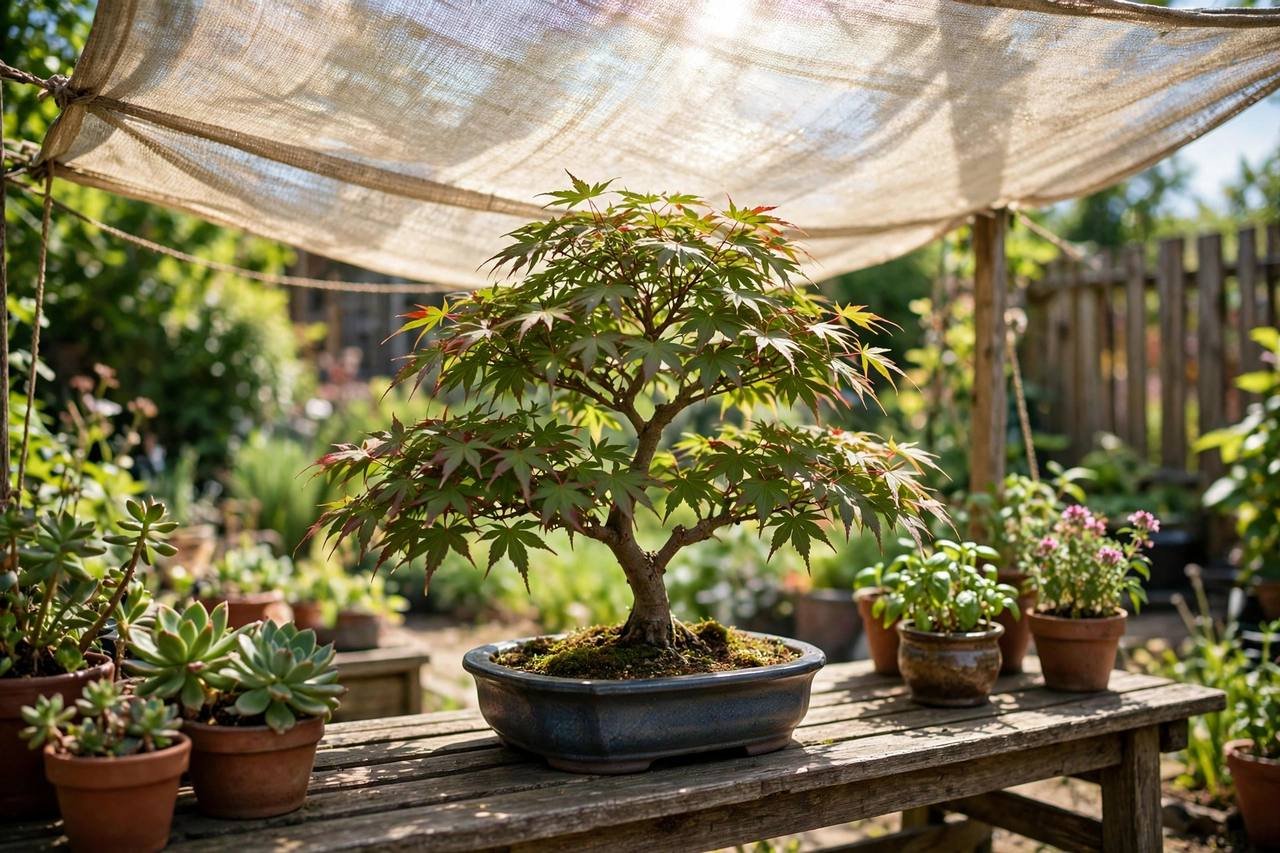
Most trees will thrive with gentle morning sun and afternoon shade. If you can provide your tree with an East facing spot, such as on the East side of your house, under a taller tree or next to a fence blocking the West, then you will get the desired effect. If you have a tree that receives full sun, move it gradually over the course of a week. Refer to the sunlight guide to see how much light your maple should receive throughout the year and signs it is receiving too much or too little.
Shade Cloth and Dappled Light
If you can’t move your tree, provide it with shade. 30-50% shade cloth will reduce the harsh light but allow air circulation. You want dappled light, not full shade. If your tree is in full shade all summer it will become weak with spindly growth and lose its colour. Fix the shade cloth onto two posts, leaving the sides open to provide air underneath. If you put your tree in a fully enclosed tent like shade, it will trap heat.
Reflected Heat — Walls, Paving and Gravel
Your tree may be suffering from reflected heat. If it is next to a West facing wall, on concrete or over gravel it will receive an extra dose of heat. This will cause the leaves on the side next to the wall to burn. If this is happening, move your tree 1-2metres away from the hot surface or place it on a wooden bench.
Airflow: Moving Air Without Drying Wind
If your tree has no air circulation it will become a greenhouse. Your maple will sit in the hot stagnant air. Providing air circulation will cool the leaves.
Why Still Air Is a Problem
Trees tucked behind solid fences or between two walls can be several degrees hotter than those in open areas. The heat will build up.
Wind Protection That Still Breathes
Hot dry winds will cause your maple’s thin leaves to lose moisture quicker than the roots can provide. This is one of the quickest ways to cause leaf burn. Provide wind protection. This means breaking the wind not blocking it. A slatted fence, hedge, lattice or larger plants will all break the wind but allow some air through. Place your windbreak on the wind side of your tree but not directly next to it. This will create a calm area several times the height of your windbreak.
Watering Checks: Part of the Daily Routine
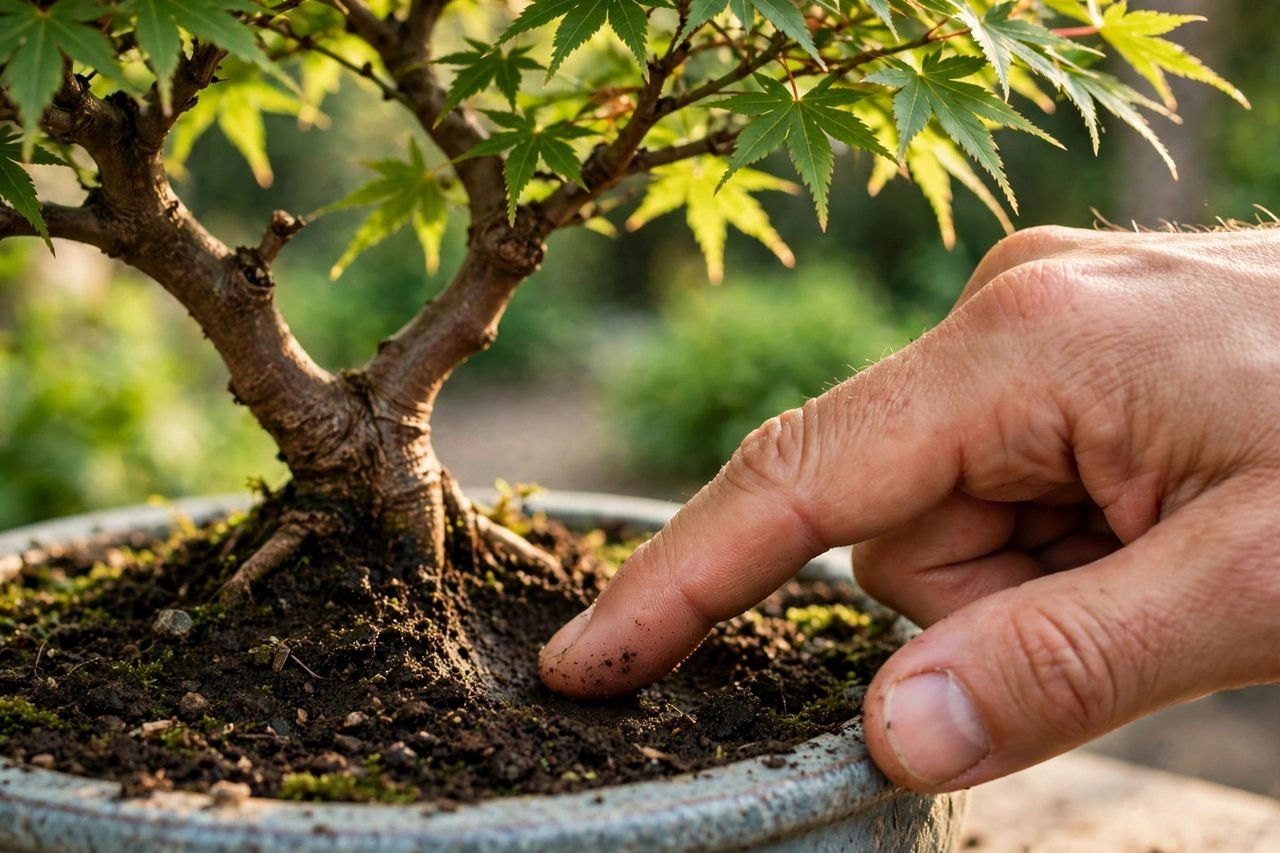
During the summer you should check your tree daily. Use the fingertip check from the hot weather watering guide. This is the most useful habit to provide good Japanese maple bonsai summer care. Water your tree in the morning, at soil level. Check once in the morning and once in the late afternoon during hot weather. During a heatwave check more often. If you are watering in the morning and the soil is dry again by the afternoon, your tree needs more shade or a cooler spot. Never overwater a poor draining pot to fix leaf burn. If the soil is still damp but your leaves are burning, it is a drainage issue. Overwatering will only drown the roots.
Pot Temperature: The Hidden Heat
Often when your leaves are burning nobody looks at the pot but it is often the hottest item on your bench. Small dark pots in full sun can cause the roots to overheat. This will show in the leaves.
Dark Pots and Small Pots
Dark glazed pots will absorb much more heat than light unglazed pots. Small pots will also heat up much quicker than larger pots. Japanese maple’s have delicate shallow roots that are close to the pot wall. If your pot is hot to touch during a hot afternoon, your roots are hotter than they like. Refer to the pot guide for information on the size and type of pot. During the summer use lighter colours and larger pots.
Cooling the Pot
You don’t need to change your pot. Place it on a wooden bench rather than stone or metal. Or place it inside a slightly larger light coloured pot to create an air gap. Check your pot at 2 o’clock. If the pot wall is hot to touch then your roots are too hot. Provide shade.
A Six-Step Summer Routine
Bonsai Empire will not allow your Japanese maple to be over 85°F (30°C). If it is going to be over this temperature, provide indirect light. 85°F is your trigger point. If it is forecast to be over this temperature, provide shade the evening before. The evening before a heatwave, provide shade and place your tree in the coolest spot. Every hot day:
- Check forecast. If it is over 85°F (30°C) provide shade cloth and place your tree in its summer spot. If it is over 95°F (35°C) place in the coolest spot you have.
- Check soil. Gently push your fingertip into the soil. If the top is dry, water. If damp, check again in the afternoon.
- Water at soil level in the morning. Water gently until it starts to run from the holes underneath the pot. Don’t get the leaves wet.
- Check shade. Ensure your tree and pot are getting the afternoon shade.
- Check wind & pot. Check the pot wall. If it is hot, move your tree or provide shade. If there is a hot wind, provide windbreak.
- Check leaves in the evening. If they recover by the evening they were stressed by the heat. If they are still wilted and the soil is dry, water. If they have new brown edges, provide more shade tomorrow.
A Hot Week on a Real Tree
A maple on a sunny patio would burn every July. It would always burn on the West side. The owner was watering twice a day but the leaves were still burning. The issue was not the watering. The tree was moved 2metres to the East side of the house. There was a fence blocking the afternoon sun. The pot was placed on a wooden bench. Within a week the burning stopped.
A laceleaf in a small dark pot would wilt every afternoon. The pot was too hot to touch at 2 o’clock. By placing it inside a larger light coloured pot the wilting stopped. The tree was not moved.
Summer Care Mistakes to Avoid
- Overwatering to stop burning. If the soil is damp, overwatering will not cool the leaves. It will drown the roots. Check first. If it is damp, provide shade.
- Full sun all day. The spot that was perfect in May may cause burning in August. Move your tree to its summer spot.
- Watering leaves in strong sun. Watering thin leaves in direct sun can cause burning. Water at soil level in the morning.
- Putting your tree in full shade all summer. Whilst providing shade will help with the heat, putting your tree in full shade all summer will cause it to become weak with spindly growth. It will also lose its colour and won’t build up strength for next year. Provide shade during the hottest times. Allow morning sun.
- Not considering your pot. A dark pot on stone paving can cause damage to delicate roots. This will show in the leaves. Check your pot is not hot to touch during a hot afternoon.
Summer Care Not Improving? Check This
- Leaves are burning but soil is still damp. This is not a watering issue, it is a drainage issue. Water around the roots won’t help leaves losing water to the sun and wind. It will make it worse. Ensure water is draining well from the drainage holes. Provide shade.
- Tree is wilting every afternoon but recovering by the evening. The soil is likely fine but there is too much heat. Provide more shade and cool down the pot.
- Soil is drying out by midday. The pot may be too small, the mix may be too loose or the spot is too hot and windy. Move your tree to a cooler spot. A larger pot can wait until next repotting. Never during a heatwave.
- Leaves are falling off in mid summer. Some leaf drop after a heatwave is normal for the tree to protect itself. Continue to water regularly, provide shade and don’t prune or feed until it has recovered.
Before Summer Starts: A Quick Checklist
Move your tree to its summer spot. Provide shade cloth & windbreak. Check your pot is light coloured or in shade and on wood. Ensure drainage is good. Check soil daily & water at soil level.
What Growers Ask About Summer Care
How hot is too hot for my Japanese maple bonsai?
If it is over 85°F (30°C) move to indirect light. If it is over 95°F (35°C) treat as a heatwave. Provide full shade during the hottest times and check 3 times a day.
Can my Japanese maple bonsai stay in full sun all summer?
Some sun tolerant cultivars can in cooler climates. In hot climates, no. All cultivars like morning sun and afternoon shade.
My maple’s leaves are burning, should I cut them off?
No! They are still providing nutrients to the tree. Don’t cause extra stress by cutting them off. Only cut off clearly dead branches.
Is misting helpful during the summer?
Only slightly. Only mist in the morning. Never mist in strong sun as it can cause burning. Refer to the humidity guide for full details.
Conclusion
Providing good Japanese maple bonsai summer care is simple. Provide afternoon shade, good air circulation, fingertip check daily and keep the pot cool. Doing this will ensure your maple survives the hottest weeks with no leaf damage. Refer to the care guide for general care.
Sources
Trusted reference guides for further reading: