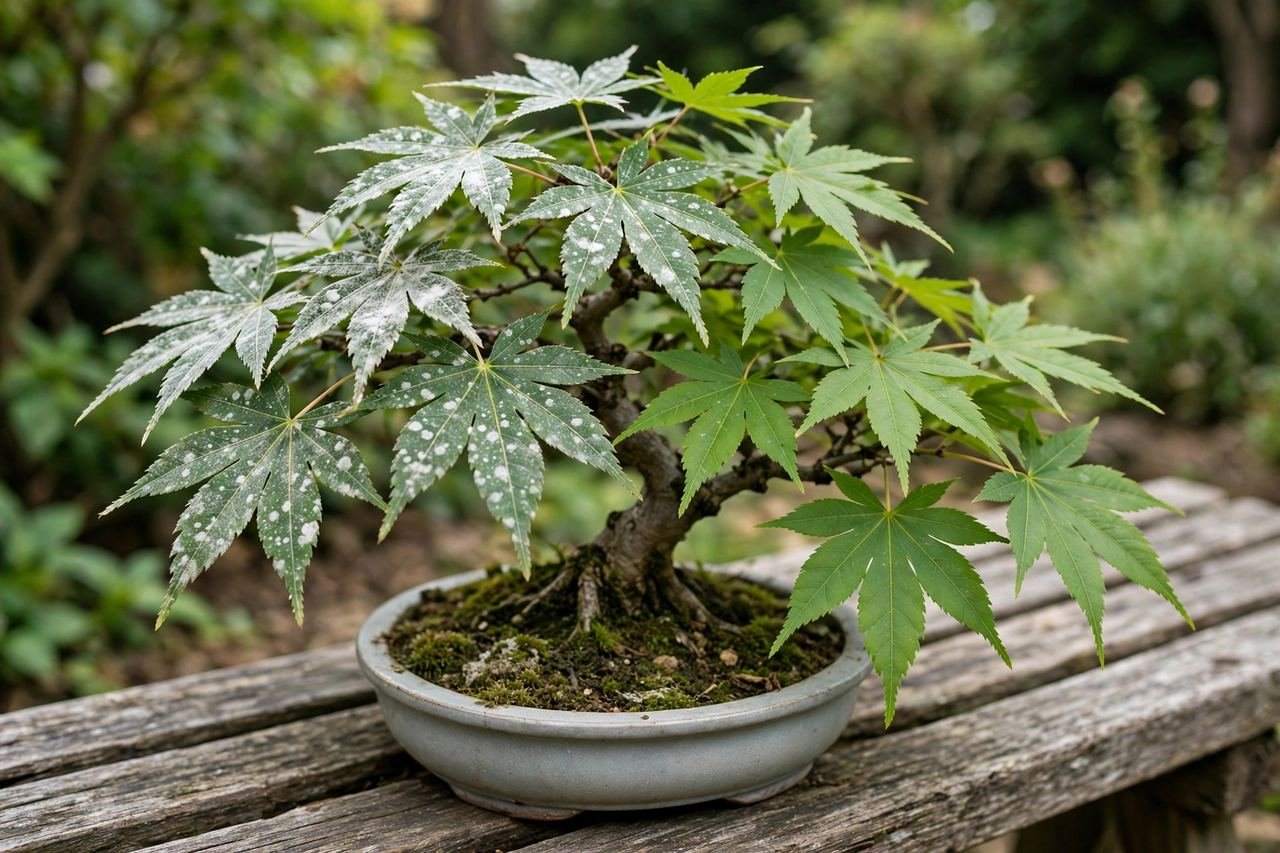
There was no white on Monday. On Friday there is a light dusting on the newest leaves. White spots on Japanese maple bonsai leaves can be confusing as until you know what caused them it gives very little information.
There are many reasons for white spots on Japanese maple bonsai leaves. They can be a fungus, mineral deposits from water, an insect’s waxy covering or just splashes. Each issue needs to be treated differently. A hard water issue won’t be helped by a fungicide and mildew won’t be helped by scrubbing.
White Spots at a Glance
First check the following. Gently rub the spot with a damp finger tip. If it rubs off leaving a flour-like residue and appears again in a few days it is likely to be powdery mildew. If it is hard and crusty it is likely to be mineral deposits. If the white is fluffy and appears on the twigs and bark as well as the leaves it could be woolly aphids.
White spots on Japanese maple bonsai leaves are usually not a serious issue but don’t assume, take note of where the spots are on the tree and when they appeared. Match up at least two of the clues below.
The White-Marks Comparison Table
| Mark | What it looks like | How to test | First action |
|---|---|---|---|
| Powdery mildew | Soft white or grey powder, new growth first | Damp fingertip smears it; it returns in days | Improve airflow, keep leaves dry |
| Mineral residue | Hard white crust where water dried | Feels gritty, does not smear; follows the spray pattern | Water at the soil, use rainwater if you can |
| Woolly aphid wax | Fluffy white tufts on twigs, bark and leaf undersides | Tufts crush when touched; ants nearby | Wash off with water, recheck in 3 days |
| Cottony scale | White cottony egg masses under leaves and on twigs | Masses stay fixed; leaves may yellow | Rub off by hand, check for crawlers |
| Spray or dust residue | Pale film or speckles, only where spray landed | Wipes off with a damp cloth and stays off | Rinse the leaves, check what was sprayed |
How to Inspect the Marks: Three Gentle Tests
You will need clean hands, a damp cloth, hand lens and good lighting. Check the newest leaves first as mildew and aphid both like new soft growth.
Rub Test. Dampen one finger and gently rub over the spot. If it is powdery mildew it will rub off leaving a flour-like residue. It will return in the next few days. If it is a mineral deposit it won’t rub off. It will feel hard and gritty.
Location Test. Mildew will spread across the leaves creating a soft patchy white. It will be worst on the shaded inner leaves where there isn’t much air movement. Mineral deposits will follow the pattern of where the water landed. Usually the side facing the sprinkler/hose. It will not be on the shaded inner leaves.
Under Side Test. Look at the underside of a spotted leaf using a hand lens. Mildew will appear on both sides. Late in the season you may see small black spots from the tiny black fruiting bodies (chasmothecia) of the mildew. Cottony scale will show as white egg patches underneath the leaves.
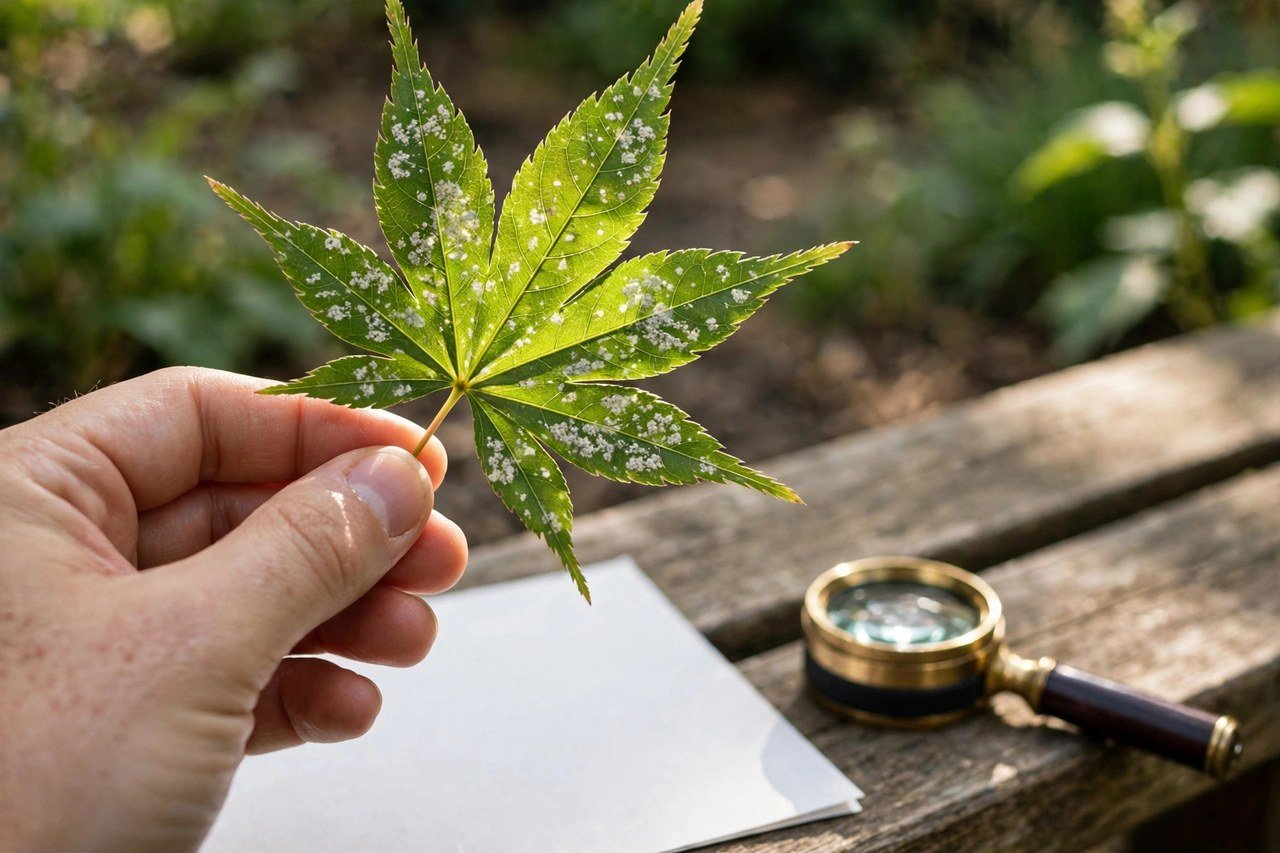
Take a picture of the whole tree, then a close up of one spotted leaf and the underside of that leaf. Your local plant clinic will want to see these.
Powdery Mildew: The Fungus That Looks Like Flour
Powdery mildew is the most common living cause of white spots on Japanese maple bonsai leaves. There are many types of this closely related fungus which will grow on the surface of the leaves, young stems, shoot tips and buds. The white powdery look is due to the long chains of microscopic spores. According to the University of Maryland Extension it is a powdery white fungus which will spread rapidly during warm days and cool humid nights.
On Japanese maple it is usually found on the new growth. Small white patches will appear which will join together to create a soft patch. Severe cases can cause the leaves to turn yellow.
The conditions are more important than the fungus itself. Unlike most fungi it does not require wet leaves. It grows best in temperatures between 60-80°F. Warm dry days and cool humid nights. If the temperature is over 95°F it will be inhibited.
This is rarely fatal. According to the University of Maryland Extension it is rarely fatal but will cause yellowing, browning, distorted leaves and early leaf fall. Due to early leaf fall it will cause the tree to be weaker going into Autumn. This is more of a problem for a small bonsai as it doesn’t have much of a reserve.
If white spots on Japanese maple bonsai leaves are smudging like flour, returning in a few days and are on the shaded inner leaves and new growth rather than a splash pattern it is mildew. See the diseases section for more information on other fungal issues with leaves.
Mineral Residue and Spray Marks: White That Was Never Alive
Not all white spots on Japanese maple bonsai leaves are living. If you have hard tap water there will be dissolved minerals in the water. When the droplet dries it will leave a hard white crust. It won’t smudge and will be exactly where the water landed.
Sprays will act the same. If you have sprayed a foliar feed, pesticide or fungicide over the leaves it will leave a pale film or speckles. Again it will only be where the spray landed. If it can be wiped off with a damp cloth it is a deposit.
To fix this issue simply water from the soil in the morning. If there are deposits wipe them off with a light wipe of a damp cloth. See the watering section for how to check your soil throughout the pot.
Insect Residue: White That Belongs to a Pest
There are two insects which will cause white spots on Japanese maple bonsai leaves. See the pests section for full details.
Woolly Aphids will cover themselves in a fluffy white wax. This will create cotton wool looking colonies. According to Clemson Cooperative Extension the colonies are easily identifiable due to their white fuzzy appearance. They will move or crush when touched unlike mildew. Ants will often be walking up the pot attracted by the honeydew the aphids exude.
Cottony Maple Scale will cause white cottony egg patches underneath the leaves and on the twigs. The patches will not move. The leaves above may turn yellow and fall off. The white will be in cottony lumps unlike mildew.
Other White Marks Worth Knowing
Sun bleaching can cause a leaf to fade. This will be a pale colour but it is the leaf itself not a coating. Nothing will rub off. If the leaves are pale with brown edges see the leaf scorch section.
Airflow and Sanitation: What to Change on the Bench
Most white spots on Japanese maple bonsai leaves can be fixed on the bench. Powdery mildew likes still humid conditions. If your trees are too close together your leaves will remain damp for hours after watering. Space your trees out.
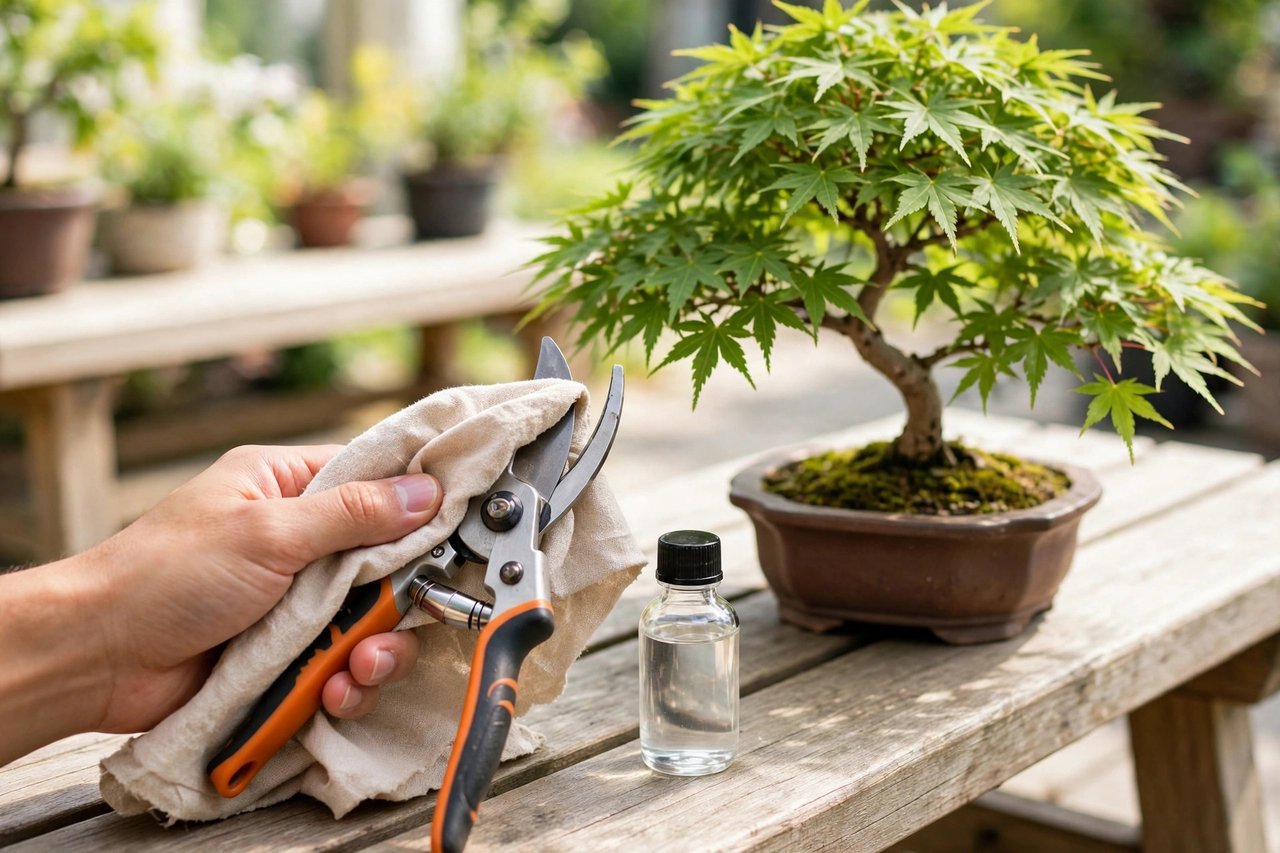
Thinning out a dense canopy will help light and air reach the inner leaves. This is where mildew is worst.
Remove any fallen leaves from the soil. Mildew fungi will overwinter on the leaves. Bag them up and throw them away.
Water from the soil in the morning. Never spray the leaves in the evening. Keep your tree healthy but don’t over feed. Soft growth caused by heavy feeding will be the first thing the fungus will attack.
Getting a Reliable Diagnosis Before You Treat
Most white spots on Japanese maple bonsai leaves won’t need anything. Mildew on bonsai is usually fixed by improving air circulation, spacing and removing the worst leaves. Mineral deposits need to change how you water. Pest issues need to be washed off and checked again in a few days.
If the spots continue to spread after improving air circulation for a week or the leaves are turning yellow and falling rapidly seek a diagnosis. Take a sample to your local cooperative extension plant clinic. Tell them what cultivar you have, how you are watering and what has been sprayed on the tree.
If you do need to use a product make sure it is labelled for the confirmed issue and plant. Check locally to see if it is registered. Never use a horticultural oil if the temperature is over 90°F or within 2 weeks of a sulphur spray. Never spray in hot sunlight, and never spray a dry tree.
Cultivar, Climate and Pot: What Changes for White Spots
Finely cut laceleaf foliage stays damp inside because it is so dense. This means the inner leaves will remain damp causing mildew to spread faster than on a broad leaved tree. Red leaved cultivars will hide early mildew so check by touch.
If you live in a humid climate with warm days and cool nights mildew will be your first guess from late summer onwards. If you live in a hot dry climate it is more likely to be a mineral deposit.
Young trees won’t have much of a reserve. This means spotted leaves will fall quicker and they won’t recover as quickly. If you have a free draining substrate your roots will be in the air. If you have a heavy substrate the opposite will happen. Leaf issues won’t help root issues.
Two White-Marked Trees, Two Different Answers
A grower living in a humid valley notices a soft white patch on the inner leaves of her laceleaf maple in late August. The spots are smudging and returning in a few days. She spaces the tree out, thins the inner growth and waters from the soil.
A grower living in an area with hard water notices white spots on the top leaves of her maple after a month of overhead watering with a hose. The spots are hard and gritty. They can be wiped off with a damp cloth. She waters from the soil using rainwater.
Where White Spots Goes Wrong
- Spraying without knowing what white spots on Japanese maple bonsai leaves are. Mineral deposits won’t be helped by a fungicide. Make sure you know what it is.
- Scratching the leaves hard to remove the white. Bonsai leaves are very thin and will tear if scratched hard.
- Only checking the top of the leaves. Mildew will grow on both sides. Woolly aphid and scale will be on the underside.
- Returning a spotted tree to your collection too soon. Mildew spores are carried by air currents. If one tree is infested on a shared bench it can spread to the others.
When White Spots Will Not Budge
- The spots returned after 3 days. It is almost certainly mildew. Improve air circulation, thin out inner growth and check again in a few days.
- The spots are only on one side. This suggests it is water/spray. Check which side faces the hose/sprinkler and change how you water that side.
- The spots are fluffy and on the twigs. This is an insect. Check for woolly aphid or cottony scale. Wash off the spots and check again.
Your White Spots Questions
Can powdery mildew kill my Japanese maple bonsai?
Rarely. It will cause the leaves to turn yellow, early leaf fall and slow growth.
Will the mildew spread to my other bonsai?
Yes. Space the spotted tree away from the others until the new growth remains clean for 2 weeks.
Should I remove the white leaves?
Remove the worst spotted leaves and any fallen leaves. Bag them up.
When should I seek expert advice?
If the spots continue to spread after improving air circulation for a week or the leaves are falling quickly take a sample to your local plant clinic.
Conclusion
White spots on Japanese maple bonsai leaves can be confusing. Rub the spots, check where they are and flip the leaf over. If they smudge and return it is mildew. If they are a crusty splash pattern it is water. If they are fluffy and on the twigs it is an insect. Make sure to change how you care for your tree on the bench.
Sources
Trusted reference guides for further reading: